Winning the trust of contributors: When is the right time to take out your camera?

Federica De Caria
is a video journalist for Falkland Islands Television
Federica De Caria continues the diary of her new life as a videojournalist for Falkland Islands Television. In this post, she describes a trip to West Falkland, and the unusual experience of practicing journalism and film-making without time pressure.
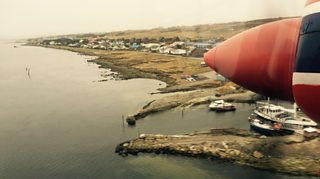
Arriving in West Falkland
When June arrives in Stanley it brings the winter. You wake up with the wind knocking at your window and the garden covered in white. Half of the steep, narrow streets of the town are closed because of ice and getting out of Stanley becomes harder.
I managed to organise a trip to West Falkland just in time, when you can still cross your fingers and hope that the weather will let you jump on a flight. I spent four days at Port Edgar filming a farmer’s daily life and trying to help out on the farm. This was the ‘package holiday’ on offer from my employer: getting to fly to West Falkland is not that common.
For the first time I could spend more than a couple of hours with people I had to interview and so I could think in terms of timing. When could I get the best interview? When should I take out the camera?
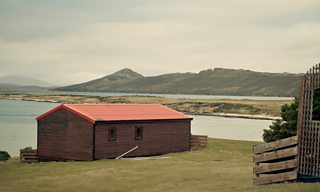
On Tex's farm
There are less then 200 people living on the west island, scattered around the coastline. The last thing that they are used to is being on camera. The biggest settlement is Port Howard, where a ferry crosses the Falkland South channel linking the east island with the west one. Not far from there is Fox Bay and Port Edgar, the latter being the farm I was directed to, usually reachable via air.
The trip should have taken place last summer, but then for a variety of reasons it got postponed and postponed. When the station manager mentioned it to us, I instantly volunteered.
One of the biggest criticisms of Falkland Islands Television is that it’s just ‘Stanley TV’ – that it’s too focused on what happens in the capital and that it ignores ‘the camp’, the vast land beyond the town.
To understand what’s going in the camp isn’t easy. You’d be inclined to say nothing happens there. What can happen in a place where there are more sheep than people? Where your phone won’t get a signal, let alone a fast internet connection? It’s a place where life still follows the rhythm of the seasons. However, people live there and they’d like to have their stories told too.
So on a Thursday morning, I packed my camera, dressed in double layers and called up the airport to know whether my flight was still leaving on time. It was, and I was the only passenger. You don’t need to let anybody know when you’re arriving: the radio will do what your phone usually does.
Tex, who I was to stay with, and his daughter Fayan, were waiting for me when the little plane landed. They waited on a long strip of land in a little shed with a red flag. It’s their private airport. It’s how the three girls (Tex has three daughters) used to get to Stanley for school once they reached secondary age.
Their primary school was their home, with an itinerant teacher coming periodically and giving classes over the phone. But I will learn all this from Fayan much later, and about the happiness of a foggy Monday morning when the plane can’t take flight and get you to school.
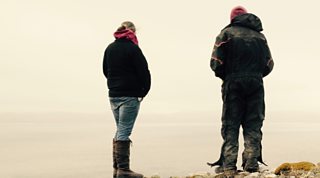
Tex and Fayan
First, I had to break the silence with the two strangers in their car. Not that that hasn’t happened before. But this time I didn’t have anything in common with the two people - or that is what I thought. I wanted them to talk to the ‘city girl’ and I had to convince them to trust me.
At the beginning it was hard, the silence only broken by the bouncing of the car. They brought me to some cliffs to check for sightings of whales and then onto a beach to show me where the dolphins were playing amongst the waves. I soon understood that they actually wanted to show me their home.
I had told myself that I would wait a while before I took my camera out. I had four days to capture my footage. The station manager had warned me that they might be a bit shy in front of the mechanical eye and that time could be a great bonus. When I saw the dolphins though, I had to get it out, and once the camera is out, it’s out.
They didn’t let me help on the farm. ‘You’re a girl’, they said. But ‘she’s a girl too’, I answered, referring to Tex’s daughter, receiving in response a funny gaze that meant a lot more than what could have been said. I wasn’t allowed to lift the heavy rocks, to smash them, or to feed the cats and the dogs by cutting up pieces of goose with bare hands and a knife.
However, I was allowed to film whatever I wanted. The mechanical eye soon became an accessory of my outfit, still not a friendly element, but an accepted one. By the second day, they were sharing little pieces of their life with me. Tex was telling me about when he was eighteen and decided to leave the island to see the world that he only knew from a television screen. He told me about the war and of the patriotic feelings that brought him back. Fayan talked to me about her youth around the farm, playing with her younger sister and about the school.
West Falkland is another world. A world where practical knowledge is king. While we were walking along the coastline, Fayan pointed out the different birds bathing into the water. She had names for each of them. She knew because she and her little sister played there all the time as kids.
It was Fayan who answered the phone on the foggy morning of my departure, to describe to the airport in Stanley the strength of the wind, the direction in which it was blowing and how far you could see from the bay. The decision to take off or not was based on her information.
We were still waiting for the call back that would have let us know about the decision when Tex walked through the door. He’d been out fixing the little wind turbine that helps them produce the electricity they need. He watched me and said smiling: ‘Well if it’s too foggy to fly, you’ll have to stay a bit longer’. I wish I could have recorded that moment as well.
But I couldn’t. I couldn’t record it all because some of the conversations happened over a glass of wine, over dinner. Pressing ‘record’ would have ruined it. The second time someone tells a story is never like the first time. It becomes a synthesis and loses spontaneity. Thinking back, I still wonder, should have I been bolder in taking out the camera?
Above: Federica's first film report of her trip to West Falkland
Where journalism still means getting to know people: Federica’s first dispatch from the Falklands
The best way to learn is hands on: Federica’s second dispatch from the Falklands
