Where journalism still means getting to know people: Falkland Islands Television

Federica De Caria
is a video journalist for Falkland Islands Television
Federica De Caria, a recent graduate student of journalism, decided to leave London to work for the local TV station in the Falkland Islands. We asked her to update us on her experiences, and this is the first of her reports.
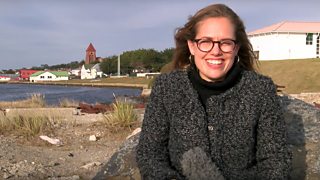
Federica De Caria
After obtaining my MA in International Journalism in my mid-twenties, I did a series of placements and researched possible jobs in journalism. But London is not a nice place to be unemployed.
One day, searching Twitter for #videojournalist, I saw what looked like a pretty singular opportunity: a Falkland Islands Television scheme that would bring you to the Falklands to work for the local TV station for six to twelve months. It was a paid job that promised the chance to film and edit on a daily basis. What's more, it included a trip to somewhere I’d never imagined visiting. This wasn’t just a job; it was an adventure. I applied.
I started a long research process, reading books and studying online. All I’d known about the Falklands was that they were still British because of the victory in the war against Argentina in 1982. I acquired a precise knowledge of their geographic position - thanks to Google Maps.
Soon I was doing an interview over Skype with the TV manager. The first thing I learnt was that if I was chosen, my flight for the Falklands would leave from RAF Brize Norton in Oxfordshire. No other airlines fly to the islands.
I got the job. That flight from Brize Norton takes 16 hours, with a brief stop at Ascension Island, a tiny strip of land next to the coast of Africa. Around 800 people live at Ascension and they almost all work in some way for the military facilities on the island.
After a quick change of cabin crew, we were on out way south again. My military flight didn’t look much different from other airline flights. Drinks and food are served and the procedure is almost the same as at any other airport in Europe.
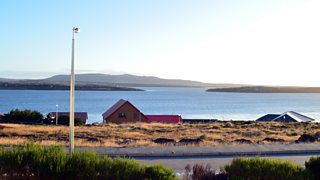
I’d read that there are 3000 people on the Falklands, of whom 2500 live in Stanley (above), the only city. The other 500 live in what they call Camp, the wilderness areas of the rest of the islands. But reading the numbers and being there are very different.
The Islanders get to see BBC, ITV, HBO, Fox News, Sky and many other South American channels, but FITV, based in Stanley, is different. It’s the local channel and the locals pay a small fee to see it. It’s a weekly service, talking to the community about the community.
FITV is sponsored mainly by Stanley services and KTV, the satellite provider. Its programmes roll in a loop on people’s screens for a week, mostly news updates and features about events that took place during the previous seven days. At the core is the studio programme, Falklands in Focus.
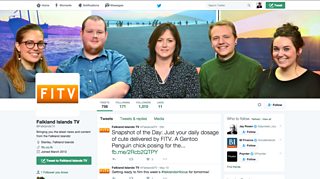
Meeting the team didn’t take long – there are only five of us. There’s a morning meeting where you’re invited to put forward ideas. Then you go out, shooting, presenting and editing. There’s help, but already it's up to me to make things happen.
After only a week, I am into the routine, finding myself in front of or behind the camera, waiting outside court in the morning, filming an interview after lunch and at night, after some editing, out until 2am to shoot something like the Moon Walk, a charity event in which some of the islanders spend the entire night on a circuit around the island.
What’s different here is that to succeed, you need to get to know people. If you ask for a few words on camera from a passer-by in a big city, it's very different from doing the same in a small community. In a place like Stanley you need to gain people’s trust – and then maybe they’ll talk. I have six months to do that, and to develop the skills that will make me a good video journalist.
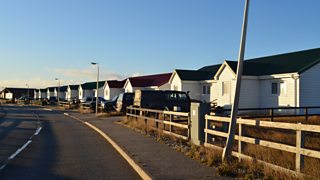
It might be easy enough if I wasn’t also experiencing culture shock. I’m Italian originally and my Mediterranean diet included tons of veggie. Here, a tomato costs around £1. There is no ATM on the island. Instead, there’s your cheque book to pay with at the supermarket, while you ask for cash back.
Until now my smartphone his been like my pacemaker. Back in London, I’d have breakfast scrolling through Twitter. I’d get a sneaky SnapChat pic while walking out of the door. I’d check my emails before jumping on the tube. Now I wake up with no wifi in the house. A monthly nine gigabytes internet plan costs around £100. Even two gigabytes costs around £40. We have unlimited connection in the FITV newsroom, but that’s it.
The consequence of all of this? People actually spend time talking to each other. My boss told me that one of the previous FITV interns came in every morning with fresh news from the taxi driver. The best tip for what you’re shooting tomorrow will probably come from someone you met in the pub.
Everyone has a story: you just need them to trust you to tell it. Let the challenge begin.
