Deadly realities for journalists in Libya, as attacks and kidnappings go unreported

Austin Cooper
Middle East and North Africa researcher, Rory Peck Trust
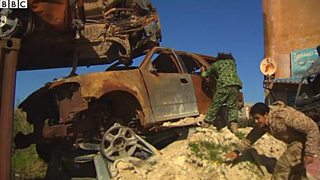
Fighters allied to the Libyan Army on the frontline in Benghazi.
Twenty five year-old Zaid has been staying with friends, moving from house to house, for more than a year. He’s starting to worry that he’s overstayed his welcome, but there’s a far more intrusive guest in his neck of the woods at the moment: the al-Sabry neighbourhood in Benghazi has long played host to the frontline in the fight between national forces led by General Haftar and Islamist rebels. The streets are deserted, and no one can return to their homes.
When Zaid (not his real name) heard the army entering his street last year, the first thing he did was step out of his front door and start filming. Zaid is a Libyan freelance cameraman. After the popular uprising succeeded in overthrowing Colonel Gaddafi, he had high hopes for Libyan media: “2012 was the best year of my life” he told me. “It felt like anything could happen.”
Zaid is part of the young generation of independent journalists in Libya who cut their teeth during the revolution, but who now look back at the brief flowering of media freedom that followed the uprising as an all-too-distant memory.
Ayat Mneina, co-founder of independent social media news platform ShababLibya, explains: “Things have changed. The media has become both a target and a tool, an opportunity to shape reality and maintain control in Libya.” The role of journalists and journalism in rebuilding the country is constantly undermined and threatened, she says.
It’s hard to know where to start when listing the challenges Libyan freelance journalists now face. To put things in perspective, since 2014, more journalists have disappeared in Libya than in Syria.
Threats, attacks and kidnappings are barely reported in the country, and often happen in broad daylight. More than 30 attacks on journalists were reported to Reporters Without Borders in 2015 but the real number is likely to be far, far higher. As competing militia and government forces vie for control of the media, these dangers have become part of a freelancer’s daily life. Often freelance journalists and their families never find out what has really happened to colleagues and loved ones who just disappear.
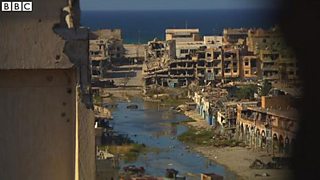
Whole neighbourhoods in Benghazi have been destroyed.
And families are not spared these threats. In a survey of safety concerns undertaken by the Rory Peck Trust in 2015, as part of a two-year project funded by the United Nations Democracy Fund, one journalist told us that his grandmother had been kidnapped in an effort to stop him working. Another had recently fled after a militia-led arson attack destroyed his family home.
The independent news outlets that sprang up after the revolution are now few and far between. Enterprising newspapers like el-Sawt, that used to take article submissions by post during the uprising when internet coverage was particularly bad, are all but gone. Ayat Mneina again: “Television offices have been bombed, and newspapers like al-Mayadeen and al-Ahwal in Benghazi have been threatened out of publication. If that’s the cost of trying to shed light on what’s going on in your home town, in your own country, it’s not unreasonable to ask yourself if it’s really worth it?”
Social media networks that used to provide alternative news platforms for journalists and media activists have long since become unsafe. Some freelancers in areas targeted by so-called Islamic State tell me that they post news reports on the internet in the morning, and delete them before noon. They know that social media monitoring tends to happen after lunch.
On their own, every journalist instinctively reacts to build their own ad hoc safety protocols, to survive any threats they face. In Libya, they’ve had to learn fast. Freelancers have had to be independent, but often end up isolated. For this fledgling freelance community dedicated to independent journalism, being part of a meaningful professional network that shares information, skills and experiences could be the key to survival in their polarised country.
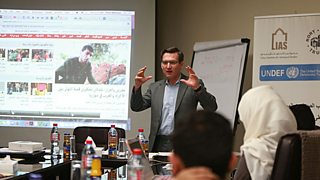
Journalist and editor Paul Eedle instructs Libyan freelancers at a regional Rory Peck workshop.
That community of freelancers is beginning to take shape. At the Rory Peck Trust, we’ve now trained 27 freelancers currently working across Libya, to strengthen their safety awareness and professional freelance skills.
Bringing these journalists together – most of them for the first time ever – at regional workshops in Tunis and Amman has created new links and strengthened others. As well as having somewhere to turn to for support and advice, some of these freelancers are already collaborating on assignments. Happily, Zaid was able to join the training workshops we ran in Amman.
We’ve now put a lot of that information into an online resource for those unable to attend the workshops. It’s free and available to anyone who needs it. For us, combining advice on safety with improving freelance business skills goes hand in hand, as an investment in the future of independent journalism in Libya.
Zaid remembers the day he had to leave al-Sabry, the district where he was born. “It was a Sunday. I thought I’d be back home by the end of the week.”
The insurgents in the area found out they were in control of a journalist’s house and Zaid soon received messages online threatening to burn it down. It’s now unlikely that there’s a home to go back to, he fears. None of this has put him off freelancing however – quite the opposite. It’s driving him to learn how to be a better and, hopefully, safer journalist.
Founded in 1995, the Rory Peck Trust is dedicated to the support and safety of freelance newsgatherers and their families around the world. It was set up in memory of respected independent cameraman Rory Peck, who was killed on assignment in Moscow in 1993.
BBC Academy section on journalism safety advice
Foreign assignments: Andrew Harding
Safety pack for Syrian journalists includes rare trauma support
Unprepared, inexperienced and in a war zone
Safety for freelance journalists: Two tribes come together
