Heard the one about the literacy campaign that’s coaching young stand-ups?

Cathy Loughran
is an editor of the BBC Academy blog
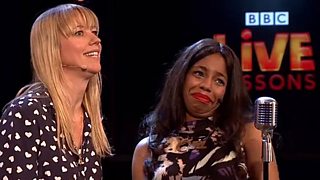
Sara Cox and London Hughes present Comedy Classroom's Live Lesson
Do you remember the ‘class clown’? The kid who played to the gallery in double maths, distracted the swots, viewed detentions as an occupational hazard and was sometimes even funny?
Well a BBC Learning team in Salford is trying to encourage teenage comic talent – in a good way – with its latest multimedia campaign, BBC Comedy Classroom. They’re looking for the UK’s best young stand-ups, sketch and caption writers and they’ve got a battery of top comedy talent on board as online ‘coaches’, from campaign poster boy David Walliams, Miranda Hart and and Adil Ray to Micky Flanagan and Shappi Khorsandi.
Of course, this being BBC Learning, the three competition categories (Class Joker, Class Act and Class Comic) are about much more than a talent trawl. The whole thing has to dovetail with the national curriculums of England and Wales, Scotland and Northern Ireland and get the blessing of the National Literacy Trust. To borrow the campaign catchphrase, “Are they having a write laugh?”
So how does a production team marry laughter and learning to engage a notoriously hard-to-reach audience, fed a non-stop stream of humour on social media, with a campaign that is essentially aimed at making them better writers? (Even the stand-ups have to submit original, well-written scripts, along with a filmed performance.)
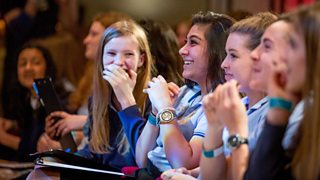
To find out more I took my seat in London’s BBC Radio Theatre, amid a sea of 200 13-15 year-olds (above) from six randomly selected schools, for the project’s one-off Live Lesson, an interactive live broadcast hosted by presenter Sara Cox and comedian and writer London Hughes, a self-confessed former “class clown”.
On hand to demonstrate their craft was a lively panel including The Peep Show’s Isy Suttie, actress and comedian Gemma Whelan, and stand-ups/writers Johnny Cochrane and Inel Tomlinson (from CBBC’s Johnny and Inel Show).
The warm-up act, comedian and caption writer Tiernan Douieb, set the bar none too high with his opener: “I don’t like maths but I do like pie….” But the audience were getting a day out of the real classroom and they were up for some raucus responding. (The Live Lesson is now available to watch.)
To follow, some pacey, knockabout stuff from the professionals on stage – although it has to be said, the biggest laughs were for some classic clips from BBC shows like Have I Got News For You? and the odd gag tweeted in from schools (“I’ve just discovered I’m colour blind, it came right out of the blue….”).
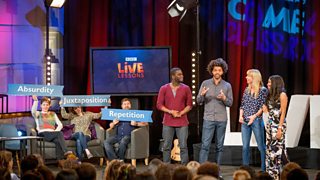
The special guests gave insights into how they get inspired, write, re-write and perform. And there was some well-signposted coaching going on (above) amid the slapstick, sarcasm and, yes, juxtaposition. Other ingredients extracted from a giant comedy ‘toolbox’ - metaphor, absurdity, misdirection, put downs and repetition - were identified or inserted into the cast’s routines to demonstrate different comic effects.
Toolbox-ticking, to an extent, but as any comedy writer will tell you (and Walliams does, more than once in his short online films) this is serious stuff.
Moray London is the executive producer on Comedy Classroom. He says collaboration and consultation with experts need to happen throughout a project like this.
“In development stage, we did a straw poll of teachers, asking whether a comedy campaign would be useful – they said “yes please” – and an ex-teacher helped produce our comedy resource pack.
“We’ve tapped into BBC Comedy Commissioning’s expertise and worked with the National Literacy Trust to ensure that what we produce has real value for the end users. And there are teacher consultants on all our Live Lessons to make sure we’re holding a mirror up to the three national curriculums.”
Being inside the BBC is an obvious advantage in getting access to comedy talent and persuading stars that teenagers identify with to get on board, he says: “This is a tough audience to please and we’re always looking for new ways to engage them. Football and football stars have already been used to encourage reading, so why not the comedians they love?”
The nations’ ‘class clowns’ are clearly in his sights, but not exclusively: “We hope to encourage kids like that to think ‘here is something where I might be able to shine’, by doing stand-up or some proper acting. And if you’re a shy person, we make it clear you can get involved by having the ideas and writing the material.”
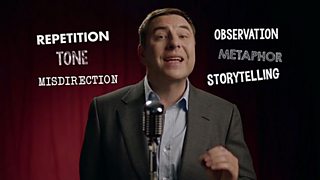
Online interviews with comedy writers like Micky Flanagan, Mark Watson, Cariad Lloyd and Nick Newman are genuinely instructive. But when Walliams (above) concludes – as he would – that what never fails to make him laugh are “men dressed as ladies and dogs farting”, does the latest BBC literacy drive risk accusations of ‘dumbing down’?
“If you can inspire young people who might not find literacy interesting, you might just provide a light bulb moment – here’s my opportunity to write and perform,” London says. “Besides, it brings fun into the classroom and teachers like opportunities to deviate.”
The campaign’s online resources include teachers’ packs, lesson plans, video tips from star writers and performers, specially written sketches, that writer’s ‘toolbox’ and a reference library of inspirational clips from the likes of Russell Howard, Jack Whitehall and Catherine Tate.
The Live Lesson is a format already used in recent BBC Learning projects on Shakespeare and classical music and will be broadcast again for upcoming campaigns around the BBC micro:bit mini computer and space exploration (7 June) and 100 years since the Battle of the Somme (30 June), piggybacking on the BBC’s other centenary output and resources.
“We know it’s an offering that teachers love and for Comedy Classroom we’ve tried to make the production values higher and spent time on the look and branding to appeal to this particular audience,” says Live Lesson series producer Dawn Langan.
The competition closes on 24 July, with the best 450 entries (150 in each category) shortlisted to 30 by professional BBC scriptwriters and producers and the final three chosen by a panel including Shane Allen, controller of BBC Comedy Commissioning, writer and comedian Charlie Higson and Sinead Rocks, head of BBC Learning. The winners’ work will be produced and broadcast on a network BBC channel later in the year – “something many writers can only dream of,” as Allen points out in his intro to the teachers’ brochure.
They say timing is everything in comedy, and it felt quite neat to be sitting in that Live Lesson audience in the wake of the backlash against what some see as fun-stripped, rigid school testing regimes, and on the very day that the BBC was formally required to put “distinctive content” at its heart.
Funny that….
