It’s social media but not as we know it, with 1Mbps of download power

Federica De Caria
is a video journalist for Falkland Islands Television
In her latest insight into the job of a video journalist in the Falkland Islands, Federica De Caria describes how the battle for a scarce and expensive wi-fi connection demands a very different approach from using the social media platforms most journalists take for granted:
Once you have landed at RAF Mount Pleasant airport, and before walking through customs and collecting your luggage, you will find yourself in front of a ‘Sure’ sign. They’re orange on a white background, and they advertise a wi-fi hotspot. But the telecoms company notice also tells you that the wi-fi is not free - you can pay £5 for an hour’s connection in the airport shop.
So you turn, looking for the shop to purchase your 60 minutes of surfing, and notice a rolled down shutter. The shop is closed. You find it strange, but you confidently think there is going to be another way to let everybody know you’ve landed safely. You’ll soon discover, however, that you’re wrong.
In the Falkland Islands, wi-fi connection is gold. There is one telephone company, and it has a monopoly. Sure is the controller of the link with the outside world. Unlimited internet is not available, but we do get some in the Falkland Islands Television office, in possession of the right password. There you can navigate as fast as 1 Mbps download. And no, that’s not a typo. (Average UK broadband speeds reached 28.9 Mbps last year according to Ofcom.)
Connection is also pricey. Sure supplies a choice of packages to its customers, ranging from the ‘starter’ (1,500 MB per month for £15 with 1Mbps download) to the top-of-the-range, business-style ‘platinum’ (52,500 MB per month for £425). The reason for these prices? The satellite that transmits data is new, expensive and has limited bandwidth.
So the internet is a precious resource, and needs to be rationed. FITV shares the building with several other users, so we need to share capacity too. If somebody decides to download a large file or to stream a YouTube video during working hours that’s likely to slow down the connection speed for everybody else.
Consequently we are not allowed to stream videos or download anything that is not a simple email attachment or an important file, vital for our weekly show Falklands in Focus, before 5pm, when everybody usually leaves the building.
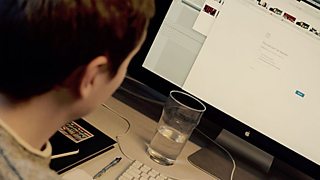
Screen freeze: 'Safari can't open this page' is a familiar message
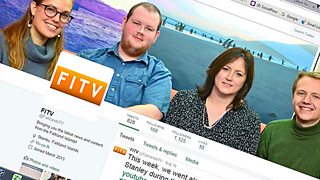
FITV has a Facebook page as well as Twitter (top image) and Instagram accounts, and 80% of our online audience is international. Our content is most popular in the UK, Canada and New Zealand.
We upload videos weekly on our YouTube page - mainly packages from the programme that may be of international interest. However, the upload is not instant, as you’d expect in most newsrooms. You can easily find yourself waiting for hours in front of a screen before the bar reaches 100%.
That said, we rarely have to deal with breaking news, so the speed (or lack of it) doesn’t represent a significant problem for the stories we cover. We’re mainly working on finding the right format, a balance between quality and speed - the right codec that allows you a quick export and at the same time guarantees you the fastest available upload.
At FITV social media is mainly used to communicate with the outside world. “It’s not surprising that our biggest audience is in the UK rather than being local,” explains my colleague James Page who’s in charge of updating our social media content. “Even if just 1% of the UK population was visiting our pages, it would be much more than the entire population of the Islands.”
However, there is one potential problem area we have in common with the UK newsrooms - the comment section. Historic tensions between the Islands and Argentina are well known. Even now, as the situation shows signs of improvement thanks to a renewed dialogue, there are individuals who do not welcome that move. So we find ourselves having to keep a close eye on the comments posted, particularly on YouTube.
Islanders do interact with us on social media, but quite often feedback is given face to face. The fact that connection is so expensive here means that people spend a lot less time on their phones than they might do elsewhere. Consequently our presence on such platforms assumes a different function.
Whereas Facebook and Twitter in the UK, for example, are used by journalists as a source of information, as a means to get in touch with possible interviewees or to find stories, here they are simply a sort of window through which the outside world gets to know the Islands better.
It won’t surprise you to learn that many people don’t have wi-fi in their houses, and the lucky ones that do keep their passwords to themselves. So the spread and power of social media on the Islands is very limited, if developing, and we need to take that into account to do our job.
Even here, social media is a necessity. We just need to find the best ways to use it to our advantage. Those may be different to the functions taken for granted by journalists in other parts of the world, but in the end social media is just an instrument. It’s a case of horses for courses.
Other BBC Academy blogs by Federica De Caria
How do you report a Falklands trial when you know everybody involved?
