What does iOS10 have to offer journalists? A look at new capabilities in video and other areas

Marc Settle
specialises in smartphone reporting for the BBC Academy
In a previous post, Marc Settle looked at Apple’s new mobile operating system iOS 10, especially at how changes to photos could affect journalists using it for reporting. Here he looks at changes to video and other areas:
A year ago, writing about the then new iOS9, I complained that the inability to change the video frame rate from 30 to 25 frames a second was a major problem for journalists in Britain, the rest of Europe and most of Asia and Africa. While third party apps offer a 25fps option, the native iOS camera doesn’t; it only records in 30fps (or variants thereof) which is great if you want your footage broadcast in North America but not for those of us in many other places which use 25fps.
Well, I’m making exactly the same complaint again about iOS10. And not much else seems to have changed in iOS 10 for video either.
Turning to audio, often the poor relation of video and photos, while there are no changes to how audio is recorded or edited with the installed Voice Memo app, there is something new and useful in how the audio can be shared on iOS10.
Until now, the sharing options for audio have been limited to things like email, messages and a few select apps like WhatsApp and AudioBoom. iOS10 has opened up the sharing so that audio recorded in Voice Memo can be transferred directly into apps like iMovie, Voddio and even PNG - the BBC’s internal app for multi-media mobile journalism.
On the face of it, then, iOS10 represents tinkering around the edges rather than anything revolutionary – at least in relation to the range of devices currently out there. The big unknown is how it will work with the new iPhones, which are also due to be unveiled shortly.
Away from audio, video and photos, here's what has caught my eye that a journalist might find useful.
One innovation which arrived in iOS9 - sharing answerphone messages as m4a files, has been given a further upgrade. Now you can get a transcript of a message that's been left for you. (Although many Android owners will no doubt be muttering how their phones have been able to do this for a while.)
The feature has yet to be switched on by the UK operator I use, O2, so I’ve not been able to try it out myself, but others say it works well...mostly. In order for a transcript to work, the message itself needs to be fully audible.

The example above was shown by Apple during the unveiling of iOS 10 in June.
Many times I've listened to messages which are incomprehensible because of drop-outs caused by a poor phone signal, so those won't be easily transcribed. Equally, with the feature working through the power of voice-recognition technology, I'm looking forward to seeing how well it copes with heavily-accented voices. It'll be little use if it only works with clearly enunciated messages left by those who speak the Queen's English.
Something else that a journalist might find productive is that the text of the transcribed message can be copied and pasted into a text message or email. So it could be that a contact leaves a statement; you then access the transcription, copy and paste it into an email and send it to the newsroom. It's worth pointing out that all this will only work if your network supports Visual Voicemail - so not Three or Vodafone in the UK, but O2 and EE are fine.
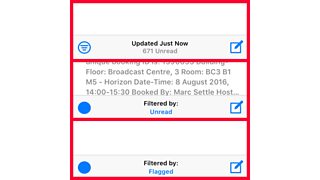
Emails - the bane of many a journalist’s life - can now be filtered to show “all”, any that have been “flagged”, or the no doubt thousands that resolutely remain “unread”.
Decent connectivity, to file content back to the newsroom or out to social media, is one of the three bedrocks of effective mobile journalism. (The other two, since you asked, are decent battery life and plenty of storage). iOS10 brings an extra level of reassurance for mojos who find a fast Wi-Fi network but want to be sure it’s safe to use.
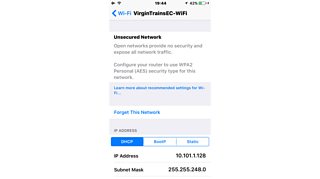
If and when you connect to Wi-Fi with less-than-ideal security, you’ll get a message like the above, enabling you to take an informed decision about using the network.
And in relation to the thorny issue of having plenty of storage, iOS10 can now display how large apps are, down to hundreds of kilobytes. (iOS9, in the upper half of the image below, tells me iMovie is using 626mb while iOS10 narrows it down to 651.6 megabytes.
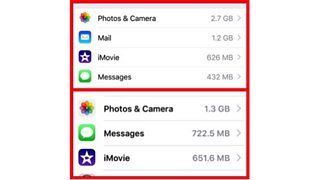
Quite why I’d need to know this with such precision is not immediately obvious, but I suppose, as they say in the supermarket business, every little helps.
So there you have it. Despite including a good number of tweaks and changes, there's actually not that much in iOS10 that made me think "now that is going to make the life of a mobile journalist a whole lot better/easier/faster".
Cumulatively, the little changes might do a bit, perhaps. But I wasn't struck by any one particular stand-out feature. Again, this may be apparent once the new iPhones come out.
The first part of Marc Settle’s report on iOS10 looked at change to photos.
