
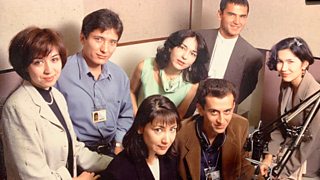
In the beginning was the word: Diloram (third in the top row) with her BBC Uzbek colleagues at Bush House, London.
I remember the launch of the BBC Uzbek radio. We were thrown immediately into “a combat”- the first Russian-Chechen war started next day.
Working under pressure of interviewing as many players as possible, who all spoke Russian, there was no time to do the voiceovers. So we aired them in Russian followed by summaries in Uzbek. The immediacy and urgency of our reporting made up for these imperfections.
These were the early years of the political disintegration after the collapse of the USSR. We developed a network of reporters - in Russia, Central Asia as well as in Australia, Egypt, Israel, Turkey, and the US. Our audience, which for decades had been locked out from the outside world, was excited to hear news in Uzbek from far-flung parts of the world.
We wanted to inform our listeners and to encourage them to discuss the society in which they lived. Our first educational radio series, Your Health Is In Your Hands, was broadcast on Uzbek state radio waves.
Determined to attract female audience, we introduced the weekly Ayollar Soati (Women’s Hour). Our listeners were invited to leave their comments and questions on an answerphone. Amazingly, the bulk of input came from men who aired their views on what women should or shouldn’t do and what’s best for them. Even when, on New Year’s Eve, we specifically asked women what they wished for themselves, it was male listeners telling us what a woman should wish for herself… We followed up on their calls, hoping that the wives would occasionally chip in.
The feedback we got also showed us that so many visually impaired people were among our loyal listeners. To them our radio programmes were a true lifeline to the outside world.
Our phone-ins also revealed how religion was becoming increasingly important. A seemingly straightforward question about women and headscarves led to an explosion of comments. It was content such as this the BBC News produced first analysis on religious aspirations taking over in Uzbekistan.
As our audiences came to trust us, they also saw us as an agency that would solve their problems, complaining of injustice and ill-treatment. We took on many of issues as we discussed human rights and the plight of political prisoners inside Uzbekistan.
Following 9/11, the US military operation in Afghanistan became a turning point for us at BBC Uzbek. Uzbek programming was extended considerably to reach our new audiences in Afghanistan, and Afghan Uzbek journalists joined our team. It was an inspiration to know that our tailor-made radio-programmes could now reach millions of Afghan Uzbeks.
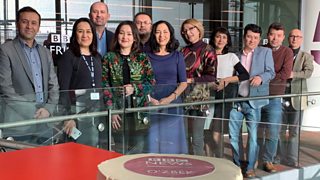
BBC News Uzbek team today
At that time, the Uzbek authorities’ pragmatic attitude to the BBC started to deteriorate. After the bloody events in Andijan in 2005, we had to cease our newsgathering operations. In Uzbekistan we were branded traitors. People were too scared to give us interviews. In addition to this, China - mindful of its Uyghur population who speak a language very close to Uzbek - started jamming our shortwaves, which effectively meant that our radio-programmes to Uzbekistan were jammed too. When we launched our website, it ended up being blocked.
That didn’t stop us from doing our journalism. Alongside hard-news reporting and getting to the bottom of issues in the era of misinformation, human-interest stories have become a staple of our output. When labour migration from Central Asia took an unprecedented scale, we focused on the fates of millions of Uzbek migrants. Our journalists followed them everywhere bringing their stories to life.
Our team is currently reaching out to two distinctive audiences. One is inside Uzbekistan and the global Uzbek diaspora. The other is inside Afghanistan. Two years ago we launched a TV news programme for Afghan Uzbeks. With this bespoke TV programming we reach about 2m people weekly. Reaching our audiences online, on social media (which delivers most of our traffic) we keep in mind these two very different audiences. We deliver our content in Cyrillic, Latin and Arabic scripts. In Uzbekistan we have an accredited reporter, and users there can now access our website unhindered. Twenty-five years after our first radio programme, we are producing TV documentaries that are broadcast on partner stations in Uzbekistan and Afghanistan.
