Filming a World Cup legacy debate in Russia

Kateryna Khinkulova
Senior Producer, BBC News Russian
Tagged with:
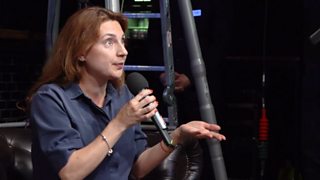
An audience member asks the panel if school sports are benefiting from the World Cup
The debate that we broadcast on 6 June was held in Yekaterinburg, the capital of the Urals and on the very edge of Europe.
It’s one of the 11 World Cup host cities, which also include Moscow, St Petersburg, and Sochi, and as it’s the easternmost of them, and a major city where BBC News Russian doesn’t often go, we thought let’s go somewhere that’s a bit more off the beaten track.
The format of the BBC News Russian debate programme is different from BBC One’s Question Time. Our programme is based on a motion, like the Oxford Union debating society, ideally with two speakers supporting the motion and two speakers opposing. We have an audience, invited through our social media channels and our website, who are free to express their views and ask questions and also to vote on the motion.
We knew there was going to be lots of coverage of the preparations for the World Cup, but decided it would be interesting to debate the tournament’s likely legacy and put it into context with other countries, such as the UK with the Olympics, and Brazil with the Olympics and also the World Cup. What sort of infrastructure did they introduce, what happened to all the venues, and have the lives of the people improved?
The initial debate venue was a very prominent one in the city, and everything was going really well. Then, fairly close to the filming date, we were told that we couldn’t film there.
We had to think on our feet and quickly find another location. It was tricky, because such broadcasts are a major operation, but we managed to reorganise it. Even with the alternative venue we had some difficulties, because the local authorities told them not to host us, but they went ahead anyway. Perhaps people were worried that we were going to bring their World Cup preparations into disrepute, or show the city in a disrespectful or unfair way.
There were people in the audience who were very enthusiastic, saying the World Cup is a wonderful opportunity, a huge boost to Russian morale, and an image-creating opportunity. On the other hand there were those who claimed it’s too expensive, that the vast amount of money spent on rebuilding stadiums for the World Cup could be used to do lots of other things across the country, like improving infrastructure.
Our panellists were very good. One of them was Maria Komandnaya, who’s well known because she co-hosted the official World Cup draw ceremony with Gary Lineker. She was very enthusiastic about the World Cup and made a good case for it. We also had a local journalist, Dmitri Kolezev, who argued that the money could have been spent better.
We asked the audience if they or anyone they knew was involved with the World Cup or projects related to it, and many of them raised their hands.
Some of those in the audience were from outside Yekaterinburg, and there was a local councillor from a town in the Urals, Natalya Krylova, who was very vocal in her criticism of the way so much money was being spent on it compared to what people in small towns need, for instance she spoke about people not having working toilets.
I think the debate showed that while a lot of people in Russia are generally supportive of the World Cup, some are frustrated, feeling that - if they don’t live in a host city - then they’re not given enough attention.
People in Russia may not get to see this kind of event often, certainly not on Russian state TV, and so it was a special occasion for us to host such a lively discussion. The BBC Russian debate programme is filmed on location all over the world and is part of the BBC’s expansion plans to enlarge our global audience reach. It was set out to engage with people by providing alternative perspectives which they might not otherwise encounter.
