BBC World Service: How Money & Power taps into a global obsession

Steve Titherington
Senior Commissioning Editor, BBC World Service
Tagged with:

BBC World Service's Money and Power season launches tomorrow (Saturday 16 June) and will explore how our lives are being shaped and reshaped by those with money and the power it brings. Senior Commissioning Editor, World Service Steve Titherington introduces the season.
This June the World Service is honing in on the thing that obsesses most of us – money, and the thing that often equally annoys us most – power - that is at least when we don't have it.
But this is not a series about banking and finance. It's mostly about relationships and how money binds us or divides us in our most intimate daily lives. This is a series about marriage, families and living with money and without money and it's about teeth. That's right, teeth - I'll come to that in a minute.
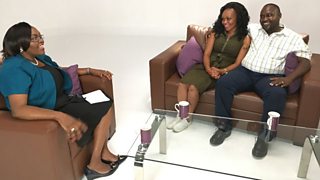
So we meet those who have won the lottery - becoming instantly rich, and we talk to those to whom an extra $100 is still a dream. And what would your dream be if you had real wealth? To live in a palace with your family, but as we discover, in every dream home there really is heartache. And how well do we really understand what living together for “richer or for poorer” actually means within marriage? We invite couples into the Money Clinic (pictured above) to talk about their finances and as a result learn about their relationships - even those closest to us can be far apart when it comes to ideas about family finance.
We'll be reporting from countries across the world - Korea, Pakistan, Israel, Kenya, Uganda, Ghana, Sweden, Spain, Canada, the US and the UK – and the month-long exploration will look at how money, and the power it brings, can define our relationships and our lives. The season will look at how, and why, money causes some relationships to prosper and others to fail. At this stage as the season launches, much is about logistics as the Creative Editor, Ian O'Reilly, works with the individual editors to get everything ready for release. This year has been marked by a real sense of joy and lightness of spirit which Ian has added, bringing an element of fun throughout.
What always amazes me is the range of extraordinary ideas that come from a very simple exercise. Each year as part of the BBC World Service’s Creative Challenge, we offer everyone and anyone who works in BBC News the chance to pitch a programme idea for the BBC to air worldwide on TV, on Radio and online and in any of the 42 languages now on the BBC World Service. They can be correspondents or office coordinators, technical staff or star reporters. A group of editors from across the different departments get together to choose the most intriguing ideas, but they judge it blind, not knowing anything about who put the idea in. It's only the idea that matters. Once a year we have a chance to upset the apple cart, and see which way the apples fall. I'd recommend it for any organisation putting creativity central to its core beliefs.
Two of my favourites this year are Money Clinic and In Every Dream Home A Heartache.
Money Clinic came from Ruth Alexander - you may have heard her on More or Less talking about money and statistics. For this series of programmes, producer / director Karen Griggs created a pop up studio for a programme that finds common ground in Miami and Nairobi. Using a white set in each location we rented similar looking sofas and put the couples and the financial therapists together. It's fascinating, effortlessly global and sensationally revealing without being sensationalist - and how little we know about what our other half knows about us!
The series brings you millionaires, bankrupts, people who exploit and people who are exploited by money and power. And there are those for whom success has bought them everything - or almost everything. In Every Dream Home A Heartache is more a film than a news report. From an idea by BBC Urdu's Asad Ali Chaudry and filmed spectacularly by producer / director Masood Khan, it is the story of Pakistani immigrants living in Oslo and who return to the Punjab to build their dream home. Over the last 20 years or so, hundreds of mansions have appeared in the Kharian region of the Punjab. Each mansion represents success, but not if their children have no interest in the old life.
In Oslo these Punjabi men and their families have worked hard and saved hard but in Pakistan they have to face a dawning realisation. As Sajjad Mian put it, "Are we Norwegian or are we Pakistani? I'm born here and I love it. My children are born there and love that country. I know my children would never survive here."
For three or four weeks a year the mansions are holiday homes to the returning migrants and their Norwegian born children. This is often a time when differences and rifts in extended families emerge and a time when young people must assess their futures, and the elders to admit their extravagance. As Ghulam Abbass declared to us: "We didn't build these houses to live in. They're only to show off. I've only done all this to show off!"
Given a choice about the stories they wanted to tell about money, the programme makers have told stories about people. A great story is universal in its lesson and intensely personal in its telling - that's the story of money and power the world over… Oh and teeth? In Putting Your Money Where Your Mouth Is, BBC Journalist Natalia Guerrero travels to Miami and LA to find out what are our teeth say about us and our finances. Well just to say watching the film of hundreds of people queuing at dawn in America for free medical care from volunteer dentists will ensure you will never take teeth or money for granted again.
Steve Titherington is Senior Commissioning Editor, World Service
