Who was... Una Marson? Notes on the BBC’s first black woman broadcaster
Jemimah Norman
Assistant Communications Officer
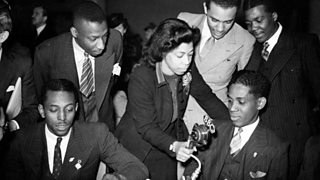
I first stumbled across Una Marson in an otherwise unremarkable lecture at university. As a second-generation Caribbean born in the UK, I was intrigued by this relatively overlooked Jamaican writer-activist and her landmark BBC literary forum. I couldn’t have guessed that a few years later, I’d find myself an employee at Old Broadcasting House trying to picture her daily interactions.
Born in 1905, Una was a journalist, a poet, an unmarried colonial subject making waves in wartime Britain. She co-wrote and directed the first black play staged in London’s West End. She campaigned tirelessly for gender and racial equality, famously calling for a “rally of women to sweep the cobwebs from certain brains and dust out the eyes so they can see better”. She lived with mental health problems and spoke about her experiences of it.
And there's more...
If these details haven’t built a formidable enough picture, here is a woman who not only became the BBC’s first ever black producer in 1942 but also created Caribbean Voices, a radio programme which has since been called ‘the single most important literary catalyst’ for anglophone Caribbean writing.
For me, this cannot be underestimated. Partially inspired by her freelance work on George Orwell’s short BBC literary series Voices, Una recognised the potential in transmitting literature that freely expressed the Caribbean cultural experience even as it was backgrounded by racial and social tension. As Head of the West Indies Service, she harnessed radio as a powerful connecting force for the Caribbean and Britain which could foster dialogue between these disparate but deeply entwined geographies. Where her debut presenting slot Calling the West Indies offered Caribbean servicemen in Britain room to send morale-boosting messages home, the reimagined Caribbean Voices was an opportunity for guest writers – many of whom were among the first wave of Windrush migrants – and their listeners to explore the complexities of an emerging postcolonial identity.
Over its 15 years on air Caribbean Voices featured appearances from Nobel laureates VS Naipaul and Derek Walcott, as well as Sam Selvon, Kamau Brathwaite and George Lamming. In truth, I wonder whether I’d have encountered Walcott’s Love After Love (something of a poetic, disco-less I Will Survive) without Una...
A source of inspiration
With another International Women’s Day just behind us and today marking observation of the Commonwealth’s 70th anniversary, I think Una’s vision should serve as an inspiration to all. But with these commemorations in mind, it’s particularly important to note that her story was not without difficulty. As can be imagined, in addition to external intolerances she faced hostility from some colleagues who struggled with her influence as a black woman. These experiences of prejudice and her declining mental health led to a period of sick leave in 1945 from which she never returned to broadcast.
Nevertheless, Una's legacy lives on. Using what she called “the miracle of radio”, Una refashioned old formats to showcase authentic storytelling that empowered marginalised authors, representing their respective communities. Crucially, she also made space for debate about belonging and cross-cultural exchange at a time of momentous change; debate that is still being grappled with today.
Personally, I couldn’t have known how much Una’s vision helped give me a glimpse, through some of the Caribbean literature I hold closest, at the London my grandparents might have encountered when they first arrived at the turn of the ‘50s. As a black woman at the very start of my career, I am even more inspired by the resilience, resistance, and imagination Una displayed in a world that would have no doubt been much more hostile than our own still imperfect one.
