
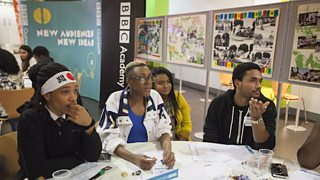
The election is past - and with it the chance to vote for the MPs who will sit in the UK Parliament.
Voting is something I feel strongly about. As a woman and a Catholic - two groups that did not always have the vote in the UK - but also as a result of filming in South Africa following the first post-apartheid election. The image of a young black South African woman kissing her voting paper with sheer joy is one that I will never forget.
So I was particularly glad that BBC Outreach was able to work with programme departments in Bristol and Birmingham, exploring with groups of young people the issues that concern them in the context of the election.
For many of the young people we worked with, the 2015 general election would have been their first chance to exercise their right to vote - a right they did not necessarily value or see as important.
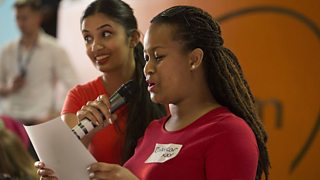
In Birmingham, BBC Outreach held an event aimed at first time voters. We wanted to find out which issues were important to them and explore how they might make their voices heard. It was a lively, interactive event with the theme: ‘If you want my vote…’
It was part of an initiative called #brumvotes, set up by the BBC to interest younger voters in the election and generate programme content that they’d enjoy, especially online. We worked with BBC WM and Midlands Today, too.
Crucially, this was a politician-free zone: we were looking at what really mattered to those participating, not at how their views aligned with specific political parties.
We started the evening by exploring lots of different ideas - at one point writing comments on a life-sized model of the No 10 Downing Street door - culminating in competitively pitching programme formats to a panel of experts which included local broadcast journalist Noel Phillips, presenter Nikki Tapper and spoken word artist Deci4Life.
Early on, a discussion revealed a wide range of concerns about different topics: education - ‘free wifi for all and free bus passes’, crime - ‘harsher sentences for rapists’, finance - ‘stop corporate tax dodging’, politicians - ‘a load of rich kids making decisions for poor people’.
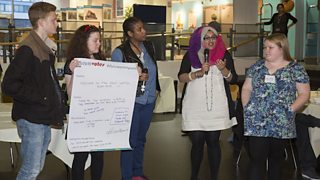
But soon the discussion turned to how these concerns might make compelling programmes. For example, the comment, ‘I’d like to see some politicians do an all-nighter bar shift’ was worked up into a programme idea where politicians would actually spend a day or longer living the life of a young person, with all its challenges. ‘I’d definitely watch that’, was the comment.
An underlying message to the politicians was: ‘Talk to us in language we actually understand’. This wasn’t about vocabulary or comprehension - it was about finding the means to talk with young people in ways which relate to their experience.
In Weston-super-Mare we ran a project with Weston College, ‘Your Voice Counts’, encouraging young people to make a film about the pros and cons of voting. Their report and conclusions can be seen here. We also ran sessions with BBC local radio stations in Bristol, Gloucester and with Radio 4’s Any Questions.
As a public service broadcaster, we need to make sure we have programmes and online content which educate, entertain and inform our younger audiences. If we don’t, we’ll get left behind. It can be argued that the sections of the audience which are growing fastest - young people, black, asian and minority ethnic groups, as well as people who are less well off - are some of the people we could serve a lot better.
So we make an effort to attract young people to work with us - we value their ideas and creativity. There are a number of schemes designed to do this - from work experience through internships to apprenticeships at all levels.
And it’s beginning to work.
The Outreach team for the Birmingham event included Talisha Johnson, a broadcast assistant trainee, who joined the BBC as one of the Director General’s local radio apprentices.
Talisha worked with the team to put together the event, and recorded and edited a package for the Chatback programme on BBC WM. Jade Richards, who has just started work as a Radio 1 intern, and was recruited through the 1Xtra Live outreach event in Birmingham, also took part in the workshop, judging programme ideas as well as writing and performing a poem: ‘If you want my vote’ - you can see Jade performing an extract from her poem here.
Not all of the work we did with first time voters was with young people. At one of the Outreach sessions we did in Weston-super-Mare, one first time voter was aged 75. But that’s another story...
All of these activities meet a fundamental Outreach principle - that they should be mutually beneficial - to the participants and also to the BBC and its audiences - building skills and knowledge with the young people and gaining valuable audience insights for us.
At the end of the Birmingham day, local radio apprentice Talisha and I decided to do a ‘blog off’ - we’d both write a blog about our experience. This is mine. And you can read Talisha’s blog here - the first of many, I hope, from one of the BBC’s up-and-coming journalists.
Diane Reid, Head of Outreach & Corporate Responsibility
