Imagine swirls of foul-smelling tobacco smoke. A fug, like a London pea-souper enveloping a long, narrow room. Windows flanking one side of the curved room crammed with desks.
Hear the sounds: the noisy rattle of a duplicating machine; hand-cranked; the buzzing of a dozen agency tape machines; spitting paper every thirty seconds; and, the occasional ping of a bell to signify the arrival of an ‘urgent.’ On top of it all, the clatter of typewriter keys. Twenty ancient upright Imperials being hammered at great speed. The descant to this melody - a chorus of voices, Oxbridge-accented, northern, North American, middle-European. “The President of the United States, comma, Mr Richard Nixon, comma…”
“The popular American entertainer, comma, Mr Elvis Presley, comma, has died, full stop.”
And all too often, “Scrap that. We’ll start again.”
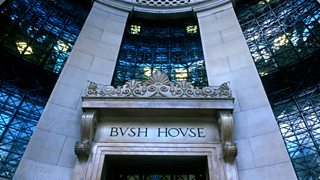
This was the Bush House Newsroom when I first knew it in the early seventies. I don’t think the atmosphere had changed much since its inception. And the voices? They were the journalists, dictating their stories to typists.
It was an absolute tenet of the newsroom in those days that stories for radio must be dictated. In a place where most had started their careers on newspapers, this was an essential. The art of crafting a news story for radio is very different from writing one for print. Most importantly, a listener can’t reread a sentence if it’s unclear. Hearing it out loud gave the writer - and the typist - a chance to catch words which might make it difficult either for the announcer in English or for the translator.
Dictating didn’t come easily to everyone. Many former print journalists needed to see things on paper. One quoted E.M.Forster, “How do I know what I think till I see what I write?” But those who mastered the art delivered some of the simplest, clearest and purest prose to be heard on radio.
The mechanics of getting a story out were complex. In those days, before computers, a draft was submitted to the Duty Editor, and usually returned covered in edits. The corrected version was then typed onto what was always referred to as a ‘sandwich’ consisting of a stencil top copy and about four or five ‘flimsies’ interspersed with carbon paper. Mistakes could not be fixed at this point, and wasting a stencil was a heinous crime. The people in ‘Distribution’ printed the stories then trailed around the desks placing hard-copies in trays. And if they liked you, they might be able to insert a comma or a full-stop with the aid of a thin scalpel.
Stories for the language services were stamped with their name ‘Thai’, ‘German’ ‘Hausa,’ rolled up, fastened with an elastic band, placed in a glass tube and fired through a series of Lamson Tubes – a pneumatic delivery service stretching across the building. They were delivered to a place in the Centre Block called ‘the Outpost’ where they were collected by translators. The frequent blockages of the tube were as serious and damaging as a computer crash today. (Someone once fired a lot of hard-boiled eggs up there, which wasn’t helpful.)
It was altogether a very male-dominated atmosphere and very few of the women there were journalists. On my first day, I was sitting quietly in what was called ‘the pool’ when one of the fiercer Duty Editors flung himself into a seat next to me, shouted “Snap!” and started to dictate. I think it was something to do with the Vietnam War.
Not being familiar with the routine I began to type in a fumbling way, until he yelled, “What is the matter with you?”
“Sorry,” I said, “but I’m not a typist.”
“No, you certainly are not!” he barked, flinging away to find someone who could actually take dictation.
It wasn’t all perfect. Dictation could usually be relied upon to pick up verbal errors but it didn’t stop the notorious ‘Seventy-six dissident Soviet physicists’ getting on air. When new technology arrived in the shape of computers we went on working in our scruffy old newsroom, while upstairs, shiny new VDUs and carpeted pillars awaited us. After negotiations with the unions, we moved upstairs. But such was the unease with the introduction of new technology that for a few years we lived in a strange limbo where journalists dictated to typists sitting at computers.
Gradually, cuts and economies caught up with us and the support staff disappeared. Eventually there were no voices raised in dictation, and no clacking of typewriter keys. Cigarettes had gone, alcohol was banned. As someone said, the newsroom had become like a slightly scruffy insurance office.
What we lost was that magical ability to hear what a story would sound like on air, to have a second pair of ears listen even before the second pair of eyes read the draft. But, what we gained was autonomy - the ability to write on our own, to think things through.
Sally-Anne Thomas is a former newsroom editor at BBC World Service and BBC Alumni member.
