

At BBC Russian, we have always been aware of our amazing history (regular broadcasts started in 1946). Our radio archives span decades and contain recordings of unique historical importance. And for a while now we’ve been thinking: how can we make them available to the audiences in the new digital age and how could we turn audio archives into attractive video?
We wanted to keep the focus on the voices, so we decided to subtitle everything, and add some images of the interviewees. And who better to front a historical project but legendary veteran broadcaster, Seva Novgorodsev! So the concept of the new series, Voices from the Archive, was agreed.
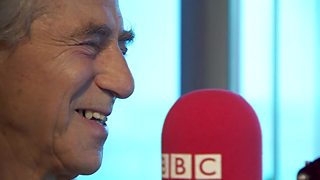
Voices from the Archive presenter Seva Novgorodsev
When you listen to the archive now (on digital audio files), it takes you back to a time when the Iron Curtain was a genuine barrier to contact between the Soviet people and the West. Visits to Britain were extremely rare, and few people dared to speak their minds openly down a telephone line from Moscow to London, because all international calls were made through an operator who was almost certainly listening and perhaps recording every word.
The BBC was referred to as an 'enemy voice' (vrazheskiy golos). In those days, much of BBC Russian output was made up of music, documentary features on the arts and history, poetry and prose readings and radio adaptations of plays - all part of an effort to give Soviet citizens a taste of forbidden Western, and their own ‘dissident’, culture. This was not counter-propaganda, - we were giving the vast audience in the Soviet Union access to the BBC’s trademark balanced reporting, and to a free flow of information.
Today there are many thousands of digital audio files in the BBC Russian archive, so selecting the content for our new project wasn’t going to be easy. In the resulting first series of Voices from the Archive, which consists of 12 episodes, we have given those recordings a connection with the present through the thoughts expressed in the original interviews that still have resonance today. Each episode features two personalities. While about half of them spoke with Seva Novgorodsev during his decades of broadcasting on the BBC, the rest are from programmes and interviews by BBC Russian journalists such as Masha Slonim, Natalia Rubinstein, Boris Nechaev, Tatiana Berg, Diran Meghreblian, Igor Pomerantsev and others.
It’s all about stories, first-hand and first-person. The people speaking with the BBC come from different times and places, many of them are no longer alive, and the stories they tell are about a time before many of us were even born. Many of the conversations took place in the 1990s and 2000s when Russians could travel abroad freely and there was a powerful impulse to speak openly about the Soviet past. It’s history as told by witnesses:
- White Russian émigré Countess Anna Ivanovna Shuvalova tells how, just after the revolution in 1917, she used all the rude words she could muster to stop a Soviet commissar from requisitioning a peasant’s calf
- Vasily Petrenko, the youngest general in the Red Army, remembers his part in liberating Auschwitz in 1945
- Ballerina Maya Plisetskaya, whose parents were both victims of Stalin’s purges, tells how she discovered she had danced before the Soviet leader in his dying days on 27 February, 1953
- Writer Andrei Sinyavsky talks about the importance of his friendship with Yuli Daniel, during their infamous trial in 1966 for publishing their "anti-Soviet" stories abroad
- Krushchev’s daughter, Rada Adjubei, remembers how her father’s successors “discouraged” him from recording his memoirs in the late 1960s
- Natalya Koroleva tells how she was forbidden to say her father was the Chief Designer, Sergei Korolev - the man behind the Soviet space programme which put Gagarin into space
- In 1978, at a time when it was dangerous to speak to foreign journalists, Nobel Peace Laureate, nuclear physicist Andrei Sakharov tells the BBC's Moscow correspondent Kevin Ruane that the struggle for human rights in the Soviet Union is important for the future of all humanity, not just for Russians
- Bass guitarist Sasha Titov remembers being arrested in the underground rock scene in 1980-90s Leningrad
- Liberal politician Galina Starovoitova’s story is about hatching a plan with Margaret Thatcher to rescue Gorbachev from the coup plotters in August 1991.
Seva Novgorodsev said that our new series brings back the voices of the people who, each in their own way, made history and that it’s a testimony of times and lives. I can’t agree more. He also said it’s the BBC at its best. I’ll leave it to our Russian-speaking audiences, wherever they are, to make that judgement – but I am proud of the work we’ve done and am looking forward to starting on the next series.
Jessy Kaner is the producer of the BBC Russian video series Voices from the Archive.
- New episodes will be published every Friday on bbcrussian.com, after which they will be available on demand.
- Following the initial 12 episodes, there will be new editions of Voices from the Archive.
