70 years of Composer of the Week

Jon Jacob
Editor, About the BBC Blog
Donald Macleod, presenter of BBC Radio 3’s twice-daily Composer of the Week – an exploration of classical music and those who write it - sits at the desk in Studio 80a. Beneath his adorable white beard and hair he maintains an air of quiet authority and potential mischievousness.
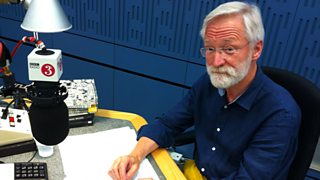
Composer of the Week presenter Donald Macleod
A glance at the desk confirms what I’d hoped when I prepared for our meeting: this man likes a bit of order. Everything around him has its place. The necessary tools of his trade carefully positioned around him: a microphone; a desk lamp; a modest pile of well-read academic books; his script; and his pen delicately held between his fingers.
And beside me as I sit down, a big cake with a picture of Mozart on it, and the words ‘Happy 70th Birthday Composer of the Week’ in Monotype Corsiva.
We shake hands. I splutter something like, “I’m really pleased to meet you, I’m a big fan.” He responds charmingly to my tried and tested (and in this case, genuine and sincere) interview technique. “It’s very nice to meet you.”
The sound of Donald’s warm voice calms me a little. Speech radio can sometimes cast a cruel spell on the listener, tricking him or her into thinking we have a closer relationship with the presenter than we really do. In Donald’s case, there’s an added layer to this already seemingly complex relationship: there’s a quality to his voice which makes it perfect for storytelling and (no offence to the tutors I had at university) he’d have been brilliant helping me on the 204 Music History course I enrolled on 20 years ago.
I point out to the publicist hovering nearby that it would probably be good idea to move the cake as far away as possible, so as to avoid me inadvertently putting my elbow in it. The cake is needed for a subsequent photo-call and I can sometimes gesticulate wildly when I’m excited. She agrees.

The birthday cake, featuring Mozart, is wisely moved to a place of safety
Donald became the programme’s regular presenter in 1999. Before then, he’d performed various presenting roles on the network. He was heralded in the press as the man who would first take Radio 3 listeners Through the Night, the network’s first foray into 24-hour broadcasting. As regular presenter of Composer of the Week, Donald would be the one consistent recognisable voice of the programme covering a wide variety of composers and genres.
“I don’t do it alone,” notes Donald waving his pen in the direction of his producer busying herself in the control room, “I couldn’t possibly know this much information about everything.” I ask him politely not to shatter my illusions.
First broadcast on Monday 2 August 1943 at 7.30am – 18 months after its ‘older sister’ Desert Island Discs – This Week’s Composer as it was known then was on the Home Service, sandwiched between a 15-minute ‘Gramophone record’ featuring the Band of His Majesty’s Royal Artillery and an address by the Rt. Rev the Lord Bishop of Lichfield. The 25-minute edition featured a selection of – presumably excerpts – from violin sonatas by Mozart.
Listed in the Radio Times (in the same week as an advertised talk explaining “How To Arrange A Concert: ‘by which is meant a public concert, not one arranged by the BBC for radio transmission”), This Week’s Composer gives the appearance of being indistinct, uneventful and inauspicious to our eyes.
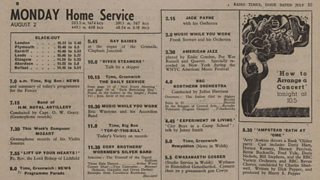
The Radio Times listing of the first broadcast of 'This Week's Composer'
The speed with which the programme became popular amongst its audience is apparent when reading some of the correspondence sent to the The Listener magazine.
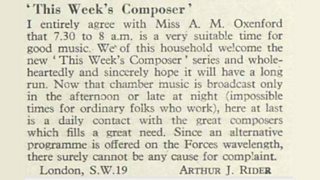
Arthur J Rider's letter in The Listener, September 1943
A lot of subsequent letters were in reaction to the programme being ‘banished’ to a 9.30am slot. The same complaint was reiterated by a whole host of other listeners in 1945:
“May I add my plea to those of your other correspondents for restoring ‘This Week’s Composer’ to its original hour of 7.30am? 9.30am is a time when nearly all men and a great many women cannot listen at all. Classical music is particularly to the calm of the early morning: light music at that time is like being asked to eat a sugar-bun before breakfast.”
In another letter, the schedule change represented: “a large cut for most enthusiasts. When the BBC gets an unwilling public accustomed to a regular dose of something with an educational value, surely they should be content to leave well alone.”
The word ‘enthusiast’ and ‘educational’ are important. This Week’s Composer had a dual function, the programme did more than just play music (there were plenty of symphony orchestra concerts in the afternoon and evenings – although less during the second world war). The 25 minute show was contextualising the music too, in what would amount to a present-day ‘link’ of the kind heard during Through the Night. More than that, the programme offered classical music before the working day. At a time when morning news bulletins, let alone ‘breakfast programmes’ weren’t yet staples in radio schedules the programme was breaking new ground.
This Week’s Composer would remain part of the Home Service schedules until 1964 when the programme moved to the BBC’s education radio network ‘Network Three’. TWC wouldn’t move to its final and surely more spiritual home on the Third Programme until Monday 2 October 1967, twenty-one years after the radio station had been launched.
That the programme continues to this day is a testament to the way in which certain well-loved programmes like This Week’s Composer were recognised as central to output early on, but also how they evolve over time. The one time youngster at the vanguard of broadcasting has developed as it has aged, maintaining the same idea – contextualising classical music - but early on seeing opportunities to maintain relevance by reflecting present-day ‘serious music’ culture.
Relatively early on, This Week’s Composer featured not only a gilded past, but also living and working composers of the time. Zoltan Kodaly (d.1967) featured as early as 1946; Aaron Copland (d.1990) was included in a programme of “American Composers of Today” in 1947; Richard Strauss, (d.1949) Sergei Prokofiev (d.1953), and William Walton (d.1983) all featured in 1949; Benjamin Britten (d.1976) first spotlighted in 1950; Michael Tippett (d.1998) in 1966.
Today, the same commitment remains and with it an implicit promise of thoroughly researched programmes covering the vast repertoire from an array of composers and genres. The opportunity to interview living composers about their life and work now fits the brief, creating evidence for future musicologists and biographers, as in the case of a series of programmes featuring John Rutter.
Similarly, Stephen Sondheim, whose interview in 2010 to mark his 80th birthday proved to be a memorable moment, and not just for me, it seems.
“He sat across from me here,” says Donald answering my fan-boy question about the musical theatre great, “and every time I asked a question, he would close his eyes for a few seconds to think before answering. It was the most nerve-wracking interview I’ve ever done.”
The unflappable Donald momentarily lets his guard down as he relives the memory. For a moment I battle between pity for what sounds like a tough gig, and envy that he got to spend some time with the composer.

Many happy returns', Donald Macleod blows out the candle on the cake
Jon Jacob is Editor of the About the BBC website and blog.
- To mark the 70th anniversary of Composer of the Week, Donald MacLeod will invite listeners to suggest names of composers who have not previously featured in the programme. Donald and the team will pick one of the composer suggestions to be the subject of a special Composer of the Week broadcast this Christmas 2013.
- Some of the more recent Composer of the Week are available to download and keep in edited form from the BBC Radio 3 website.
- On the Radio 3 Blog Executive Producer Chris Taylor blogs more about the first broadcasts of Composer of the Week.
- More details about celebrations for Composer of the Week at 70 can be found on the Media Centre website.
