
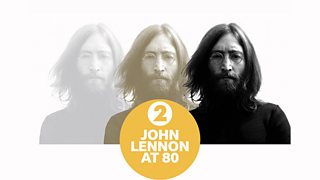
When you mention the name John Lennon, any work project suddenly becomes that little bit more daunting. When you’re offered the chance to work with his children, well, the word ‘daunting’ suddenly seems rather meek. Having said that, when I was asked to produce John Lennon At 80 for Radio 2, I didn’t hesitate.
Growing up in the North West of England I had a deep fascination with The Beatles. This was probably stoked by the fact that my best friend’s mum had seen them play live in 1962 in my small Lancashire town, at the Co-Op of all places. She’d met them, even received handwritten letters from each of them. Almost unbelievable to me by the late 1980’s, when John had made it onto my bedroom wall.
In 1990, I went to a gig in Liverpool to mark John’s 50th birthday. His widow, Yoko Ono and his then 15 year old son, Sean, compered the show. During my career I’ve made plenty of documentaries about rock legends - Led Zeppelin, Jimi Hendrix, Pink Floyd, Eric Clapton. They all have an element of tragedy, but this one was different. When I began work on this programme, I was acutely aware that yes, we were concentrating on John Lennon at 80, but with Sean involved, the story suddenly included a boy who had lost his Dad in the most awful circumstances.
I don’t mind saying I was more than a little apprehensive about working with John’s family. Fortunately I had absolutely no reason to be. Sean couldn’t have been more insightful, intelligent and, fortunately, equipped with a sharp sense of humour. Due to Covid restrictions, when we began work on this project, flying to meet him in New York was out of the question. We spent a lot of time on Zoom, chatting through ideas and working out the best way to approach what seemed like an impossible task. Soon it was suggested that Paul McCartney might get involved and then, could his big brother Julian be involved too?
Once we decided what to do, we approached Paul, Sean’s godfather Elton John and Julian. Would they even want to take part? We couldn’t ask them each the same questions and we couldn’t travel the same path as other programmes about Lennon had taken. Sean would take the lead and do the interviews, not me. I was acutely aware that as a child, he’d lost his father, not John Lennon, and I was terrified of pushing him over an emotional cliff. I don’t think any of the conversations were easy for him but he approached each one with a thoughtful and a natural curiosity.
We had many conversations about what he wanted to talk about, how he felt he could talk about his Dad’s musical life and the things he genuinely wanted to find out. Hearing Sean talk so openly with Paul, with his brother and with Elton was nothing short of utterly compelling. In their conversations, they brought John’s music to life again, speaking about John as someone in the present, not a lost classic. Even Sean discovered things he hadn’t known about before.
When I first became aware of John Lennon, his legend loomed large across the 80s. I just about remember my sister’s 7” single of Imagine, which was re-released after Lennon’s murder in December 1980, and I remember the nationwide shock of what had happened. But by the mid 1990’s, my generation suddenly, tragically, had one of our own to mourn, Kurt Cobain. As time marched on, more heroes fell and the death of Lennon was caught up in so many more talented losses so I was pleased to bring John’s legacy back to the fore by making this programme. Many legends are re-evaluated and maybe some of the things he did or said are now considered out of step in today’s political climate. But as he said in an interview for Rolling Stone magazine just days before he died, he never wanted to be a "dead hero". And as Sean says in the programme, when he was alive, John never stopped evolving and he never stopped updating his own opinions.
I don’t think I’ve ever worked on a programme that felt so terrifyingly important - I know from personal experience how strongly Beatles fans critique anything that mentions John’s name or feature his music. I hope what we’ve done is provide a unique perspective on John for his birthday, with new voices and new insights into who he was and how he lived. I wouldn’t want to re-write history, but what I did want to do was give Sean a chance to talk about his father on his own terms, with those who were so close to him.
John Lennon At 80 is produced by Listen and available on BBC Radio 2 on Saturday 3 and Sunday 4 October, from 9-10pm. Listen again on BBC Sounds where you can also hear the interviews in full.
