
“Ask the questions: ‘are we reflecting the audience we are aiming at?’ or ‘do we think we have a balance of voices here?’ This shouldn’t be a taboo subject.”
That’s the advice of BBC Social News’ Jonny McGuigan when it comes to our aim of representing women and men equally in our content. Jonny’s team is one of 600 across the BBC taking part in the 50:50 Project as part of our commitment to featuring 50% women on-screen, on-air and in lead roles across all genres.
And I’m pleased to say that we can show the BBC is improving its female representation in the second 50:50 report. It also outlines five areas for global growth to our grassroots initiative that was started by journalists just over three years ago. And we’re proud to reveal that over 60 organisations in 20 countries have joined our mission to enrich communications content through diverse voices.
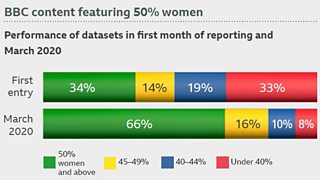
So what’s the proof that the BBC is improving women’s representation? March was our second 50:50 Challenge Month and two-thirds of the datasets filed reached 50% women contributors - that’s 32 percentage points higher than the number reaching that mark when they first started monitoring their output. It’s also up on last year’s challenge month, where 57% teams hit 50% women in their content.
What makes this even more incredible is that the challenge was in the month the world went into lockdown because of the coronavirus crisis. Like everyone, the BBC had to adapt. We streamlined our services and changed the way we work. It meant some teams were no longer able to continue with 50:50 - but the vast majority did.
The fact our teams chose to continue shows to me there’s been a real shift in mind-set. They see the importance of understanding what their content looks like - especially in the world we find ourselves in now - one where we need to ensure everyone’s voice is heard. 50:50 helps our teams identify if they’re doing that.
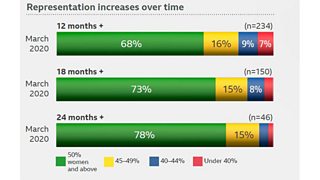
After the 2019 50:50 Report, we’d come up with a theory – based on somewhat limited data – that the longer a team implements 50:50, the more likely they are to reach 50% women. Now, armed with two years’ worth data we can see that trend continue.
The increase in women on BBC outlets is having an impact, as the BBC’s Director of Content Charlotte Moore explained: “Audiences tell us they’ve noticed a difference and it’s increased their enjoyment too. Telling stories for all audiences and reflecting the world we live in has improved the quality of our programmes by bringing fresh and engaging contributors.”
On BBC online content, some 39% of people surveyed in a YouGov poll also said they noticed a shift towards more women. Among 16 to 34 year-olds, 40% say they derived greater enjoyment as a result of seeing and hearing from more women and almost a third of women ages 25 to 34 consuming more BBC content. For me, all of this makes for positive reading.
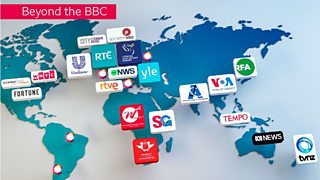
Also extremely encouraging is that 50:50 now has more than 60 organisations in 20 countries as partners and the BBC is committed to finding more like-minded partners to implement 50:50 within their own organisations.
We’re not just looking for partners from the media sector – all companies communicate and so can make use of the 50:50 core principles. It’s why we now have partners across, academia; conference businesses; law; public relations and the corporate world.
Unilever’s Head of Communications Paul Matthews explains: “We are already seeing early signs of the mind-set shift we need to make, with teams increasingly building consideration of the gender representation of our spokespeople into our communications plans and media training.”
We want equal representation of women and men in the media to be sustainable. To that end, we are committed to inspiring our next generation of content-makers. Today, we reveal how fifteen of our partners are universities from across six countries creating a global 50:50 academic network.
The students across these institutions implement 50:50 to their course work. Our hope is they take the 50:50 mind-set of enriching content through diverse voices with them as they embark on their careers within the media.
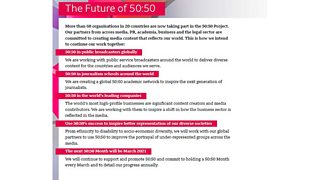
The areas of growth we’re highlighting in our report for 50:50 are all for one crucial reason and that is to ensure the media is reflecting society.
The BBC’s Director of Creative Diversity June Sarpong explained how we are building on the success of 50:50. “More than 30 teams across TV and radio have signed up to pilot 50:50 monitoring for disability and ethnicity,” she explains. “Our disability pilot is being supported by the Media Trust’s Reframing Disability project, a collaboration that we are very proud of.”
It is through collaboration we believe that we can shape the media so it better reflects our world.
