50 years of World at One

Martha Kearney
Journalist and Presenter, World at One
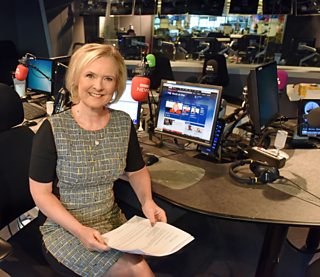
Martha Kearny
It was the brainchild of BBC Home Service controller Gerard Mansell who stuck his neck out by moving the immovable, The Archers and Desert Island Discs, to make way for a “crowd of buccaneers”.
1965 was a time of change and the BBC needed to reflect that. I can’t see a controller daring to do that now, but Mansell’s risk paid off. It swiftly found appreciation amongst listeners and gained a big audience.
He wrote that “Many regarded it as brash and dangerously outspoken. William Hardcastle broke all the accepted rules of broadcasting. He breathed heavily at the microphone, he stumbled over his script and addressed himself to the most powerful in the land with unaccustomed directness and no hint of deference.”
One of the programmes first reporters Sue MacGregor told me once that he famously got his own name wrong by announcing portentously "This is William Whitelaw with The World at One". While Jim Naughtie likes to retell a fond tribute about how his red jersey was left on his chair after he died and subsequent editors would wear it like the yellow jersey in the Tour de France.
William Hardcastle interviews Richard Dimbleby about his career at the BBC, how he prepares before a state visit and his attitude towards royalty, 23rd December 1965.
We believe that first day’s coverage included Ian Smith arriving in London for talks on Rhodesian independence; the Pope addressing the United Nations and apparently the Prime Minister Harold Wilson had rebuked the BBC over ‘some upstart young television journalist called Day’. Robin Day of course went on to present The World at One. When he arrived for the morning meetings the first thing he did when he sat down was to set a packet of cigarettes on one side and cigars on the other and from that moment he smoked and chewed on both until he signed off.
Though my predecessors made it seem effortless, presenting can be a terrifying experience. I was a huge fan of Nick Clarke whose polite, yet incisive, probing of politicians should be a model for all interviewers. I was cheered to learn even he lost his cool during one Outside Broadcast from a party conference when his item was drowned out by a nearby Beatles tribute band. As Nick got more and more incensed, the story goes that the band started to play All You Need is Love.
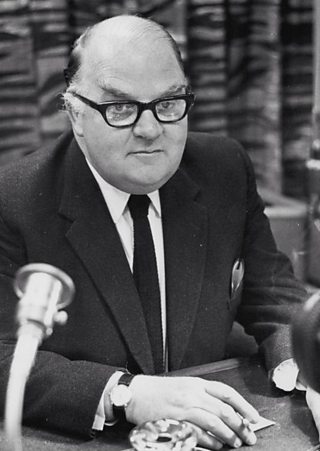
William Hardcastle
From the outset the programme had a formidable line-up of reporters. Over the years this has included Nick Ross, Jonathan Dimbleby and Sue MacGregor. The programme was one of the first to send reporters out to do vox pops. Something that landed Sue in trouble when she was banned from Sainsbury’s for waylaying the customers.
As ever it is the editor who shapes the personality of the programme. Andrew Boyle was the “maverick genius” who exposed Anthony Blunt as a Russian spy. I know how much I rely on my current editor Nick Sutton whose calm and incisive intelligence is a bedrock as the morning pandemonium reigns around.
That sense of chaos exists because there is so little time to get the programme on air. Whoever is editing gets in around 6am. I cycle in for 7.30am and our morning meeting begins at 8.30am. Jim Naughtie describes that meeting as: “a collective reading of the papers and grunt at each other over coffee”. After that we chase eight or nine stories which get narrowed to five or six depending on which guests we get and how stories develop. Our producers not only set up guests, but they edit all the interviews too. Nowadays it’s done digitally and not with the razor blades and tape used when I first started.
Breaking news is always welcome, though the closer to going on air the hairier it can be. I recall one morning at around ten minutes to one spotting on the newswires that Baroness Thatcher had died. With cold drops of sweat running down my spine all hell broke loose as we rushed to confirm the news before broadcast. Nothing was in place as I made my way into the studio. Somehow the producers found the obituary tape and tracked down a fitting range of guests. There was no time for scripts so instructions were constantly shouted through my headphones.
In my early days I just couldn’t believe how hectic it all was – even after years on Newsnight. The worst, and funniest, moment was when I was still at my desk and heard the one o’clock pips sounding, the signal for me to begin speaking in the studio. My heart nearly stopped…until I spotted Eddie Mair grinning away. He had played a practical joke, which became a regular occurrence until I learned not to leap up panic stricken from my chair.
Many famous journalists have come through the ranks of The World at One. In 1982 Kirsty Wark was a producer on the desk. Her editor was Jenny Abramsky and Tony Hall, the Director General now, was her deputy. Back then she learned so much not only about the craft of production, but a crafty brew too. She told me “There was a mini fridge in the corner of the WATO office – near the coffee machine – but there was also a bottle of whisky out of view, and a few seasoned members of the team – neither Jenny nor Tony I hasten to add - used to lace their morning coffee and or Coca Cola with a little stiffener…oh how the programme has changed.”
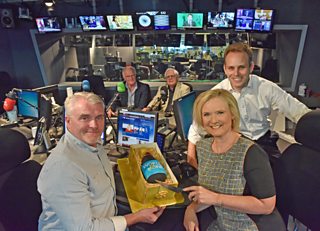
Every birthday celebration needs a cake. WATO's 50th birthday cake was made by Bake Off competitor Paul Jagger.
In fifty years the programme has evolved. You’re more likely to find a batch of homemade cakes or biscuits than a bottle of Scotch now. The best innovation has been the extension to 45 minutes, which has means we can cover a much wider range of stories for our loyal audience.
Looking back over all those years of The World at One, we decided to do an anniversary series that celebrates the best of Britain. News by and large covers the more depressing aspects of life from natural disasters and war, to political arguments and economic problems. Former Cabinet minister Peter Walker once called us “The World at Glum”. So it has been uplifting to report on more positive stories. We have had nominations from David Cameron (universities and science) Ed Miliband (the NHS) and Nigel Farage (the law) as well as Jude Law on theatre. Alan Bennett notoriously picked hypocrisy as what the English excelled at. We have reported excellence in cancer research and computer games, the Premier League and fashion. My favourites have come from our listeners who sent me cycling around the Manchester velodrome and to a nature reserve for a spot of biological recording where I was greeted with these words “There are 48 varieties of slug which is 47 more than most people realise.”
Our listeners can very kind – I was sent lots of cards after I revealed my allergy to bees – but make a grammatical mistake and you will be ripped to shreds. Thankfully I haven’t suffered the fate of Jim Naughtie. When he first arrived he was informed by some listeners, unhappy with his Scottish accent, that he didn’t know how to pronounce his own name!
So in a world of 24 hour news, twitter and a bewildering fast changing media, how has a fifty year old programme remained so popular? Our audiences are 1.5 million every day.
We pride ourselves on our news breaking interviews and agenda setting analysis. Some programmes may preview and others may reflect on the day’s news, but The World at One is at the heart of what’s happening. Most of all I think that independent streak, which was the guiding light of the early years, has stubbornly persisted and been the impetus for our journalism.
