About the BBC - BlogAbout the BBC - Blog
Local Navigation

Archives for November 2010

The Editor's blog - Access All Areas

Post categories:

Laura MurrayLaura Murray|11:46 UK time, Tuesday, 30 November 2010

Kevin Bakhurst, the controller of the BBC News Channel and the BBC News at One and the deputy head of the BBC Newsroom, has blogged today about how the BBC is exploring disability issues, ahead of Friday's United Nations International Day of Persons with Disabilities.


To read Kevin's blog in full and to post a comment, head over to The Editor's blog.

Laura Murray is Editor of the About the BBC Blog

Tracking ratings for BBC programmes

Blog comments are currently unavailable. Find out more.

Post categories:

David BunkerDavid Bunker|16:10 UK time, Thursday, 25 November 2010

The Apprentice

Like many people of my age I love to watch The Apprentice - but as life gets busier I can't always be in at 9pm on a Wednesday night to watch it. Luckily I have a PVR (Personal Video Recorder), and even if I forget to record it or series link it I can always catch it on the iPlayer. And if I don't do any of those things there is also a narrative repeat on BBC1 on Sunday night.


However, what makes life convenient for me as a viewer can make it a nightmare as someone whose job it is to keep across the ratings for BBC programmes. Life used to be so simple - we would get the BARB overnight figures on a Thursday morning and know pretty much the final reckoning on how the programme had performed. Now these overnights are only part of the picture.


'Consolidation' as it is called (adding in the videoed/PVR'd figures for 7 days after broadcast) has been included in the BARB service for some years and there are rules that the TV industry agree on. But the audience can now access our content in so many different ways - do we consistently add this consumption to get a total picture of performance? What about narrative repeats? And what about those who watch on iPlayer - shouldn't they also be accounted for? And what about if the schedulers decide to repeat a programme several weeks later - shouldn't this be added in at the end of the year in the final reckoning for that programme? If we are not careful we in Audience Research will be spending a lot of time with our calculators out and even then we may miss some vital part of the picture. The audience increasingly don't care when or where they see a programme - and we need to keep up with them.


To address this increasing complexity we at the BBC are in the early stages of developing a systematic way of tracking a programme's performance over its lifecycle. Every time it is available to be watched by the public (live broadcast, recorded and played back, repeated, or watched on demand) we are able to add in the extra audience - and over time accumulate the total consumption of that programme. This isn't quite as simple as it sounds - to add in the iPlayer viewing figures we don't just take the number of views or requests but we account for the actual amount of the programme they have watched so we have an equivalent 'average audience' to make it equivalent to the way linear TV audiences are reported. And our iPlayer stats just measure the numbers of streams/downloads - they don't take account of how many are watching that stream or download - so we also apply an estimated factor based on other survey data to account for this. These refinements ensure that we get a consistent measure of total consumption of a programme across different platforms and allow us to add them together with greater confidence.

This is all very well for us audience geeks, but how will we get 'overnight addicted' TV types to take notice? Well we've decided to create a new metric - 7 days after the day of broadcast (the same as the current BARB consolidation window) which we are calling Live Plus 7 and which will include all the viewings (live or recorded) across conventional television and on demand. This single Live Plus 7 figure will be available around 10 days after broadcast and we will ensure that it is fed systematically into the business each day for each programme - so people won't have to wait too long to get at it. We will also continue to accumulate audience viewings for that programme beyond that date so we can look at how many watched over a longer period. This isn't meant to be a substitute for BARB - the existing BARB currency is at the heart of what we are doing and I know they are taking steps on an industry-wide basis to increasingly reflect the changing reality of viewing - but it is an approach that will work for the BBC now in helping integrate linear TV and iPlayer consumption and ensure we get a true measure of a programme's impact.


So what does this approach tell us about how many watched The Apprentice? Well for episode one 6 million watched it live as it went out, and a further 900,000 watched it back the same day - both figures already accounted for in the overnights. But over the subsequent 7 days a further 3.1m watched the same episode either from a recording, on iPlayer or from the narrative repeat - giving a Live Plus 7 figure of over 10 million. Episodes 2 and 3 also accumulated to above the 10 million mark. For a channel like BBC3 where narrative repeats are more widely used and the audience are more iPlayer savvy it is even more important - the first episode of the comedy Him and Her went from an overnight of 0.8m to a Live Plus 7 figure of 2.5m. So although I'd be the first to say that the overnights still do matter, they increasingly don't tell the whole story - and our new approach goes some way towards filling in the gaps.

Next year we plan to start revealing this information by publishing some of this Live Plus 7 information each month in a similar fashion to the way we announce BBC iPlayer stats now.


David Bunker is the Head of Research for BBC Vision

Read more about the BBC TV end of year figures announced today by Director of BBC Vision, Jana Bennett on the Press Office website.

Kevin Bakhurst, the controller of the BBC News Channel and the BBC News at One and the deputy head of the BBC Newsroom, has blogged about the viewing figures for the BBC News Channel. To read his blog in full and to comment, head over to the Editor's blog.

Sustainable programme making at the BBC and beyond

Blog comments are currently unavailable. Find out more.

Post categories:

Pat YoungePat Younge|11:18 UK time, Wednesday, 24 November 2010

Sometimes programmes change the world when they are broadcast. Unfortunately, all programmes change the world during the course of production, because of the negative impact programme making has on the environment.


Making programmes requires energy to light studios, power catering trucks, fuel vehicles etc, and consuming energy usually creates carbon emissions which the overwhelming majority of climate scientists believe are heating up our planet. Not good.


Then there’s the waste. Last week’s scripts, that old set, unwanted costumes, the food, plates and cups needed to feed the cast and crew on location. All usually heading for landfill when production is over. Until now.


Over the past year we’ve been looking at what it would take to make programme production more “sustainable”. In a perfect world, a sustainable production would leave the world a better place than it found it. In reality, we want to do everything we possibly can to minimise our environmental impact - burn less energy, use less stuff, throw less away.


That’s a tall order for any programme maker, on top of all the other demands the production process puts on them, so we’ve done some things to make it easier for them.


For starters, we've built Albert, the world’s first carbon calculator specifically for programme production. It’s called Albert for no particular reason, it's easy to use, and shows production teams their carbon impact and where they can put in the most effort to reduce it. We've been piloting Albert in recent months and in future, all programmes made by BBC Vision Productions will now have to use him/it.


My colleague, Richard Smith, has also written a guide on how to make productions more sustainable, stuffed with tips on how to make things better. For example, low-energy lighting could lead to big cuts in the amount of energy we use in studios, whilst solar-powered generators will one day replace the noise, smell and rising cost of diesel on location. And from cameras to cutlery, we’ll be working with our suppliers to ensure that they share our values – so the next time a production books a caterer, hopefully they’ll know the polystyrene cups have to stay at home.


This is all happening right now in Vision Productions. Dragons’ Den was lit by a solar-powered generator earlier this year. The award winning drama, Five Daughters, banned disposable plates on location and saved money on waste disposal. Casualty plans to switch to low-energy lighting when they move to the new drama village in Wales next year. Our colleagues in the Nations, English Regions, Children’s and Audio & Music are also on board with piloting the calculator. Next year we hope to share Albert with the rest of the UK broadcasting industry, because this is an issue for everyone, not just the BBC.


Ultimately we want every programme made by the BBC to be as sustainable as it can be. There are challenges everywhere. The main one is cost and sustainability doesn’t come with a blank cheque. We have a duty to spend the licence fee wisely and teams will have to make tough decisions as to when the green option is or isn’t worth it.


And this can’t get in the way of creativity. So what to do when a show has an ambitious but do-able idea that’ll make their carbon footprint grow not shrink? My best guess is to go with the idea but pedal hard to make reductions elsewhere.


Sustainability is already business-as-usual in many industries, but it’s new in ours and as early adopters, we will face the biggest hurdles. We certainly don't have all the answers, but then again, nor does anyone else, and where we get it right the environment wins big.


Ultimately I believe that sustainable production can and will become commonplace because the only alternative is un-sustainable production – and that’s not an option for our business, our audiences or the planet.


Patrick Younge is Chief Creative Officer, BBC Vision Productions

  • Alec McGivan, Head of BBC Outreach, has also blogged today about why the BBC is launching a new sustainability strategy.

Making the BBC more sustainable

Blog comments are currently unavailable. Find out more.

Post categories:

Alec McGivanAlec McGivan|11:18 UK time, Tuesday, 23 November 2010

In order to see this content you need to have both Javascript enabled and Flash installed. Visit BBC Webwise for full instructions

Just over two years ago the BBC launched a new environmental policy. Along with many other companies we sought to reduce our carbon footprint by bringing down the amount of energy and water we used, reducing the amount of waste we sent to landfill and the level of carbon emissions our travel was producing.

We are now half way through the five years we set ourselves to achieve these reductions and two things are clear. Firstly that we need to work harder to reach the targets we set ourselves and secondly that in those two years the environmental agenda has moved on significantly.

So we’re adding to our existing work and adopting a more holistic approach to sustainability. We want the BBC to become a more sustainable organisation across the whole range of our operations. Sustainability means different things to different people and for us it is about being a responsible steward of our natural, human and financial resources. 

Embedding sustainability into everyday working is key and that is why today we are launching our new sustainability plan called The Difference. 

A central plank of The Difference is that the BBC should lead the media industry in sustainability – creating and exemplifying industry best practice. Pat Younge, BBC Vision Chief Creative Officer has written about the launch of our Carbon Calculator and the work that BBC Vision Productions are doing with the independent production sector. And we are looking at ways in which our Research & Development department can help work with external suppliers to reduce the energy use of new broadcast technology such as YouView set-top boxes.

I should also stress that this initiative isn’t about making editorial decisions based around one particular side of the environmental argument. As always our editorial decision making will be guided by due impartiality and a diversity of opinion. However, where we can reduce our own negative environmental and sustainability impacts, cut our costs and use our size and scope to make it easier for others to do the same, we believe this is in the public interest.

Among the internal initiatives we are launching as part of The Difference are changes to our buildings to ensure that we reduce the amount of water and energy we use and cut the volume of waste we send to landfill. We are rolling out improved video conferencing facilities, encouraging cab share and introducing a policy to limit flights to help reduce our travel footprint. We are introducing new technology to reduce the number of computer servers we use and avoid printing unnecessarily. Beyond the BBC we are also setting higher sustainability expectations from our suppliers. These and many more smaller actions will help us make the changes needed to become a more sustainable organisation.


Finally I should say that the initiatives outlined today overall will save the BBC money over the course of the current licence fee period. We only approve large scale investment if we can prove that it will return money to the BBC over a period of time and help our target of reducing the amount we spend on running the BBC.

Alec McGivan is Head of BBC Outreach

  • Patrick Younge, Chief Creative Officer of BBC Vision Productions, has also blogged today about what programme makers can do to make sustainable productions.

A Big Year for Big Screens

Blog comments are currently unavailable. Find out more.

Post categories:

Stephen Morgan|08:16 UK time, Thursday, 18 November 2010

I was very pleased to hear about the Royal Engagement and am sure people will love watching the Royal Wedding on our Big Screens. People tell us, time after time, that they enjoy coming together to share an experience with others who have a common interest. Even when events such as rugby and football games are available on television, there's nothing quite like the atmosphere you get as part of a crowd.

Swansea’s Taliesin Dance Days event


Back in the Summer I was telling you about some of our Big Screen events and our partnership with London 2012 and local authorities. But it doesn't stop there. We're constantly developing new partnerships in local communities. The screen is a digital community canvas. One example of a recent collaboration is with the National Screen and Sound Archive of Wales. We're able to showcase some really fascinating stuff. Viewers watching Big Screen Cardiff can now see footage of the city centre in the 1930s and 1970s. How things have changed! Everything seemed to be displayed in the shop windows in those days. For the locals, going back in time with the Big Screen, is a fascinating journey. The films revisit parts of Cardiff which have been totally transformed, including the old Tiger Bay, made famous by Dame Shirley Bassey. Around a third of the Big Screen’s airtime is dedicated to local films, made by local people. You may have seen recent pictures of Swansea, marking Armistice Day, on UK television news. The Royal British Legion returned to the city for the second time to host Silence in the Square. Its sister event at Trafalgar Square is now in its fourth year. Both events were integrated, via the Big Screen.

The Royal British Legion hosting Silence in the Square

The audience enjoyed performances by The Saturdays, local singers and Sarah Lark, finalist of BBC's I'd Do Anything. It was a very moving experience and after total silence fell on the square, people placed poppies in the fountain. It was a poignant scene.

I'm always amazed how people of all ages react to our interactive games shown on screen. It's fascinating to watch the reaction of people as the screen often stops them in their tracks. Using a motion-sensitive camera, audiences are thrilled to see themselves on city centre screens, responding to the demands of the games. I must tell you about our recent Children in Need Big Screen Quiz in Cardiff. People watched short television clips and answered questions based around magical moments from Children in Need.

Children in Need Big Screen Quiz

 There were 4 possible answers for every question, each represented by a box on screen. You then had to stand within the relevant box to register your answer. Cardiff played against big screens in the other nations, with competitors based at Norwich, Edinburgh and Derry.

Pudsey Bear joins locals to take part in the Children in Need Big Screen Quiz

You only have to look at people's faces to realise they were having fun. As well as playing games on screens we've been able to give students a platform to develop their own games and interactive ideas.

People love taking part in our events and enjoy watching others appearing on screen. We recently hosted a Strictly Come Dancing event in Swansea, giving locals a chance to take to the dance floor. Karen Hardy recorded a special dance routine for the Big Screen, which people were able to perfect on the ground. Local dance experts also stepped in to delight the crowds.

The Strictly Come Dancing event in Swansea

This leads us nicely into the Christmas season. Festive favourites for me will include concerts by the BBC National Orchestra and Chorus of Wales, including Carols for Christmas at St David's Hall. These will all be shown live on the Big Screen, with highlights peppered into our daily schedules.

Have you been to any of our events? Let us know what you think.


Stephen Morgan is Screen Manager for Wales

Raising money for Children in Need

Blog comments are currently unavailable. Find out more.

Post categories:

David RamsdenDavid Ramsden|10:17 UK time, Wednesday, 17 November 2010

Children in Need logo

When people find out that I work for BBC Children in Need the first question they ask is, “What do you do for the rest of year?”

The truth is that the Charity is here all year round making sure that the money raised is going to projects that are making a real difference to the lives of children and young people across the UK.

At any one time we have over two thousand live projects. They are typically run by small charities and voluntary groups and may be dealing with issues including poverty, deprivation, abuse, neglect, illness and the challenges faced by disabled children and young people.

We can only support more projects if we raise more money, so from early in the year, we begin planning the campaign which culminates in November, and this year airs on Friday the 19 November.

Our theme is “Show your spots, lets raise lots!”, which we hope will give people the cue to get stuck into fundraising. What people here in the BBC will have seen over recent weeks, is everywhere and everything getting spottier by the day! We think a theme gives fresh impetus each year and more opportunity for people to use their imagination.

In order to see this content you need to have both Javascript enabled and Flash installed. Visit BBC Webwise for full instructions

This Friday’s Appeal show looks set to be a really special evening. The Executive Producer Elaine Paterson has put together an incredible line-up, with music from the likes of Tom Jones, Kylie, Westlife, JLS and Take That, along with some great entertainment including a Dragons’ DenCome Dine With Me and East Street where Coronation Street meet Eastenders. There are also some amazing events across the UK, with big concerts in Belfast, Glasgow and a Pudsey take-over at the Millennium Stadium in Cardiff.

One of the most important parts of the evening for us is the opportunity to introduce some amazing young people to a wide audience and to show how the money that the public raises can help them to deal with the challenges in their lives.

This Friday the stories we tell will include amongst others that of 11 year old Nasreen, an amazing young lady who has a muscle weakness disease and who is totally dependent upon her family for daily activities. Nasreen attends Demelza Hospice, funded by BBC Children in Need, for respite care where she and her family get invaluable practical and emotional support.

This is also the week when I get constantly asked if we will beat last year’s total. Appeal 2009 raised over £20.3 million on the night and a final figure of over £39 million by the end of the year.

At the moment we really don’t know how things will go. We have heard about lots of fundraising that is going on and we have seen Pudsey stuff flying out of the shops, but the critical thing will be just how many people call on the night.

I also spend a lot of time at the moment encouraging people to fundraise and you should go to www.bbc.co.uk/pudsey to find out how simple it is!

We know that times are tough and this means that children and young people are particularly vulnerable and really do need our help.

This will be a long week, but I know by Saturday morning, people across the BBC and across the UK will have come together and raised millions of pounds that will help to change lots of young lives.

 David Ramsden is Chief Executive of Children in Need

To find out how you can get involed, head over to the brilliant Children in Need website, where you can make a donation, add Pudsey ears to your digital photos and bid in the auction.

Connect & Create BBC Volunteers

Blog comments are currently unavailable. Find out more.

Post categories:

Glynn RylandGlynn Ryland|10:18 UK time, Tuesday, 16 November 2010

In order to see this content you need to have both Javascript enabled and Flash installed. Visit BBC Webwise for full instructions

At some point in life everyone considers the idea of volunteering, giving their time and efforts to help others, and BBC staff are no exception. In fact I'd say that there is a strong altruistic culture amongst staff here and a requirement for the corporation to channel this energy into measurable projects.


We often hear from charities who say they are up to their eyeballs in people wanting to come and 'paint a wall' for them. We find that many charities are after something more meaningful, something that will resonate and leave a legacy for their beneficiaries. So the BBC has a small department called "Connect & Create" and we are, to all intents and purposes, the volunteering scheme of the corporation. It's a simple structure. We have formal partnerships with ten national charities and a smaller number of local project charity partners. We put together projects that place BBC staff into these charities in whole variety of ways.


Often we help the charities produce creative work, such as films or podcasts. Other times we place staff with specific expertise to lead workshops and run seminars. On other occasions they are involved in mentoring beneficiaries from all walks of life. Each project is unique and there is always lots going on, as we run projects all across the year and across the UK.


A group shot from the Whizz Kids project from Newcastle

Of course you can measure the numbers of staff and projects, but the real measure comes in the stories we hear from people. We hear some amazing stories and staff seem universally bowled over by the experiences they have sharing their skills in this way. My personal favourite is the team in Newcastle who mentored a group of disabled children in how to make a film about wheelchair access for their sports classes. The children did such a great job with their film that it was broadcast on Look North that same evening.


Glynn Ryland is the Manager of BBC Connect & Create

You can find out more about Connect & Create and see a list of its charity partners on the BBC Outreach website.

BBC iPlayer on BT Vision

Post categories:

Bridget MiddletonBridget Middleton|12:43 UK time, Friday, 12 November 2010

"Yesterday we announced that we will start to roll out BBC iPlayer across the BT Vision platform next month. By April next year, every one of the 520,000 BT Vision set-top boxes installed should be able to access our catch-up video on demand (VOD) service at no extra cost.

In order to support BBC iPlayer, BT Vision will update the software on their boxes, rolling it out gradually across their customer base. Once a box is upgraded, our app can be launched from BT Vision's main menu, giving access to more than 400 hours of new TV programmes and many more hours of BBC radio each week."

Gideon Summerfield, the Product Manager of TV iPlayer has written aboutBBC iPlayer on BT Vision. You can read Gideon’s post in full and comment on the Internet Blog. 

Internet Blog - feedback on BBC Red Button

Post categories:

Laura MurrayLaura Murray|13:50 UK time, Thursday, 11 November 2010

"Today the BBC Trust published its review of the BBC's interactive television service, BBC Red Button. The BBC Trust regularly reviews BBC services, inviting public opinion to assess how well our services are performing and what, if anything, should change.

This review follows a public consultation undertaken in late 2009, which produced over 5,600 responses, and included a study of the BBC's own research into how viewers engage with the service."

John Denton, the BBC's Managing Editor of TV Platforms has blogged about the feedback received on BBC Red Button. To read John's blog post in full and to make a comment, head to the Internet Blog. You can read the full review on the BBC Trust website.

BBC Two celebrates the diversity of history this autumn

Blog comments are currently unavailable. Find out more.

Post categories:

Martin DavidsonMartin Davidson|15:05 UK time, Wednesday, 10 November 2010

In order to see this content you need to have both Javascript enabled and Flash installed. Visit BBC Webwise for full instructions

My biggest challenge as commissioning editor for History on the BBC is to ensure that we cover as much variety as we can. It’s an incredibly dynamic, fascinating and wide-ranging genre and it’s my job to bring as many different audiences as possible to the pleasures and intrigues of human history.

You may have caught Michael Wood on BBC Four recently, excavating and illuminating over 2000 years of English history buried in the Leicestershire village of Kibworth-Harcourt, assisted by scores of local inhabitants. From shards of Anglo-Saxon pottery to First World War diaries, all of life was here. I hope this has whetted your appetites, because over the next couple of months, it is BBC Two’s turn to offer up a cornucopia of history programming.

I’m most excited about the 12 weeks of Edwardian Farm. Ruth, Peter and Alex have spent yet another year immersed in the life and work of our great-grandparents’ generation, this time working a farm in the Tamar Valley, with the clock firmly set to the first decade of the twentieth century. For the Edwardians farming involved not just growing crops and tending animals, but turning your hand to tin-mining, off-shore fishing, and catering for the new nationwide taste for freshly cut flowers, soft fruit, and tourism, courtesy of the fast burgeoning railway. Riveting and moving in equal measure. 

Civilisation is a big thorny word – judgmental and pompous – but according to archaeologist and historian Richard Miles, it’s utterly indispensable. Ancient Worlds is his six-part exploration of the evolution of civilisation, from Mesopotamia to Augustan Rome, which grapples with the great imponderables of human society. The landscapes are mind-blowing, the thought-line provocative. Alongside the series we have a wonderful one-off from the incomparable classicist Mary Beard. She turns her attention to Pompeii, that amazing fly-in-amber – or rather, volcanic ash – survivor of ancient catastrophe. We know how these people died, but Mary investigates how they lived. Her film brings their life back to life.

And what of our more intimate and recent histories? In her three-part series, Amanda Vickery spends time At Home With The Georgians, poking through their houses, their furniture, and their most personal musings, to offer up a compelling and emotional portrait of an age whose outlines we still inhabit to this day. The heartache and happiness associated with finding the right partner and setting up home (or not) resonate as brightly – and occasionally, as desolately – today as when first committed to private diaries 250 years ago.

A hundred years later, Britons had become obsessed with the intractable questions of social justice, political corruption and fairness. Sound familiar? Ian Hislop goes in search of that much maligned figure, the Victorian Do-Gooder, without whose valiant efforts life would have been so much harder for children, the poor and the vulnerable.

I think the history programmes on BBC Two this autumn achieve my aim of really showcasing and investigating some of the truly fascinating stories that human history offers us, providing an eclectic mix of accessible yet rigorous programmes, combining the unashamed expertise of the likes of Mary Beard, Richard Miles and Amanda Vickery with the enduring popularity of an engaging presenter like Ian Hislop and the ‘living history’ approach so brilliantly executed in Edwardian Farm. I hope you like them and I look forward to hearing what you think.


Martin Davidson is the BBC's Commissioning Editor of History

Edwardian Farm and Ancient Worlds begins tonight at 20:00 on BBC Two.

BBC Diversity Consultation opens today

Blog comments are currently unavailable. Find out more.

Post categories:

Amanda RiceAmanda Rice|10:01 UK time, Wednesday, 10 November 2010

In order to see this content you need to have both Javascript enabled and Flash installed. Visit BBC Webwise for full instructions

Today the BBC opens a consultation to ask for your views about our ongoing diversity work.

As a body funded by licence fee payers, the BBC is continually finding ways to talk to and involve the widest possible range of audiences including under-served communities. Asking people to tell us how well they think we serve and reflect specific groups within society and acting on that feedback is part and parcel of that.

People’s views contribute to raising awareness around what is meaningful and distinctive to different groups and to driving creative ideas.

Ultimately, we want to inform the production and editorial decisions that influence how and to what extent the breadth of UK diversity is represented on screen. Thinking about, including and reflecting our diversity helps us tell the most original and compelling stories.

Working towards those aims, we also want a workforce that is as diverse as modern Britain and we have developed a plan to achieve that – but we want to hear what our staff and the public think about our direction.

At the beginning of October, the main provisions of the Equality Act came into force. The Equality Act 2010 consolidates a patchwork of previous legislation into one Act to simplify the law. The Equality Act 2010 is wide reaching and provides a clear framework which will protect more people from discrimination, indirect discrimination, harassment and victimisation in a number of key areas. 

In addition, in April next year the Public Sector Equality Duty element of the Act will be enforced. This means that along with other public bodies, the BBC will need to show how it has considered active steps to advance equality, eliminate discrimination and foster good relations between people from different groups across various activities and functions. Speaking to the public and listening to their views and concerns is a vital part of this activity.

We’re want to consult with you on the BBC’s broad ambitions on diversity and to ask what you think of our plans. In much the same way we recently asked people for their views on disability and other diversity issues.

We want you to tell us what you expect of the BBC in relation to equality and diversity, and how well you think we’re doing. We’re interested to hear what you think of the areas we’ve prioritised and your contributions to this dialogue.

For the BBC, diversity is about harnessing greater creativity to make the most original and distinctive programmes which reflect the full diversity of society. We’re best placed to do that if we understand our audiences and employ the most talented staff from the broadest range of backgrounds. Have a look at some recent examples of our programmes to see how we’re striving to reflect the breadth and depth of diversity in the UK.

Don’t forget to take part and tell us what you think - our consultation closes on January 7th 2011.

Amanda Rice is the BBC's Head of Diversity

This year, as part of the BBC's diversity strategy, we carried out research and consultation on the portrayal of lesbian, gay and bisexual people across broadcast media including the BBC. Read about the research.

Learning and the BBC

Blog comments are currently unavailable. Find out more.

Post categories:

John Millner|16:27 UK time, Tuesday, 9 November 2010

Why does the BBC, a broadcaster, involve itself in education? It's worth asking this question firstly because the answer isn’t entirely obvious, and secondly because for those who need to market their product in the education sector, the presence of the publicly-funded BBC is controversial, to say the least.

Early BBC school radio transmissions, from the year before the BBC's incorporation

Early BBC school radio transmissions, from the year before the BBC's incorporation

The answer is partly to do with history. The BBC was of course set up to educate as well as to inform and entertain, and from its early years in the mid 1920s the BBC sought a special relationship with teachers and students. The first schools broadcasts were transformational. They used the new medium to broaden the curriculum with subjects like music, dance, and modern languages which had hitherto been beyond the reach of many schools; and to enrich it with new ways of teaching English literature, social and economic history, geography and biology, bringing a whole new world of knowledge, experience and imagination into the classroom. And this was not just one-way broadcasting. Presenters addressed the children directly as if they were in the room with them, and the children talked or sang back to the loudspeaker. Programmes were supplemented with illustrated workbooks, and teachers were asked to feedback on how these broadcast-enhanced lessons went, and to send samples of children’s work back to the BBC. The Schools Broadcasts manual spoke of a collaboration between the classroom teacher and their wireless colleague. This was interactive radio 50 years before the internet.


The BBC School Radio site

And 85 years on... The BBC School Radio site today

The BBC has been deeply involved in the educational life of school students and their teachers ever since, shifting its main delivery platform for formal learning first onto TV in the 1950s and 60s, and then at the beginning of this century, online. Once schools and students had ready access to it, the web brought huge advances in flexibility, interactivity and pedagogical potency. It also made it possible to deliver learning experiences not only through teachers in classrooms, but also directly to students both inside and outside of school: cue Bitesize. Fundamentally, however, the new platform was simply a continuation of the same educative mission by other means. The BBC, then, has been in this space for the best part of a century.


It’s not just history though. There’s an underlying philosophical argument for the BBC’s educator role, which has to do with the social purpose of education - its function as an engine not just of individual betterment but of a wider social and economic wellbeing. Education is about enlightening and enriching individual lives, but it’s also about enlightening and enriching us all, which is why most societies on earth invest so heavily in it. Education is about building up not monetary but social capital, and it’s simply too important to be left up to market forces alone to provide. As with those early wireless broadcasts, the BBC provides online learning services like Bitesize and Class Clips purely in order to help young people to learn and their teachers to teach: there is no other bottom line. The support of learning and teaching is one of the corporation’s six core public purposes - the reasons why Parliament approves the licence fee and why the public on the whole willingly pay it. It’s part of why we have a BBC.


Teachers in particular understand this. Levels of approval of how the BBC spends the licence-fee are 17% higher among UK teachers than among the public at large. That’s because nearly 80% of teachers regularly use BBC content in their lessons, making well over half a million weekly visits to the BBC’s teacher-facing websites. Reach of the BBC's direct-to-the-student sites is similarly deep: over 70% of all secondary students use one of the Bitesize websites, making around a million weekly visits. Usage levels like this deliver extremely good value-for-money to the licence-fee payer.


Of course there’s room for a mixed economy of providers and distributors of educational content, and of course competition can be a good thing, driving innovation and efficiency. But education is a fundamentally collective endeavour and teachers are first and foremost public service professionals rather than consumers of educational product. The publicly-funded BBC is among other things a communal repository of our shared hopes for a next generation that is more highly-skilled, better educated and more fulfilled than the last. The BBC has not only a proud record as an educator, but a rightful and proper place in the educational landscape.

John Millner is Learning Executive for 5-19 Learning


Read John's previous blogs about Bitesize and GCSE results and the pull of the North.

Controller of BBC Learning, Saul Nassé, blogs about his new strategy for learning.


Find out more about the BBC's strategy for learning on the Press Office website.

40 years of The Goodies

Blog comments are currently unavailable. Find out more.

Post categories:

Robert SeatterRobert Seatter|12:56 UK time, Tuesday, 9 November 2010

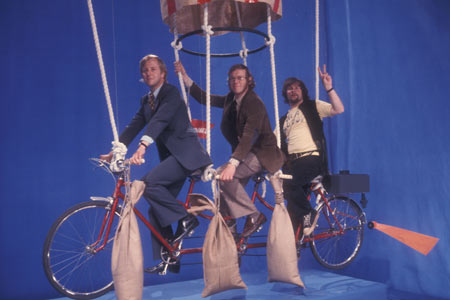
The Goodies on on a bicycle (‘trandem’)

Forty years ago this week (8 Nov 1970), three men on a bicycle (‘trandem’) careered into our comic TV world, promising to do ‘anything, anytime, anywhere’. One was posh right down to his Union Jack underpants, one was a middle-class technocrat concocting new inventions in his back room, and the third was a flat-capped son of honest toil with a penchant for aggression (before becoming a passionate twitcher and observer of all things natural in our back garden…).

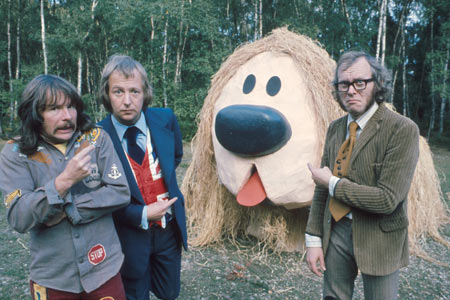
The Goodies being chased by a giant rampaging Dougal (from The Magic Roundabout).

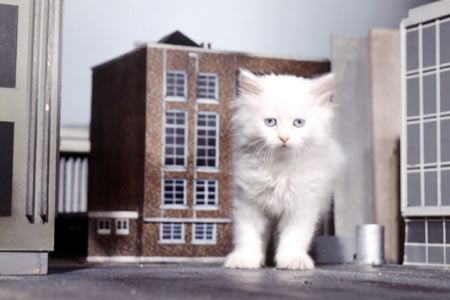
They were of course The Goodies! Can it really be 40 years ago they appeared for the first time? They came with a host of enduring, goofy, visually punning sketches – remember the trio chased by a giant rampaging Dougal (The Magic Roundabout was never ever the same again!), or by bomb-dropping geese, ‘ecky thump’ blood puddings, or when they turned delinquent on Skid Row, abandoned on the moon, and (ahead of its Who do you think you are? time) transformed themselves into their own ancestors: Keltic Kilty (Graeme) , Kinda Kinky (Bill) and Kountie Kutie (Tim)! And perhaps most memorable of all, in the episode ‘Kitten Kong’, where an enormous fluffy white kitten terrorised our cowering heroes.

A giant kitten on The Goodies set.

Kids loved it, adults loved. One poor viewer apparently thought they were so funny that he laughed himself to death! It also had the rare notoriety of being derided as ‘too childish’ by BBC executives, while being criticised by Mary Whitehouse for being ‘too sexually orientated’. The mind boggles!


And occasionally, they even strutted their stuff on Top of the Pops. ‘The Funky Gibbon’, written by Bill Oddie, propelled them into the charts and made them the 5th biggest grossing pop act of 1975.

So where did The Goodies come from? The trio had met at Cambridge University, contemporaries of Beyond the Fringe/Monty Python, and created their unique brand of humour, inspired by – in their own words – a mix of Buster Keaton, Mad Magazine, Bugs Bunny and Tom & Jerry. Whatever the case, America’s superman heroes were never ever to be the same again. They were now transformed into bumbling, class-befuddled, benign and oh-so English do-gooders. Amazingly, they lasted for ten years, and their influence still lingers today in The Mighty Boosh and We Are Klang, to name but two.

Can’t you still hear that theme tune: Goody goody yum yum..?

Robert Seatter is Head of BBC History

Listen to comedian Ross Noble's revist to The Goodies: Anything, Anywhere, Anytime and Pick of the Week on Radio 4 for a Goodies fix. You can also watch the Return of the Goodies on Saturday night on BBC Two.

BBC Trust publishes Licence Reviews

Blog comments are currently unavailable. Find out more.

Post categories:

Jana BennettJana Bennett|10:10 UK time, Monday, 8 November 2010

The BBC Trust has today published its Licence Reviews of BBC One, BBC Two and BBC Four, setting out the role and purpose of the channels for the next five years. These reviews are designed to ensure that the channels are delivering the BBC’s public purposes and providing audiences with the kind of programming they want and expect.


I have written to BBC staff today to explain the findings of the reviews and what they mean to us as programme makers. You can read my letter below. It also contains a link to the Trust reviews. The reviews show that the channels are performing very well but also give us a good indication of what we can do more of.


_____________________________________________

Dear all,

Today the BBC Trust has published its Licence Reviews of BBC One, BBC Two and BBC Four, setting out the role and purpose of the channels for the next five years. These form part of the Trust's regular reviews of all BBC services. As part of the process, we submit reports for each channel that analyse their performance against the Public Purposes and describe our strategy going forward. The BBC Trust also canvasses the views of licence fee payers and the wider industry. You can read the Trust's final conclusions here.

Today's announcements follow the publication of the Trust's interim findings in the summer, which strongly supported the direction of the channels and asked for more detailed plans in a few key areas. Since then, we have been working closely with the Trust, and the positive conclusions of today's report should be seen as an endorsement of the strength and ambition of our plans to deliver even greater quality and originality across our full range of programmes and content.

Overall, the Trust concludes that the BBC's TV portfolio is performing very strongly - on reach, quality and value for money measures, as well as playing a central role in delivery of the Public Purposes to audiences across the UK. The BBC's portfolio of television channels has increased both its reach and share over the past year, more than any other broadcaster. Our audiences tell us that BBC channels lead over other channels for their quality, originality and distinctiveness. Shows currently on-air like Strictly Come Dancing, The Trip, Getting On and Wallace and Gromit's World of Invention demonstrate this in practice. But there are a number of themes which are important to all of us.

Audiences continue to have a strong appetite for "fresh and new ideas" on television. This is a reflection of the TV industry more broadly - and expectations are rightly highest when it comes to the BBC. We will be taking the leading role in meeting audience expectations here by always aiming for the highest quality and distinctiveness.

The BBC's television portfolio is focusing on a number of areas:

• On BBC One, we will seek to bring even greater range and variety into peak, building on a very strong base - programmes like Sherlock, Bang Goes the Theory, Five Daughters and Outnumbered to name but a few.

• BBC Two will implement its plans in factual, drama and comedy to reaffirm its position as the mainstream, highly distinctive alternative to BBC One. Shows like Wonders of the Solar System, The Normans and Renaissance Revolution, plus new dramas like The Shadow Line, and comedies such as Whites and Rev are strong examples of how it will do this.

• BBC Four will seek to achieve even greater impact and credit for high quality, highly original pieces like the First Men in The Moon, The Secret Life of the National Grid and Michael Wood's Story of England, and the forthcoming series The Art of Germany.

• In Daytime we have already made great headway, and the Review acknowledges this and supports our plans for the future. We are introducing high quality current affairs and consumer journalism into the schedule with programmes like Rip Off Britain, Saints and Scroungers and Crimewatch Roadshow, alongside new dramas including Jimmy McGovern's Moving On and The Indian Doctor with Sanjeev Bhaskar. We will continue on this journey of refreshment to ensure our services offer the UK's most distinctive programming for daytime viewers.

• Across all of our programmes, we will seek to reflect the diversity of the UK's people, cultures, regions and communities back to our audiences, and work to provide value to all audience groups. The report reinforces the importance of our opt-out programming from the Nations and Regions - but challenges us to deliver even greater quality and impact for these programmes. 

I welcome the framework provided by the five year service licences for these channels, which sit alongside BBC Three's service licence agreed last year. They are an endorsement of our plans and creative ambitions for the next five years. Along with the certainty of an agreed licence fee settlement, they place our portfolio of television channels in a strong and positive position so that we can continue to produce the very best television services in the UK.


Jana Bennett is Director of BBC Vision



BBC Compliance Aids Film-Making

Blog comments are currently unavailable. Find out more.

Post categories:

Adam BarkerAdam Barker|15:14 UK time, Friday, 5 November 2010

Julian Hendy and his father, who feature in Why Did You Kill My Dad?

Julian Hendry and his father from Why Did You Kill My Dad?

There has been much debate recently about the effect that compliance procedures within the TV industry are having on film-making. Some film-makers have suggested that the BBC in particular has become risk averse, which seems an odd perspective to a dedicated commissioning team trying to bring challenging projects to the screen.

Before rushing to judgment, we should recognise how much more complex the compliance universe has become for everyone in recent years, with fast-evolving media law, increasingly empowered contributors and audiences, and the ever-increasing level of debate online.

In the face of this, the only way for the BBC to safeguard the future of quality documentaries is to ensure we can justify and defend every film we broadcast against the criticisms, complaints and legal actions that are increasingly common.

Earlier this year, I helped to bring to BBC Two a documentary called Why Did You Kill My Dad?, in which film-maker Julian Hendy explored the true scale of violence by the seriously mentally ill in Britain today. This was a deeply controversial film which challenged received opinion, and faced many serious challenges during production, including strong legal action. It was only the film-maker's level of journalistic skill combined with the expertise of the BBC Editorial Policy and Legal departments that allowed it to reach the screen.

Some film-makers appear to believe that it is the BBC which creates unnecessary compliance dilemmas. In fact, we are simply deploying the appropriate level of expertise to deal with an increasingly challenging landscape. However experienced you are, it is always good to ask whether you have got everything right and whether everyone in your film is being treated as carefully as they should be - and if in doubt, to get on the phone. The wealth of expertise and experience offered by the BBC's executive producers, and the advisory teams who support them, is there to help you - we want you to draw on it.

Adam Barker is Commissioning Executive, BBC Knowledge

Adam Barker will be appearing in the compliance debate, Age Of Consent, at Sheffield International Documentary Festival on November 6.

The festival runs from 3-7 November with BBC delegates in attendance including Controller of BBC One, Danny Cohen and Controller of BBC4, Richard Klein.

Read Director of Editorial Policy, David Jordan's blog post on the new edition of the BBC Editorial Guidelines.

Mark Thompson on Industrial Action by NUJ

Blog comments are currently unavailable. Find out more.

Post categories:

Mark ThompsonMark Thompson|06:00 UK time, Friday, 5 November 2010

The National Union of Journalists has called a 48 hour strike of BBC journalists for Friday and Saturday. Much of the output of the BBC is unaffected by this action. However, it is inevitable that some programmes and content will be disrupted. I would like to apologise wholeheartedly for this and assure you that we are doing everything we can to bring you as much as possible of our usual programming.

We will provide regular updates on-air and at www.bbc.co.uk/pressoffice of programmes that are affected.


I would like to explain how we reached this position. The strike is about changes to our pension scheme, changes which have been accepted by the majority of unions. These changes were necessary to deal with a pension deficit which, like many other schemes, is due to the performance of financial markets and the fact that people are living longer.


We first put forward initial proposals to change the BBC Pension Scheme in June. (You can read more on the reasons why changes are needed in a blog by Zarin Patel, Chief Financial Officer). Since then, we have consulted and listened to staff, and brought in changes to our proposals as a result.


We have made clear this is our final offer and that we can make no more changes without imposing an unacceptable burden on Licence Fee payers.


Four out of the five unions have accepted our revised offer, and this is also reflected in feedback from staff. The NUJ alone, which represents 17% of staff, have voted to reject the offer and go on strike. We do not know how many NUJ members voted to reject the agreement in the consultative ballot but it was almost certainly a minority of the total NUJ membership - and certainly a very small percentage of the BBC workforce as a whole.


It has never been more important to ensure the BBC is spending every penny of Licence Fee payers money wisely and delivering the quality programmes and services audiences want. We believe the current pension proposals are realistic and affordable, and will provide fair pension provision for BBC staff for the future.


This has been a difficult period for staff. However, the people who lose out most in any strike action are the very people we are here to serve - our audiences. Again, I apologise for the disruption. We will do everything in our power to bring you as much as possible of our usual programming and services.


Mark Thompson is BBC Director-General

The BBC Press Office website will be publishing regular service announcements and statements about the NUJ industrial action.

You can also follow the @bbcpress and @AboutTheBBC Twitter feeds for updates.

BBC One HD Launch Tonight

Blog comments are currently unavailable. Find out more.

Post categories:

Laura MurrayLaura Murray|21:27 UK time, Wednesday, 3 November 2010

The One Show hosts, Jason Manford and Alex Jones

The BBC One HD channel launched with the One Show at 7pm this evening.

Watch this specially made short video, featuring Danielle Nagler, the head of BBC HD inside the BBC One control room, where the channels are broadcast.

There is also a helpful BBC One HD FAQs page.


Laura Murray is Editor of About the BBC Blog

Children at the Heart of the BBC's Mission

Blog comments are currently unavailable. Find out more.

Post categories:

Joe GodwinJoe Godwin|15:17 UK time, Tuesday, 2 November 2010

Children's character Andy Pandy

It’s sixty years since the BBC created its children’s department, under its first Head Frieda Lingstrom, the legendary creator of Andy Pandy and Bill and Ben. The BBC had made radio programmes for children since the twenties, and TV programmes since the television service resumed after the war. But 1950 was the moment the BBC realized that the youngest audience were not just shorter than everyone else, but also had their own needs and tastes. The ambition was to create a BBC TV schedule in miniature, with every genre represented, tailored for children. And in that sense nothing much has changed.


I’ve been Director of BBC Children’s for a year now although I’ve worked in children’s programmes for over 20.

BBC Children’s today has a very simple mission: to create unforgettable content to inspire all children across the UK – it’s not really any different from the vision of the founders of the BBC Children’s department 60 years ago – but achieving that vision is made more complicated by radically different economic, competitive and technological landscapes – and audience behaviours.


I believe that high quality television and great web content can help shape the lives of children; providing role models who can help them develop into useful and active citizens, and helping them navigate being a child in 21st century Britain.


For children today this is undoubtedly the best of times on television - with over 30 dedicated children's TV channels in the UK alone. But that explosion of choice can hide the problem with the real degree of choice that children have in their media diets. I do think Disney and Nickelodeon make programmes of the highest quality which children devour in huge numbers but children need factual programmes that equip them to grow up in the UK, and they need challenging dramas that help them explore their emotional development, and see the lives of their communities onscreen.


The children's industry is facing an enormous paradox: an apparent plethora of media choices for kids versus a shrinking economy with limited ability to create indigenous content.


If children have more choice than ever, and choose to ignore the BBC, we have no influence, and I believe our influence is essential and good. To give children the benefit of our content, we have to make it attractive to them. It’s another reason as well to stick with the goal of our founding mothers - to create broad multi-genre schedules for children – full of programmes that help children be themselves, to relax and play, and to learn and explore. And by having mixed schedules from comedy and entertainment through to tough factual programming, we increase our chances of someone who feels they’re not interested in the latter stumbling across it, and discovering that they do like it.

Characters from CBBC'S Horrible Histories

It’s a creative challenge but who would have thought that one of the most popular and talked about shows on any children’s channel in 2010 is about history (Horrible Histories)? Who could have imagined that the most watched drama on any children’s channel is based on British books about a young girl in the care system (Tracy Beaker Returns)? And who would guess that programmes about dealing with bereavement, bullying or protecting yourself online would be getting kids across the UK talking (Newsround specials).


Its an exciting time for BBC Children's - this year, for the first time I can remember, the BBC publicly stated that Children’s was one of it's five core priorities and we have been given more resources than ever before. And, next year, I shall be leading the children’s department on one of its biggest adventures to date, when we move to a new home on the banks of the Manchester ship canal.


Much will change but whatever the platform or the technology, content in the form of stimulating storytelling and inspiring information will remain king, whether the BBC makes it, independent companies make it – or perhaps not so fancifully, whether children themselves make it with us. And, for us, that content will always be distinctive UK content.


Joe Godwin is the Director of BBC Children's


You can read the speech that Joe Godwin gave at Monday's Voice of the Listener & Viewer conference
on the Press Office website.

BBC Head of History, Robert Seatter, blogs about Andy Pandy's 60th birthday.

Read Director of the North, Peter Salmon's blog posts for more about the BBC's move to Salford Quays.


Laura Murray is Editor of About the BBC Blog

BBC Internet Blog - BBC ONE HD: test transmissions

Post categories:

Laura MurrayLaura Murray|14:29 UK time, Tuesday, 2 November 2010

"So... many of you have found the test transmissions!


I've also noticed there's been a lot of speculation about what we are up to for the last few days and we thought it would be a good idea to let you know what's been happening and will be happening before BBC One HD launches on Wednesday".


Andy Quested, Head of Technology for BBC HD & 3D, BBC Future Media & Technology, has blogged today ahead of this week's BBC One HD launch. You can read the blog in full and comment, on the BBC Internet Blog.


Laura Murray is Editor of the About the BBC Blog

Radio Blog - Three evenings of joy at The Roundhouse

Post categories:

Laura MurrayLaura Murray|09:09 UK time, Tuesday, 2 November 2010

"I woke up on a high this morning. As well as Liverpool fighting their way out of the relegation zone, I experienced three amazing gigs at the BBC Radio 2 Electric Proms on Thursday, Friday and Saturday. Three iconic Radio 2 artists. Three very different, but equally ecstatic, audiences".


Bob Shennan, Controller of BBC Radio 2 and 6 Music has blogged about this experience at the BBC Radio 2 Electric Proms. To read the blog in full and to make a comment, head over to the Radio Blog.

Jeff Smith, the Head of Music at Radio 2 and 6 Music, has also blogged about the Radio 2 Electric Proms, join in the discussion.

Laura Murray is Editor of the About the BBC blog

BBC Internet Blog - Changing how BBC Online works with suppliers

Post categories:

Laura MurrayLaura Murray|08:32 UK time, Monday, 1 November 2010

"As outlined in March’s Strategy Review, there are changes coming for BBC Online. A proposed 25% cut in spend by 2013, and a rationalisation of 400 websites to make way for fewer, clearly-defined, products will impact audiences and the BBC itself.

External suppliers to BBC Online, critical to the success of the service, will naturally be thinking about what this means for them, and it’s important that we are clear".

Jonathan Kingsbury, Head of External Supply for BBC Future Media & Technology

To read Jonathan's blog post in full and to leave a comment, head over to the BBC Internet Blog.

Laura Murray is Editor of the About the BBC Blog

About this blog

Senior staff and experts from across the organisation use this blog to talk about what's happening inside the BBC. We also highlight and link to some of the debates happening on other blogs and online spaces inside and outside the corporation.

Here are some tips for taking part.

This blog is edited by Jon Jacob.

Subscribe to this blog

You can stay up to date with About the BBC via these feeds.

If you aren't sure what RSS is you'll find our beginner's guide to RSS useful.

[an error occurred while processing this directive]

Follow this blog

Other BBC blogs

More from this blog...

Categories

These are some of the popular topics this blog covers.