The Blue Light Day Blog
When emergencies happen, how often do we stop to say thank you to those who put themselves in the line of danger and to save lives?
That's why BBC Radio 5 live held Blue Light Day: an in-depth look at the emergency services around the UK, examining how workers cope with front line pressures, and giving an opportunity to the audience to share their experiences.
We spoke to Geoff Ho, a heroic survivor of the London Bridge terror attack, and Alistair Rennie, a trauma doctor who faced the shift from hell on the night of the Manchester Arena bombing.
'We wouldn’t be here without the emergency services'
Journalist Geoff Ho was stabbed in the neck during the London Bridge terror attack as he tried to protect his friends.
The terrorists that attacked London Bridge tried to destroy lives but, at least in my case, they failed completely as I have never been happier.
I’m grateful because all of my friends in Borough Market and London Bridge are safe, sound and are getting on with their lives. The events of June 3rd have brought everyone else in the Market area even closer together. The same applies to my family and friends; we’ve never been closer.
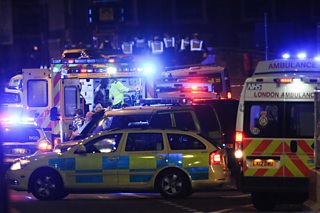
Members of the emergency services attend the terror attack on London Bridge.
My enforced absence from work meant that when I returned, I did so with a renewed passion and enthusiasm for journalism - my career for the past 20 years.
With the support and love of my partner, I can honestly say that every day has been better than the last - even the ones where she won’t let me watch Star Trek, football or the boxing!
It’s taking time but every day I’m getting fitter and stronger. I’m not quite back to the level I was at before the attacks, but I’m getting there. The other day in I sparred against someone in kickboxing for the first time in months and it felt great!
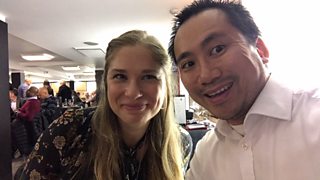
Geoff and his partner Cécile. They were only friends before the attack…they realised they couldn’t live without each other
The satisfaction you get from being able to do something you love again after an enforced break is overwhelming.
I owe so many people a debt of gratitude that I will never be able to properly repay. The men and women of the Metropolitan Police, British Transport Police and London Ambulance Service, the Royal London Hospital and the other NHS hospitals that treated victims, all of them are heroes.
I am especially grateful to people like Sam, Adam and the other doctors, nurses, paramedics and police officers that were on their night off but still ran towards danger to help out people like me and my friends. We wouldn’t be here without them.
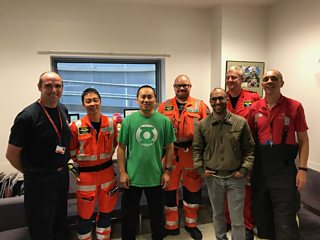
Geoff and his friend Azeem with the crew of the London Air Ambulance
'No amount of reading or exercising can prepare you'
Alistair Rennie is a Trauma doctor at Manchester Royal Infirmary. He was on shift the night of the Manchester Arena bombing.
Monday 22nd May 2017 was just a kind of normal Monday. I’d arrived at work as usual about 11.30 and been through my notes for my weekly major trauma case reviews, and then had a meeting about the new Trust helipad. After that I met the organisers of Parklife to review their plans for the upcoming weekend festival and how it might impact on us here at MRI - both flow and in case a major incident occurred at the site. I then started my clinical shift at 4pm and was due to be on the shop floor until about midnight and then on-call.
It was a typical Monday evening – bedlam, with lots of ill patients and a more coming, but that’s the reality of why Emergency Medicine is for me, and why it remains a fabulous career choice.
About 22.40, two GMP officers calmly asked if I could send every ambulance to the Arena as an incident had occurred. I retorted that I didn’t run the ambulance service, but when they promptly left I got a rather sick feeling. Strangely, as they walked out, I just said "be safe".
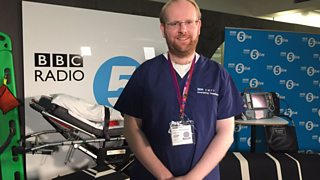
Alistair Rennie - Consultant in Emergency Medicine at Manchester Royal Infirmary
After quickly phoning the ambulance service I got the news that no-one ever really wants at work - an explosion at the Arena, with multiple casualties with multiple injuries. I immediately activated our Trust Major Incident plan and started to prep the department to receive casualties.
Whilst I’ve done lots of exercises and scenarios to test this very process, nothing makes your stomach tighten like actually having to do it for real. The nurses and porters were amazing as patients just disappeared into the hospital to create space to receive those from the Arena.
Normal teaching would indicate that the first seriously injured would arrive about an hour after the incident, but our first arrived in a Police Fiesta several minutes later with a hole in her neck where a projectile had gone! No amount of reading or exercising prepares you for that.
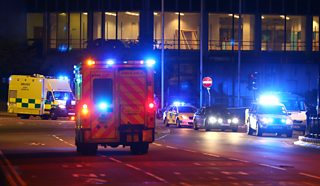
Emergency services arrive close to the Manchester Arena, in early hours of May 23rd 2017.
Within 20 minutes I had help from my fellow off-duty consultant colleagues who had arrived and helped to prepare and then actually see the injured, in conjunction with specialists from across the hospital. I then headed to the Trust Incident Control Centre, where I undertook the role of Senior Emergency Physician for the entire night.
I was responsible for the reception and treatment given to all of the casualties that attended both the MRI and RMCH that night, which was over 60 patients, including parents and children which we kept together in the paediatric ward.
I was at work until about 11am the following morning, having handed over an almost empty emergency department but a bustling and focussed hospital site.
When I finally got home, tiredness was not allowed to kick in as my two-year-old daughter just ran down the garden shouting ‘Daddy, Daddy, Daddy’. A feeling that was indescribable having just had one of my most difficult work days, but a blessing, as it allowed me to focus and enjoy my family, rather than relive the night.
Even now, 6 months on, that child running down the grass if a source of pride and solace for me, given that so many others did not have that feeling of joy and happiness that morning.
Your Stories
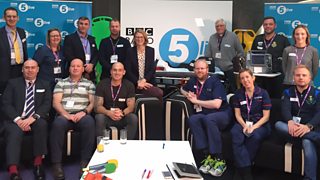
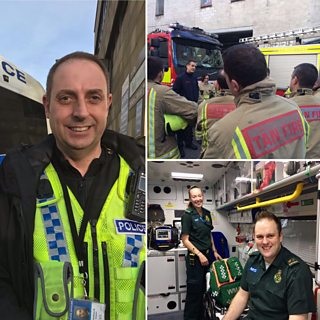
Emergency service workers from across the UK took part in a special edition of Your Call.
We heard your stories all day, on air and on social media. Here are just a few of the fantastic responses we received.
