Archives for October 2010

Business Doctor: Emma Jones

Blog comments are currently unavailable. Find out more.

Post categories:

Katie Prescott|16:01 UK time, Thursday, 28 October 2010

Business Doctor, Emma Jones

Each week, a specialist in a business subject joins us in the studio for 5 live's On The Money to answer your business questions. Emma Jones, founder of Enterprise Nation answers your questions on running a business from home.

I have registered my businesses name with Companies House to protect it, set up a website, have a business logo and am starting to win work. Is it important to patent your business name and logo? At what point would you advise changing the business from a sole trader to a registered company? - Nick

Hi Nick

If you have made these moves in terms of registering the company name and having the name as your website address, you are pretty well protected. Patents are more to protect ideas and innovations but you might like to apply for a trade mark as these are designed to protect symbols such as brand names and logos. You can find out more about how to apply and protect your trade mark here

In terms of changing from sole trader to limited company status, there are a few issues to consider such as taxation, the state of the business's records and whether the business wants limited liability, etc. My advice would be to talk to an accountant on this point.

Do you have any tips on fighting the equivalent of "writers block", i.e. when you have been looking at or working on a single project of your own, whether out of working hours or even full time, for so long that it come to the point or points where you cannot bear to look at it! - Rob

Hi Rob

My advice is, and hope you take this in the right way, get out and about! Go talk to people about your idea; make direct contact with people who you feel have the skills and experience to help shape and develop it and mix this up with some informal networking at business events and shows. When you talk to people about your project and have them contribute, it will bring the project back to life and hopefully spark your passion for it once again!

I am going to start a home business, even though I won't have a big enough turnover to be obliged to register for vat, I think it might be a good idea to register anyway. I have bought various items over the last 12 months. Can I back-date my vat registration in order to claim back the vat on these items? - Dave, Coventry

Hi Dave

You can generally reclaim VAT on goods purchased up to 4 years before you register for VAT. For services bought, this is six months before registering that you can reclaim amounts. There is a condition though that you do have to keep good records of purchasers and how they were used. You can read a guide on this very topic here


I work for civil service so have to be careful about setting up business - as it could be conflict of interest. However, is the net still the way forward or is face to face business the way to go? Is it best to be sole trader or ltd company? Should I become Vat registered? -RS ,Staffordshire

Hello RS

Yes, if you are holding down your day job and 'Working 5 to 9' ie building a business at night and weekends, I would suggest an online business is a good way to go. That way, the business can be working (and earning money!) whilst you're at work. It's never been so easy to have an online presence, whether through a blog or website, and both can be built at low cost and without much technical knowledge. You can then make the most of social media like Twitter, Facebook and LinkedIn to promote your site and attract attention.

On the question of sole trader or limited company, I suggest you take advice from a qualified accountant. Being a sole trader means you keep all the profits and are solely liable for any debts whereas limited companies exist in their own right, with the company's finances distinct from the owners finances. Speak to an accountant to find out the structure that best suits your business.

And should you become VAT registered? If your turnover of VAT taxable goods and services for the previous 12 months is more than £70,000 (registration threshold for current tax year), or you expect it to go over this figure in the next 30 days, you must register for VAT. If your turnover is below £70,000, you may still decide to register for VAT. Being VAT registered can give your business credibility with certain customers and when you charge VAT, you can claim back the VAT you've already paid, which may result in a credit. On the other hand, if you include VAT in your pricing, it may make you more expensive than your competitors and you'll have to submit a VAT return four times a year which adds to your admin 'to do' list.

What advice does Emma have for a home based business with a not very businesslike address ie. Bluebell Cottage? How do you circumvent without a PO Box? Jools

Hi Jools

If you would rather not promote your home address as the business address, you can opt for a virtual office. This entitles you to use a business sounding address and the virtual office operator will either send post on to you, or you can pick it up if your virtual office is close by. Companies who provide this service include Regus, Mail Boxes Etc and EOffice.

On The Money goes out on 5 live between 8 and 9pm every Sunday night

5 live's Rajar Figures Quarter 3 2010

Blog comments are currently unavailable. Find out more.

Post categories:

Adrian Van-KlaverenAdrian Van-Klaveren|09:23 UK time, Thursday, 28 October 2010

Our latest listening figures are out today and they show 5 live has a weekly audience of 6.3 million and a 4.7% share of listening. Rajar figures for 5 live are always seasonal and affected by major events so not surprisingly we have dropped from our all-time record figures of the last quarter (helped by the World Cup and the General Election) and from this time last year which included England's triumph in the Ashes.

This quarter has been a bit less dramatic (it included only the closing stages of the World Cup after England had been knocked out and flown home) but what's most encouraging is that we once again have more than six million listeners a week. This is the seventh successive quarter we've been above the six million mark showing that long-term we are steadily building our audience.

One very encouraging number is that people are listening to us for longer - for an average of 7 hours and 53 minutes per week - that's half an hour per week longer than last quarter and 13 minutes a week longer than this time last year. All of our weekday programmes are performing above the long-term slot average suggesting the new schedule is bedding in well although, as I've said before, we need to give these programmes at least a year to settle down.

5 live Sports Extra has gained 100,000 listeners on the quarter although not surprisingly down on the same time last year, given the cricket coverage in that period. On both 5 live and 5 live Sports Extra, we've got lots coming up between now and the end of the year including of course the fullest coverage of England's efforts to retain the Ashes in Australia. We'll be continuing our detailed, close-up coverage of the spending cuts and their impact, there'll be a special week of programmes in early December looking at what the family means in the UK nowadays and of course we'll continue to bring you more live football than you'll hear anywhere else.

Related Links

RAJAR - official site with all press releases

Adrian Van Klaveren at the Radio Festival

Blog comments are currently unavailable. Find out more.

Nigel SmithNigel Smith|10:50 UK time, Wednesday, 27 October 2010

Last week the UK radio industry's great and good gathered in Salford, 5 live's future home, for the Radio Academy's annual Festival.

As part of the Meet the Controller sessions the Guardian's Matt Wells interviewed our boss Adrian Van Klaveren. Here are two clips from the event.

What will 5 live sound like in Salford?

In order to see this content you need to have both Javascript enabled and Flash installed. Visit BBC Webwise for full instructions. If you're reading via RSS, you'll need to visit the blog to access this content.

"The most democratic national station"

In order to see this content you need to have both Javascript enabled and Flash installed. Visit BBC Webwise for full instructions. If you're reading via RSS, you'll need to visit the blog to access this content.

Related Blog Posts

Questions for the Controller

Your Questions Answered

Related Links

The Radio Academy

Steph's Sunday Shift: Samworth Brothers Sandwiches

Blog comments are currently unavailable. Find out more.

Post categories:

Steph McGovernSteph McGovern|06:47 UK time, Wednesday, 27 October 2010

Each week on 5 live's On The Money, Declan Curry sends me to do a Sunday shift in a business that doesn't follow a typical 9-5. This week I spent the afternoon at the Samworth Brothers bakery in Melton Mowbray.

Here's my report from this week's programme:

In order to see this content you need to have both Javascript enabled and Flash installed. Visit BBC Webwise for full instructions. If you're reading via RSS, you'll need to visit the blog to access this content.

Do you have suggestions for other Sunday shifts? If so, please leave a comment below.

On The Money goes out between 8 - 9pm on Sunday nights on 5 live.

Related links

On the Money

Drive at the Midterms

Blog comments are currently unavailable. Find out more.

Aaron Eccles|17:45 UK time, Tuesday, 26 October 2010

Americans go to the polls next week in elections that could see President Obama's Democrats lose control of both the Senate and the House of Representatives. That's right, it's time for the midterms. Thirty-seven US Senate seats, 37 governorships and all 435 House of Representatives seats will be up for grabs on 2 November. Of course, President Obama's name isn't on any of the ballots, but polls suggest voters plan to send him a message by booting dozens of his party colleagues out of office.

To help explain some of the headlines, Drive will be coming live from Florida for two days next week. Not only is it a key battleground state that can decide a Presidential election (and has on many occasions), it has all the makings of a political soap opera playing out at state level.

In 2008, Florida narrowly voted Democrat and helped secure President Obama's victory. But since then the economy has been suffering. Figures from September show the state has an 11.8% unemployment rate. The housing market still hasn't recovered from the sub-prime mortgage crisis. Seventy-five houses are repossessed every day. And even though only a small amount of oil from the BP disaster actually reached Florida's shores, the perception that coastal waters and beaches are polluted kept tourists and their dollars away in droves this year. All of this has resulted in a great deal of voter anger and a disapproval rating for President Obama in Florida which is hovering around the 51% mark.

It's a perfect place for the Tea Party to flourish. Tea Partiers believe in lower taxes, balanced budgets and reduced spending. The movement sprung up in the aftermath of Obama's election and has gathered steam as anger grows about his administration's health care reforms and financial stimulus package. It was Tea Party support that secured Marco Rubio the Republican nomination for the senate in Florida.

He beat the favourite candidate, the moderate Republican governor Charlie Crist, who is now running as an independent. Mr Rubio is now being dubbed the Republican Obama. He's a young, conservative Cuban American with relatively little political experience. Since getting his party's nod, he's been leading the polls and appearing at campaign rallies with Tea Party sweetheart Sarah Palin. And with Democrat Senate contender Kendrick Meek still hoping for an upset, you have a three-way race that looks set to be one of the most interesting stories in this election.

Next Tuesday and Wednesday, Aasmah Mir will be co-presenting Drive from Miami. She'll be talking to campaigners and voters from across the state. And she'll try to get a sense of why so many of President Obama's supporters in 2008 seem to have turned against him in 2010.

Related Links

Drive - best bits and a week of programmes on iPlayer

US Midterms - full coverage of News Online

Aaron Eccles is a journalist on 5 live Drive

Steph's Sunday Shift: Caludon Centre

Blog comments are currently unavailable. Find out more.

Post categories:

Steph McGovernSteph McGovern|14:48 UK time, Tuesday, 26 October 2010

Each week on 5 live's On The Money, Declan Curry sends me to do a Sunday shift in a business that doesn't follow a typical 9-5. Last week I spent the afternoon at the Caludon Centre - the mental health section of the Coventry and Warwickshire NHS Trust.

Here's my report from this week's programme.

In order to see this content you need to have both Javascript enabled and Flash installed. Visit BBC Webwise for full instructions. If you're reading via RSS, you'll need to visit the blog to access this content.

Do you have suggestions for other Sunday shifts? If so, please leave a comment below.

On The Money goes out between 8 - 9pm on Sunday nights on 5 live.

Related links

On the Money

5 live Breakfast - Covering the Cuts

Blog comments are currently unavailable. Find out more.

Post categories:

Scott Solder|12:45 UK time, Wednesday, 20 October 2010

5 live Breakfast is going to be an extra big production on Thursday morning.

We'll be coming to you from a series of live locations around the UK - bringing you reaction and analysis as people begin to absorb the impact of the spending review.

Nicky Campbell will be at the heart of the civil service, in Whitehall. Shelagh Fogarty will be broadcasting from a fire station in Leeds.

James Shaw is in Glasgow with the outlook for Scotland, Mark Hutchings is at a hospital in Cardiff and 5 live's Stephen Nolan - normally one of our evening presenters - will be reporting live from central Belfast.

We also have Stephen Chittenden in Norwich, Nick Garnett with public sector workers in Morpeth - and Andy Verity in the City of London with reaction from the financial markets.

From 10, it's 'Your Call' - your turn to go on air to give Nicky your reaction to the spending review. It's going to be a big, ambitious show - and we're aiming to connect people across the UK as we all get to grips with the biggest public spending cuts since Word War II.

Before all that, don't forget 5 live's comprehensive coverage of the spending review announcement itself today. Victoria Derbyshire is at Westminster. She'll be joined by politicians, experts and 5 live listeners - and, of course, she'll also be crossing to the Commons chamber to hear the Chancellor's statement.

Big outside broadcasts like this are the hallmark of 5 live. They're a large part of what makes us distinctive - and they put us in touch with people on the ground so that our audience can have first hand experience of what people at the centre of news stories really think and feel about what's going on.

Related Links

Spending Review - detailed coverage from BBC News Online

Scott Solder is the Editor of 5 live Breakfast

Business Doctor: Clive Lewis, Head of Enterprise at the ICAEW

Blog comments are currently unavailable. Find out more.

Post categories:

Katie Prescott|12:10 UK time, Wednesday, 20 October 2010

Clive Lewis - Head of Enterprise at the ICAEW

Each week, a specialist in a business subject joins us in the studio for 5 live's On The Money to answer your business questions. Clive Lewis is Head of Enterprise at the Institute of Accounting. He's been answering your questions about balancing your books.

Can you repeat the "turnover is vanity" mantra? Nic in london

Turnover is vanity, profit is sanity, cashflow is reality

Another one which is pretty enduring is "Cash is King"


Any advice on start up funding please? I have equipment to put into a business but no cash for advertising etc. Danny in Hertfordshire

If the equipment has a resalable value, I suggest trying an approach to a Finance company to see if they will consider a sale and leaseback of the equipment. The Asset Based Finance Association is a good starting point.

Otherwise in the event that a normal loan from a bank is not an option the following alternative sources of finance and or grants might be possible.

Friends and / or family - a friend or family member particularly one with experience of running a business might be prepared to lend you the money. But you need to draw up a written agreement specifying when the loan will be repaid and any interest payable.

Many early stage business people use their Credit Card to fund expenses - items such as travel, stationery, petrol can be purchased on credit cards which, provided the debt is controlled, is a good way to fund the early stages of a business, although interest charges can be relatively high

Another alternative which might be an option for you is to join a Credit Union. The Association of British Credit Unions (ABCUL) website provides information regarding their members and their services. Some of the larger Credit Unions offer current account facilities. If you live in an area served by one of these credit unions you might be able to avail yourself of their facilities. If you are able to save with a credit union (usually for a period of at least 3 months) you might then be able to access their lending facilities.

Finally there is advice on raising business finance through the businesslink.gov.uk website. For detailed help go to www.businesslink.gov.uk. Apart from offering advice on raising finance Business Link offer help with starting a business, as well as helping start-up businesses to access grants. The Businesslink.gov website gives details of how to find your local Business Link office.


Hi, I have set up a new business only 9 days ago, a Recruitment Business called Stanton House. What advice can you offer for sourcing cost effective advice from experienced and successful small business owners? Many thanks, Nick Eaves

There are a number of business organisations which hold events which are excellent opportunity to network with other business people. These include

Federation of Small Business (FSB)

British Chambers of Commerce

Forum of Private Business

They all charge for membership but I'm sure you could attend a few events to see what they offer and whether their membership provides good networking opportunities.

I don't know if you have got an accountant. If not I think many chartered accountants offer sound advice based on their experience of running their business and of talking to clients from a range of business sectors. If you need to find a chartered accountant go to, visit the ICAEW.

The biggest obstacle most entrepreneurs face is lack of funds. What's your advice on overcoming it? Mo from London

This is such a wide topic and I do not know anything about your business, stage of development or your particular problems with a lack of funds. So the following can only be very general.

Cash is King

When making business decisions always think what the cash implications of it will be. Got a new customer who wants to pay in 30 days? Can you afford the investment in working capital? If it is doubtful either turn the order down or try an alternative like a discount for immediate payment.

Need an asset - think about buying on credit.

Buying on hire purchase or leasing gets you the asset but payment id deferred to extend over its useful life.

Think about your credit rating

If you have a bank account think that they use behavioural scoring so going into an unauthorised overdraft can mean a future application for credit will be refused. Paying suppliers late can also damage your credit rating.

Always know your bank balance and try to anticipate future cash difficulties

A simple spreadsheet can be used to do a cashflow forecast. But you need to keep it up to date.

Talk to your bank about what they can do for you.

Banks try to be helpful and knowing your relationship manager and having a regular conversation about your business progress is vital.

Talk to your accountant

Accountants see a wide range of businesses and generally are aware of what the local banks might offer. They can offer advice and help prepare cashflow forecasts or business plans.

Some business is good for cashflow and some may not be.

Be aware of the customers or products which are good cash generators and those that are not.

There's a lot more information on the Business Link.gov website Finance & Grants page

On The Money goes out on 5 live between 8 and 9pm every Sunday night

Wittertainment's Cinema Code of Conduct

Blog comments are currently unavailable. Find out more.

Post categories:

David Braithwaite|15:38 UK time, Friday, 15 October 2010

In this week's edition of Mark and Simon's film review programme Dr Mayo suggested cinemas should adopt a Code of Conduct. Mark agreed and his initial rules were no kicking, no talking and no texting.

This prompted a load of texts and emails from listeners. Here's a selection of what came in today. Have a look and leave a comment to suggest your own and we'll discuss further in future shows.

First the emails...

My rule would be no Brit should have to watch a film in the States. On holiday many years ago my wife and I saw went to see Indecent Proposal in a small cinema near Lake Tahoe. Maybe O'm being unfair but all the locals talked throughout the movie and mainly due to needing to explain to their partners was happening. It wasn't the most complicated film and I really couldn't see the need.

Rob from Bewdley

In relation to your list of cinema dos and don'ts, how about a ban on the person sitting next to you fidgeting impatiently because you aren't responding to the film in the way he thinks you should be? Could read "No exasperated gasping at the other spectators".

Dr Linda Ruth Williams

People should not be allowed in late. It is bad enough when they disturb the audience to reach their seat during the trailers, which for me are an integral part of the cinema going experience. But to walk in after the main feature has started is unforgiveable. Cinemas should not allow anyone in after the film has started, just as they are supposed to do in the theatre.

Dawn, Chelmsford

No burritos. Once I arranged to meet my girlfriend in the cinema and would sort us out something to eat as we hadn't had any tea. I usually smuggle in chocolate peanuts and bottled fizzy drink. However this time I was in a rush and the first thing I spotted was the local burrito takeaway... I couldn't wait to see the delight on my girlfriend's face as I fulfilled my male hunter gatherer responsibilities. Once sat down the look of delight soon turned into a look of horror as I passed her a hot, steamy burrito wrapped in tin foil. I can only imagine what the people behind me were thinking as I was concentrating too hard on trying to eat a burrito wrapped in tin foil quietly, without spilling. But the worst thing must have been the hot, meaty smell which was terrorising the people sat near us. Even though the burrito was rather tasty we only managed to eat half of it and at that point I vowed never to take hot food into the cinema again.

Steve Worsley BSc Computer Science, Grade 1 in drums

No snoring. Before becoming expats in the land of cuckoo clocks and chocolate Huffy and I would frequent the wonderful Picture House in Exeter. No matter what film or what showing (even the 11am showing of Creature of the Black Lagoon 3D) there would be a snorer. I could understand it in Titanic but not Creature. At our local IMAX (Verkehrhaus Luzern) they have a little trailer in German about cinema etiquette at the end of the list of no eating, talking, using mobiles it says "Kissen ist nicht Verboten, naturalich" (kissing is not forbidden, of course) followed by two frogs kissing which is course followed by the lots of loud lip action and giggling and from my kids (ahh mum do you have to!) but then it goes nicely quiet. This could be that the Swiss are polite rule abiding people or that they know that they will get an intermission , yes, an intermission right in the middle of the film with no care for suspense of the film.

Mandy, Switzerland


I live in Warsaw in Poland and we do have cinemas with bigger sits, or more specifically, screens with large, first class-like leather chairs. It is enormously comfortable to be able to watch a movie without anyone disturbing you with kicking etc. Sure, tickets are about 30% more expensive, but that guarantees that only movie fans will be in the audience and a movie fan understands that you are not supposed to tweet, talk or eat loudly during a showing of a movie, so it is a win-win situation.


Luke Rudnicki

And now the texts...

No slurping drinks - Dave Jones, Bristol

No laser pens, any transgression may result in the offender being force fed the same pen. - Dan (Tyneside Cinema regular )

No sitting in front of people if you're tall... No saying "what was it he was in?" and no singing along with the Pearl & Dean tune, and no saying how much Revels are in Tesco. - Jade

No pretentious guffaws at poor lines of dialogue - Jonathan in Sheffield

No shaking of ice cubes when at the bottom of your drink. - Max the Axe

Zero tolerance of people taking off there shoes and making other members of the audience endure their foot odour! - Neil in Guildford

No Knitting. - David Sower. Bromley, Kent.

So, what are your suggestions?

UPDATE - Friday 3 December

You can now watch the Code of Conduct in spectacular Witter-vision on the Kermode Uncut blog.

Related links

Mark & Simon's Film Review Podcast

Kermode & Mayo's Film Reviews website - full archive of reviews

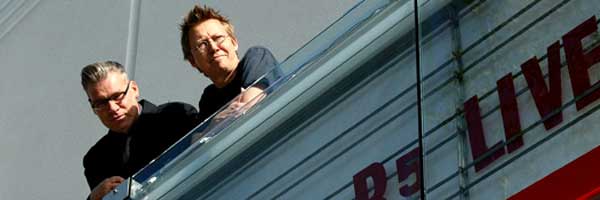
Live streaming viewers may know David Braithwaite as one of the gentlemen peering into the studio from the production booth each week.

Putting together a live video outside broadcast

Blog comments are currently unavailable. Find out more.

Post categories:

Alex Murray|16:38 UK time, Thursday, 14 October 2010

The words "...and you can watch it live on the website." is something you've probably heard a lot of recently. It always marks an important moment in the life of an Outside Broadcast (OB) for the interactive team. It means:

  • a. The live video stream is working
  • b. Nobody/nothing has been accidentally set on fire so far
  • c. Someone has remembered to tell the presenter and guests that the online audience can see them

To the best of my knowledge, no one was set on fire in the course of Friday's live Wittertainment and the live stream worked for viewers in the UK.

Getting video live from almost anywhere in the UK for two hours takes a fair amount of planning. Sometimes we get several weeks notice, others it will be less than a day. We do this often enough that we've built up a pretty clear workflow to follow. It involves asking a lot of questions and finding answers.

  • Can we get a suitable connection from the venue?
  • Do they know we're coming?
  • Is it a safe working environment?
  • What equipment will we need to ensure that the end product looks good?

Some of those might seem like stupid questions, but no one ever lost money by over-estimating the potential for stupidity to cause disaster.

Can we get a suitable connection from the venue?

To stream video we need to be sure that we can get an upload speed of at least 512Kbps to ensure that when we push the video content up the pipe, the audience don't see the spinning wheel of death on our account. We've worked on building our relationship with the Broadcast Operations team so that our dedicated ADSL connection is ordered at the same time that they order the ISDN lines for the radio broadcast.

We're also reliant on them for the sound to go with our pictures and their experience at OBs is not just a calming presence but also a handy pool of knowledge to draw on when don't have the right cable connector or are trying to find where to plug in to a connection.

Do they know we're coming?

But of course they know we're coming, we're doing a radio show from there. Er...

A radio broadcast can require very little in the way of equipment, sometimes as little as one person and a small briefcase-sized piece of kit called a "Cubie" and a "BGAN". Producing live video tends to involve quite a few bodies and equipment.

We try to cause as little disruption as possible, but sometimes we will need to make additional arrangements with the venue to make the show work. On the Wittertainment OB, this involved liaising with the venue owners so that our camera positions didn't obstruct fire exits and access for the audience. It also mean that we took out Mark Kermode's favourite seat, which he didn't hesitate to point out.

Guests can be quite unnerved if they turn up "dressed for radio" to discover that there's four cameras and a lighting rig all pointing in their direction. So we like to forewarn them so that they don't shuffle in wearing their pyjamas and a duffle coat.

Is it a safe working environment?

Before we leave the office we are required by law to fill out a risk assessment for the broadcast. Some might call this "elf and safety gone mad" but that shouldn't detract from the important principle that we should minimise the likelihood of serious injury while working.

We always try to visit a venue in advance so that we can make a decision on whether we think we can safely broadcast from there. So I visited the Phoenix Cinema to see how wide the aisles were, whether we'd need or be able to rig additional lighting and check whether there were any particular hazards we'd need to be aware of.

For example, if we need additional lighting, then I need to make sure that we had someone on the crew who had the proper training for handling lighting of up to a maximum of 3 lamps totalling 2000W. They can get very hot and they can fall over, both of which can lead to people accidentally being set on fire.

Simpler hazards are things like, darkness, steps and drops. In my career I've walked into doors in the dark, been dangled over a 10 metre drop by my belt and fallen off a step ladder while filming, none of which could be considered a safe way to work. None of these incidents occurred at the BBC I hasten to add, but they are all ones I'm expected to make sure my colleagues don't have to encounter in the course of an OB.

What equipment will we need to ensure that the end product looks good?

The black box around which we've built our OB rig is the Sony AWS-G500E Anycast Station Live Content Producer, or Anycast for short. It allows us to pull in up to six video inputs, either from cameras, graphics or tape and then feed them to the various destinations as the mixed live output you see. Instead of needing the traditional satellite truck gallery we can effectively produce and direct coverage from a space no bigger than church pew - which is what I was perched on at the Phoenix - and do so at a considerable cost saving, amounting to thousands of pounds.

Plugged in to the Anycast will be camera sources, either from our stock of cameras or ordered in from the internal provider to ensure that it costs as little as possible.

In the past this has normally been Sony HVR-Z1 cameras, one of the most commonly used Digital Video (DV) cameras in the industry. It's small, lightweight and portable but has its limitations in terms of image quality. Pretty much anyone should be able to operate one which can be a godsend when you are trying to find camera operators.

I much prefer using the Sony DSR-450 which is commonly used programme making. Its higher quality lens means that we can produce a much higher quality picture. I've also found that the controls make it much easier for inexperienced operators to handle them confidently. We used four of them for Friday's OB, one with a wide-angle lens to capture the vaulted ceiling of the beautifully refurbished Phoenix cinema.

As mentioned previously, sometimes we'll need to rig lighting at the venue to supplement the house lighting. To do so we a required to have someone who is an "Electrically Informed Person" (EIP) who has completed a lighting safety course and demonstrated that they understand the lethal risks involved in working with electricity.

On this occasion the house lights at the venue meant that we didn't need additional lighting, but in the event that we did, I had two KinoFlo Diva-Lite 400W lamps at the ready and a set of BeBob lamps available. It's amazing just how much difference you can make to the quality of the output with some basic lighting, either from an existing source or from supplementary lighting.

So who is watching?

You've probably been asking this from the first paragraph, and it's a question we always ask ourselves before committing to live streaming. There's no point in spending ages resourcing an event if no watches either live or on demand.

On Friday there was a total of 135,134 requests for the live stream. It compares very well when seen against similar figures for live and on demand video across the BBC - it's considerably more than either Monday night's EastEnders or Mumford & Sons and Friends simulcast according to the overnight statistics.

The biggest audience for this content is on demand. Not everyone can take two hours away from their work on a Friday afternoon to tune in, so it's vital to make the best of the show available as widely as possible.

Research into online video tends to show that audiences aren't prepared to sit through a two hours but will watch a highlight of around ten minutes. So over the weekend we edited down the two hours to ensure that every film review is available to watch via the 5 live site and then pushed through our relationship with IMDb, the Mark Kermode Film Reviews Facebook page and the Kermode + Mayo Film Reviews Youtube channel.

These are vital platforms for growing our audience as it allows us to reach movie fans who aren't aware of Mark Kermode (yes, they do exist) and our movie reviews. Movie fans likely to look on IMDb for movie information far outweighs anything we can hope to get on the 5 live site, so if we can fish in that pond and lure them with some tasty bait then it's worth doing as it brings new people to the joys of Wittertainment.


A lot of people will discover the reviews in these spaces through search/discovery or recommendation. These are the sort of people who may not be regular 5 live listeners but who are movie fans, so the more of these we can acquire, the more value we can get out of the original production cost.


It means that our existing audience who subscribe through social media are given a reminder that there is new material waiting for them to watch. Given the minimal resource required to post links or upload content to these locations, this represents a simple and cost effective way to serve as wide an audience as possible.

Steph's Sunday Shift: Me and the Chocolate Factory

Blog comments are currently unavailable. Find out more.

Post categories:

Steph McGovernSteph McGovern|16:12 UK time, Wednesday, 13 October 2010

Each week on 5 live's On The Money, Declan Curry sends me to do a Sunday shift in a business that doesn't follow a typical 9-5. This week I spent the day learning how to make KitKats at the Nestle factory in York.


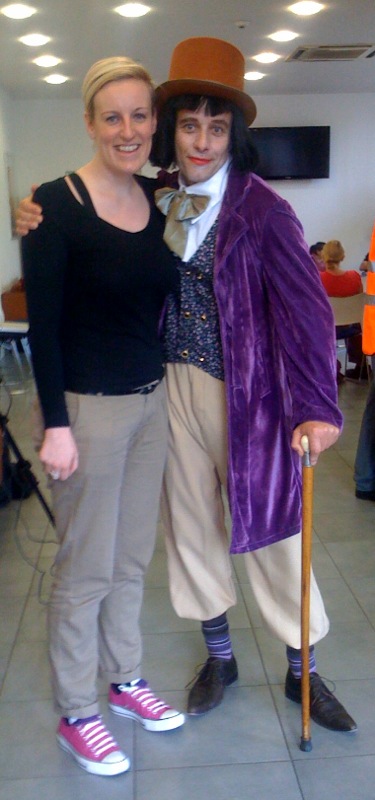
Feeling like one of the golden ticket winners from 'Charlie and the Chocolate Factory' I turned up to the Nestle factory with child-like excitement about what I'd find inside. Not least because I was greeted at the door by Willy Wonka. And, no, before you ask, he isn't there everyday. This Sunday was a special occasion; it's Kit Kat's 75th birthday so the Nestle bosses decided to open the doors to the public for the first time in over 10 years and get a bloke to dress up as Mr Wonka.

Steph with Willy Wonker

The plant has various production lines each concentrating on different type of chocolate bar. Today I was working on the two finger Kit Kat. And just like most production lines in the UK now, it is mainly machine based. There were a dozen or so hairnet adorned workers dotted around the machinery, but not many. As I wandered round chatting to them it was soon clear that they worked on the same line each shift and are quite protective about that. The two finger team is not the same as the four finger team and let's not even mention the Milky Bar kids!

According to Mintel 90% of us regularly eat chocolate. But it's not just us Brits wolfing it down, the emerging economies are helping to boost sales for our chocolate factories too. Here in York, Kit Kat production is at full capacity with the machines working 24/7 to meet that demand. Over 5.7 million Kit Kats are flying out of the door everyday, and are eaten in over 50 countries. This growing demand inevitably means that prices are going up. Nestle, Cadbury and Thorntons have all announced that most of our chocolate favourites will be going up a few pence because the price of cocoa has soared. But this is unlikely to stop us buying it. It's an affordable treat that we just can't give up, with Mintel predicting that UK sales will grow by £4.1billion by 2015.

But it's true what they say - if you end up working with it you'll barely be able to eat, smell or look at chocolate in the same way again. And for the 737 workers in the factory making some of the nation's favourite confectionery, the hours are long and the job can inevitably feel quite monotonous. Despite this the banter and enthusiasm amongst the team here was magic. The shift manager, Steve, who I spent the afternoon with could easily be a stand-up comic on the side. Jonny Vegas or Peter Kay I suggested -- apparently he gets that reference all the time. Here's a little flavour of my time with him:

In order to see this content you need to have both Javascript enabled and Flash installed. Visit BBC Webwise for full instructions. If you're reading via RSS, you'll need to visit the blog to access this content.

Do you have suggestions for other Sunday shifts? If so, please leave a comment below.

On The Money goes out between 8 - 9pm on Sunday nights on 5 live.

Related links

On the Money

Steph's Sunday Shift: Ansaback Call Centre

Blog comments are currently unavailable. Find out more.

Post categories:

Steph McGovernSteph McGovern|17:24 UK time, Tuesday, 5 October 2010

Each week on 5 live's On The Money, Declan Curry sends me to do a Sunday shift in a business that doesn't follow a typical 9-5. This week I spent the day learning about customer service, at the Ansaback call centre in Ipswich Ansaback.

Here's my report from this week's programme.

In order to see this content you need to have both Javascript enabled and Flash installed. Visit BBC Webwise for full instructions. If you're reading via RSS, you'll need to visit the blog to access this content.

Do you have suggestions for other Sunday shifts? If so, please leave a comment below.

On The Money goes out between 8 - 9pm on Sunday nights on 5 live.

Related links

On the Money

Ansaback

Behind the scenes at 5 live Breakfast

Blog comments are currently unavailable. Find out more.

Post categories:

Hasit Shah|13:48 UK time, Monday, 4 October 2010

ITV's Daybreak launched last month as the network's replacement for GMTV. A lot of money, a lot of publicity, and for us, another strong competitor (with 5 live connections) in terms of early morning news programming.

5 live Breakfast's new editor Scott Solder explains what we're aiming to do:

In order to see this content you need to have both Javascript enabled and Flash installed. Visit BBC Webwise for full instructions. If you're reading via RSS, you'll need to visit the blog to access this content.

Before joining the 5 live Interactive team, I was one of the producers on Breakfast, and I worked there for several years.

We work day and night shifts, setting up items that we think will reflect what people should be hearing in the morning. The night team comes in at 9pm, makes any necessary changes, and oversees the broadcast. There are duty editors for both shifts.

The day team's in by 11am, and meets at midday to discuss ideas. Colleagues from the BBC Business Unit and BBC Sport are also there, and in about an hour, we try and decide what the lead story is (and how we'll cover it). We don't always have a clear idea, but that's ok, because at that stage we're still many hours from going on air.

The duty editor, which was the job I used to do, also gets ideas for other items from everyone else in the room. Eventually, after writing down the better suggestions, and (diplomatically) rejecting what doesn't feel right, it starts to take shape.

The team then spends the day setting up items, while the duty editor keeps up-to-date with developments and assigns tasks. The end of the shift is 9pm, and by then, hopefully there's something resembling 5 live Breakfast in place.

There's a handover to the night team at 9, and they start making changes, talking to people from Today, Breakfast etc, going through the first editions of the papers, and generally making sure we're totally up-to-date.

Occasionally, the night editor might decide to rip up the day team's work. They then spend a night trying to replace items they've rashly decided to drop, while avoiding the wrath of the senior editors who arrive at dawn. But even if it's not so drastic, there are always some changes that will need to be explained.

Making significant alterations overnight can be difficult. You only have a small window of opportunity to make phone calls, and you have to judge how late it is acceptable to ring someone. We've all woken people up unintentionally. In fact, the first few words are pretty much always, "I'm really sorry to call so late, but..." I'm now really good at apologising.

An editor also has to be confident of knowing enough of the details of a story, and have the resources available to get it on air. Not always straightforward in the middle of the night..

Night shifts are the dark side of working in news. Most of us have to do them at some point, and I assume that anyone who works overnight - in any job - has the same dilemmas. What to eat? If you get a break, do you attempt to have a short nap? How patient can you be with your colleagues at 3am? I don't think I ever worked out the best way, if there is one.

The 'interferer' gets in at 4.30am (as does Shelagh). That's a genuine job title, and it refers to one of Scott's Assistant Editors. They come in and, well, interfere. Actually, by then, the night editor needs a fresh point of view, and they're experienced producers who now wear smarter shirts than before.

Nicky gets in at 6, by which time we're on air. Four busy hours later, it's all done, and the whole cycle starts again.

Related links

5 live Breakfast - programme details and iPlayer links

Video - About Nicky & Shelagh

More from this blog...

Categories

These are some of the popular topics this blog covers.