Key points about equivalent ratios and simplifying ratios

- A ratio compares the size of two or more amounts. If the ratio of cats to dogs is 2 : 5, this means for every 2 cats, there are 5 dogs.
- Equivalent ratios are in the same Used to show how quantities and amounts are related to each other. When one amount changes, the other also changes, as set by proportion rules, eg if 1 item costs 10p, then 5 items cost 50p. eg 2 : 5 is equivalent to 4 : 10.
- Ratios can be simplified. They can also be written in the form 1 : 𝑛 or 𝑛 : 1.
Make sure you are confident with converting metric units before working with ratios with different units.
Check your understanding
Equivalent ratios
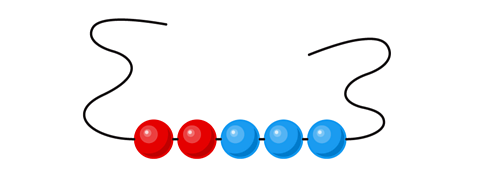
A ratio compares two or more quantities by using parts of a whole.
In this bracelet, there are 2 parts red compared to 3 parts blue. The ratio of red beads to blue beads is 2 : 3. This is said aloud as ‘two to three’.
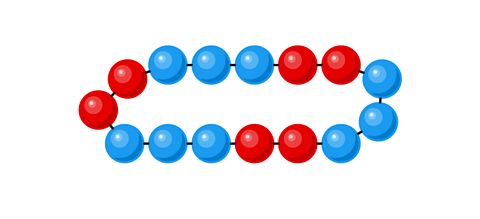
If the pattern is repeated three times, there are still 2 red beads for every 3 blue beads.
The ratio of red to blue is still 2 : 3, but can also be written as 6 : 9.
The ratios 2 : 3 and 6 : 9 are The same as but in a different form, eg ½ is equivalent to 50%. as they represent the same Used to show how quantities and amounts are related to each other. When one amount changes, the other also changes, as set by proportion rules, eg if 1 item costs 10p, then 5 items cost 50p. of red to blue beads.
It is important to write the numbers in a ratio the correct way round. For example, 2 : 3 is not the same as 3 : 2.
A ratio can have more than two parts, for example, 1 : 3 : 2.
Follow the working out below
GCSE exam-style questions

- There are red, yellow and green peppers in a box.
The ratio of red to yellow is 4 : 3.
The ratio of yellow to green is 2 : 5.
Write the ratio of red to yellow to green peppers.

8 : 6 : 15
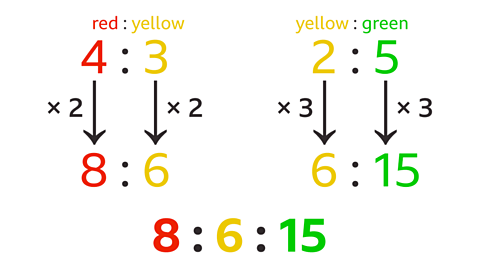
For every 4 red peppers, there are 3 yellow peppers.
For every 2 yellow peppers, there are 5 green peppers.
- To compare all three colours, make the yellow parts the same in each ratio. 6 is a multiple of 2 and 3 so write The same as but in a different form, eg ½ is equivalent to 50%. ratios with 6 parts yellow:
- The ratio of red to yellow peppers is 8 : 6.
- The ratio of yellow to green peppers is 6 : 15.
- Combine the two ratios to give the ratio of red to yellow to green as 8 : 6 : 15.
- A parcel locker contains small, medium and large parcels in the ratio 5 : 3 : 1
There are 18 medium parcels.
How many small and large parcels are there?
30 small parcels and 6 large parcels.
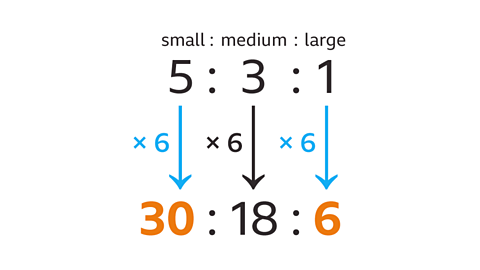
- Label each part of the ratio 5 : 3 : 1 with its parcel size.
- Write the number of medium parcels (18) underneath the 3.
- 3 has been multiplied by 6 to make 18.
- Multiply the other two parts of the ratio by 6 to keep the same proportion.
The equivalent ratio is 30 : 18 : 6.
- In a kitchen, the ratio of cups to plates is 3 : 4.
If 2 cups are removed, the ratio of cups to plates becomes 5 : 8.
How many plates are there in the kitchen?
16 plates
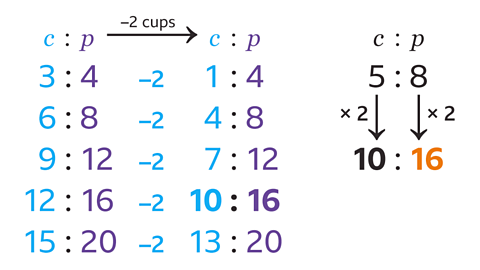
- Write a list of ratios equivalent to 3 : 4 by adding 3 cups and 4 plates each time. These are the possible options for the number of cups and plates to begin with.
- Subtract 2 from the cups part of each equivalent ratio in the first list to form a second list. These are the possible options for the cups and plates at the end.
- 10 : 16 is the only ratio equivalent to 5 : 8. Both parts have been multiplied by two.
- At the start, there are 12 cups and 16 plates. Once 2 cups are removed, there are 10 cups and 16 plates.
Game - Equivalent ratios
Test your equivalent ratios skills with these puzzles from Divided Islands.

Play the full Divided Islands game.
Simplifying ratios
Simplifying a ratio creates an The same as but in a different form, eg ½ is equivalent to 50%. ratio where the numbers in each part are lower but remain in the same Used to show how quantities and amounts are related to each other. When one amount changes, the other also changes, as set by proportion rules, eg if 1 item costs 10p, then 5 items cost 50p..
To simplify a ratio:
- Divide each of the numbers in the ratio by the same number.
- When the numbers can no longer be divided to form whole numbers, the ratio is fully simplified.
Dividing the parts by their The greatest factor that will divide into the selected numbers. 10 is the highest common factor of 30 and 20. will reduce the ratio to its simplest form in one step. A ratio in its simplest form must contain Integers are numbers with no fraction or decimal part. They can be positive, negative or zero. 42, –8, and 10,000 are examples of integers. values.
When ratios contain different units, the parts must be converted to the same unit before simplifying.
Sometimes it is useful to write a ratio in the form 1 : 𝑛 or 𝑛 : 1.
- Eg a ratio of 1 : 4·5 could show for every 1 loaf of bread, there is 4·5 g of sugar. In this case, 𝑛 does not have to be an integer.
Follow the working out below
GCSE exam-style questions
- Which equation connects 𝑥 and 𝑦 when𝑥 : 𝑦 is 7 : 2?
2𝑥 = 7𝑦 or 7𝑥 = 2𝑦?
2𝑥 = 7𝑦
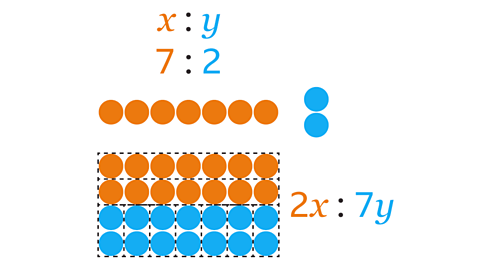
- Write the ratio 𝑥 : 𝑦 in the form 𝑛 : 1.
- Divide both sides of 7 : 2 by 2 to give 3·5 : 1.
- For every one 𝑦, there are 3·5 𝑥. This means 𝑥 is 3·5 times bigger than 𝑦.
- Write this an equation as 𝑥 = 3·5𝑦.
- Double both sides of the equation to give 2𝑥 = 7𝑦.
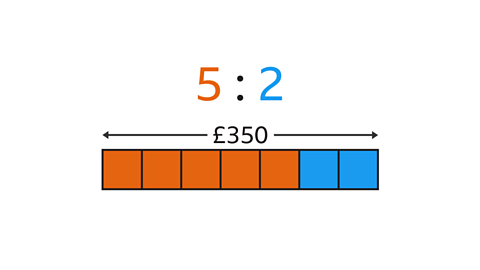
Alternatively, consider the diagram above. There are 7 orange parts (𝑥) to 2 blue parts (𝑦). If the orange circles (𝑥) are multiplied by 2, and the blue circles (𝑦) are multiplied by 7, the amounts are equal.
This means 2𝑥 = 7𝑦.
- There are 17 rockpools and 50 crabs on a beach.
Write the ratio of rockpools to crabs in the form 𝑛 : 1, where 𝑛 is a decimal.

0·34 : 1
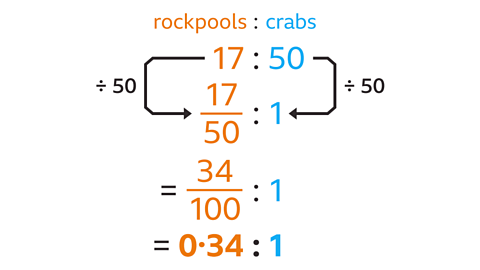
- Write the ratio of rockpools to crabs as 17 : 50.
- Divide both parts by 50 to be able to write the ratio in the form 𝑛 : 1.
- Multiply the numerator and denominator of \(\frac{17}{50}\) by 2 to give the equivalent fraction \(\frac{34}{100} \).
- Convert the fraction to the decimal 0·34.
For every 1 crab, there are 0·34 rockpools.
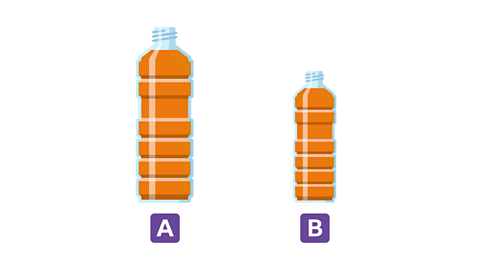
- Container A holds 2·4 litres.
Container B contains 1·8 litres.
Write the capacity of A to B as a ratio in its simplest form.
4 : 3
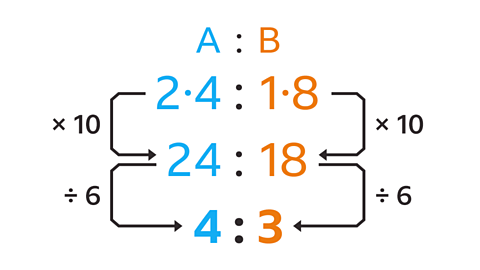
- Write the ratio A : B as 2·4 : 1·8.
- Both parts are decimals. The parts of a ratio in its simplest form must be integers. To convert the decimals to integers in the same proportion, multiply both parts by 10 to give 24 : 18.
- Simplify 24 : 18 by dividing both numbers by their highest common factor of 6. This gives 4 : 3.
Alternatively, both parts of 24 : 18 could be divided by 2 to give 12 : 9, and then divided by 3 to reach the same answer.
Game - Simplifying ratios
Try these simplifying ratio questions from our Divided Islands game.

Play the full Divided Islands game.
Quiz – Equivalent ratios and simplifying ratios
Practise what you've learned about equivalent ratios and simplifying ratios with this quiz. The questions change each time you try, so keep testing your knowledge.
Now you've revised equivalent ratios and simplifying ratios, why not look at working with proportion?
Play Sudoku with BBC Bitesize!
Every weekday we release brand new easy, medium and hard Sudoku puzzles. Perfect for testing your skill with numbers and logic.

More on Ratio, proportion and rates of change
Find out more by working through a topic
- count3 of 8
- count4 of 8
- count5 of 8