Overview of The Knot by Imtiaz Dharker
- The Knot by Imtiaz Dharker starts off with the speaker’s memory of a family outing to Loch Lomond.
- In particular, they remember the picnic wrapped in a knotted cloth. The knot is untied by their mother to display the feast inside.
- The poem then moves on to consider the later, complicated relationship between the mother and grown-up children.
- After her death, the siblings gather at the loch side and the speaker reflects on the ‘knot’ of pain experienced through loss and the choices that have led them to this point.
- This poem exemplifies the coming together of Pakistani and Scottish culture which features in many of Dharker’s poems, with the picnic of A paratha is a very popular flat bread which is fried and can be stuffed with savoury ingredients. It originated in the Indian sub-continent and is enjoyed around the world today. enjoyed on the A word for a hillside, slope, or bank in Scots. at the side of Loch Lomond.
You can read The Knot by Imtiaz Dharker on the Scottish Poetry Library website.
Context
Allusions to The Bonnie Banks o' Loch Lomond
The song The Bonnie Banks o' Loch Lomond, probably written in 1745, is a famous Scottish lament about a man who has been sentenced to death for being a rebel during the Jacobite rising. He tells his ‘true love’ that he will travel home by the ‘low road’, the fairy road for the souls of the dead, while she travels home by the ‘high road’ of the living.
‘Taking the high road’ is also an A series of words together or phrase that convey a certain meaning that does not reflect the meanings of the words separately. An example is "kicked the bucket". which means choosing the more moral or honourable path, particularly when someone else has chosen not to.
There final line of the poem is an An allusion is when you refer to a person, place, event or idea that other people will know. For example to a famous story or piece of literature. to the song:
the high, the low, the road we did not take.
The song is often a feature at Scottish weddings, traditionally sung at the end of the night in a circle with linked arms. This is interesting when we consider Dharker's personal background and the potential cause of friction with her own parents.
The final line also alludes to the poem The Road Not Taken by Robert Frost, which considers the choices we make in life, and reflects, possibly with some regret, that different choices could have resulted in very different life experience.
The background of Imtiaz Dharker
Imtiaz Dharker is a Pakistani-born British poet, and her heritage is reflected in much of her writing.
Parts of Dharker's biography may be reflected in The Knot, such as:
- hints at a difficult mother-child relationship (caused by Dharker's marriage to a Hindu Indian man)
- the bringing together of different cultures
For context, there has been historical conflict between Pakistan and India since Pakistan was founded in 1947 as a result of the independence of India from British rule, when India was simultaneously split to create Pakistan.. This historical tension may explain why Dharker's parents did not wish to speak to her after her elopement to a Hindu Indian.
Imtiaz Dharker has said:
"I left Pakistan when I was six months old so I hardly remember it but Scotland was, you know, the place where I grew up and there were cultures, three cultures, inside the house and more outside and then I met and married a Hindu Indian and went off to live in Bombay. But you do these things when you're young, you don't even realise that you're crossing borders and breaking boundaries and breaking through walls […] My parents never spoke to me, I didn't see my mother again ever, and my father, I met him 10 years later at an airport and he didn't recognise me."
– taken from BBC Sounds - Imtiaz Dharker on The Conversation
You can learn more about Dharker's personal background and the historical context of Pakistan and Britain below.
The title, The Knot, is also suggestive of the complicated relationship between Dharker and her parents, and it hints towards her marriage being a potential cause of tension.
'Tying the knot' is commonly used to refer to getting married, with roots in Scotland. (Source: Tying the knot: handfasting through the ages) When we pair this with the allusions to a traditional song often played at Scottish weddings, we learn more about what possibly ‘caused scars […] to deepen / around a silence’ in this poem.
It is important to remember that each reader will interpret what a poem means to them in their own way. Everyone's response is different. While The Knot may draw from aspects of Dharker's own personal story, the reader can separate the poet from the words of the poem and think about how they contribute to wider themes or feelings.
Historical context of Britain and Pakistan
- The British Empire began in the late 1500s under Queen Elizabeth I. It When one country enforces political control over another. several countries and territories, including regions across the Indian subcontinent.
- The people colonised by the British had British laws and customs imposed upon them, lost their ability to govern themselves and were, in many cases, violently oppressed.
- In 1947, British rule of the Indian subcontinent ended. 'British India' was divided into the separate states of India (with a majority Hindu population) and Pakistan (including what is now Bangladesh, with a majority Muslim population).
- By the time India and Pakistan became independent nations in 1947, Britain had controlled much of the region for nearly 200 years.
- Partition led to mass migration, as up to 15 millions of people moved across new borders. There was often conflict during this time and it is thought that up to one million people died as a result.
- Relations between the two countries remain difficult, with control of the Kashmir region a particular cause of conflict.
Pakistani immigration to the UK
- Pakistani immigration to the UK has a long history, with major waves beginning after World War Two.
- In the 1950s and 70s, immigration was encouraged to fill jobs in industry, public transport and the NHS.
- There is a large population of Pakistanis living in the UK, and as of 2022, people of Pakistani heritage make up the largest non-white ethnic group in Scotland, at 1.3%.
- Pakistan remains a member of the An association comprising the UK, its dependencies, and many former British colonies..
Further reading:
Form and structure of The Knot
The Knot by Imtiaz Dharker is made up of 14 lines divided into 4 stanzas:
- 3 stanzas with 4 lines each
- a final stanza of 2 lines
It has a regular rhyming scheme: abab. This is a pattern often used in ballads and narrative poems, with a A pair of successive lines that rhyme, usually but not always of the same length at the end to create a sense of finality.
- Past tense is used in stanzas 1 and 2, until the final words of stanza 2 shift to present tense.
- Present tense continues through stanzas 3 and 4.
- At the end of the final line, the poem returns to past tense.
The sense of past memories combining with present feelings is reinforced by this technique of shifting tenses.
Apart from Stanza 1 and line 6 (Stanza 2), A poetic device where a sentence continues beyond the end of the line or verse. is used throughout the poem. This helps to create a feeling of the overflowing emotions around the speaker’s mother.
The first-person singular ("me") but more often first-person plural ("we", "us") is used, as in many of Dharker’s poems. This sometimes represents the speaker and their siblings, sometimes the speaker and their mother, the whole family, or possibly wider groups of people. The experience becomes more immediate as a result, the emotions expressed are shared and are more powerful.
- Stanza 1 - describes the experience of the picnic, after the journey along the twisty road to Loch Lomond. The speaker remembers their childhood impressions of their parents.
- Stanza 2 - continues the memories, especially of the children’s hunger and the eagerly awaited picnic food presented by their mother untying the knot in the cloth that contains it.
- Stanza 3 - shifts to the present and the ongoing ‘knot of hurt’ created by the loss of their mother, first through their difficult relationship and then through her death.
- Stanza 4 - the speaker reflects on how complicated family emotions and experiences are, how our mistakes and choices impact on our lives.
Stanza 1
The opening line has a storytelling tone, matching the ababA traditional poetic form used in narrative poetry. A ballad normally features repetition, regular rhyme scheme and rhythm. They were traditionally penned to be sung or read aloud. rhyme.
At Loch Lomond they were king and queen to me
This is a child’s view of their parents: all powerful and in control of their world. The The repetition of vowel sounds in a series of two or more words. in ‘queen’ and ‘me’ is continued in ‘out’ and ‘bounty’, along with the The repetition of the same sounds or consonants in two more words nearby each other. in ‘bounty on the brae.’
The richness of the language and the underlying Containing iambs. (When we emphasise the second syllable not the first syllable like ‘to-day’, this is called an iamb). rhythm create a sense of harmony and calm. It feels like a medieval-style banquet, presided over by the monarchs, but personal ‘to me’. This encapsulates a perfect little childhood memory.
The atmosphere becomes uneasy, with the disjointed rhythm of:
we / children making sick-stops
The memory of the lovely day out nonetheless has the all too realistic detail of the speaker and siblings being sick repeatedly. As well as reflecting the literal journey to Loch Lomond, this could represent a wider reflection on journeys and migration.
Stanza 2
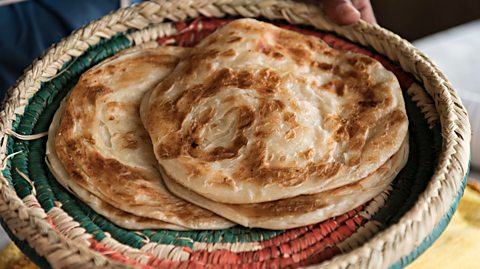 Image source, Getty Images
When they arrive, the words ‘tumbled’ and ‘sprawled’ suggest the chaotic movement and absolute freedom of the children. Everything they do is wholehearted, with the clumsy energy of youth.
The personification of ‘Light ate shade’ suggests the dynamic nature of the bright day, with the internal rhyme ‘shade’ and ‘made’ tying the ideas together. The water is dazzling and the outdoor atmosphere has made the children ‘ravenous’ rather than just hungry. Like little animals, they have emptied their stomachs and now are ready to eat again.
The overall image suggests the children have been contained in a dark place (possibly the car they travelled in) and have now burst out into daylight and freedom. This image closely relates to the food that is about to be unwrapped.
Control is re-established when the mother, ‘Her Majesty’, opens the picnic dramatically ‘with a flourish’.
Her Majesty untied the cloth / to set parathas free.
The speaker's mother is the one with the power to untie the knot and to ‘set parathas free’.
The detail of the A paratha is a very popular flat bread which is fried and can be stuffed with savoury ingredients. It originated in the Indian sub-continent and is enjoyed around the world today. creates an authentic sense of their culture, with the big bundle of home-made food bursting out (‘set…free’) as she opens the cloth.
It also brings together an image of traditional Britain and the monarchy (‘Her Majesty’) releasing food from the Indian subcontinent. This reflects the poet's own mixed heritage, but also makes a comment on The policy of gaining control over a previously independent country and occupying it with settlers. and the British Empire, and the new freedom brought about through the partition of India.
The description of a specific action – ‘She did’ – becomes more generalised – ‘she does’ – suggesting that her usual role is to be controlling. This is not a one-off event.
Image source, Getty ImagesStanza 3
The eye-catching first line starts with an A poetic device where a sentence continues beyond the end of the line or verse.
undoes this deep red knot of hurt in the heart.
This is a dynamic mother who binds the children to her and ‘undoes’ the knot. This sets free the children but also tangled up painful feelings, that are partly due to her death, but also her role in their lives. Like a knot, the feelings are complicated and interwoven. The words ‘deep red’ suggest intensity, as if their relationship has dominated them throughout their life. "Deep" suggests not just the emotional depth of feeling, but it suggests a darkness to the colour - this is not a bright, happy red. The The repetition of the same sounds or consonants in two more words nearby each other. and in ‘hurt in the heart’ emphasise the emotional pain she has caused.
‘Today’ shows that, even years later, the ‘scars’ of family dysfunction have been ‘allowed to deepen’. The metaphor of ‘silence’ as a wound that will not heal powerfully captures the idea that the family cannot move on as they have not spoken about their feelings. We see how the The repeated use of the ‘s’ sound in the beginning, middle or end of nearby words. of ‘scars’ and ‘silence’ ties the two ideas together.
The violent language in ‘wrenching our lives apart’ is the first explicit statement of the mother’s destructive emotional influence. The action again links to the opening of the picnic cloth. The chaotic spilling out of food, people and emotions are all linked. Again, this may be read as symbolising the sudden movement and violence unleashed by partition, which tore families and communities apart and remains a source of conflict, as well as contributing to the breakdown of the relationship between the poet and her parents.
The regular rhythm returns, as the siblings meet to remember their mother:
she has come back to us at the loch to open
Enjambment stresses the final word "open", returning to the action that is the poem's central image.
Video - What is word choice?
Dharker chooses words carefully in The Knot to convey meaning, such as the violent language used in ‘wrenching our lives apart’.
What is word choice? Why is it important?
Word choice can have a massive impact on your writing.
Words are like ingredients: even a small change in the recipe can affect the finished dish.
"They had a warm laugh"
But what if "they had a hearty laugh"?
Even though these sentences pretty much tell us the same thing, the words have different effects.
‘Warm’ suggests the laugh is friendly.
‘Hearty’ suggests it is wholesome, passionate and sincere.
When you choose a word you need to think about its denotation.
That's what it literally means.
But you should also think about its connotations - ideas or feelings that the word might suggest or hint at.
"Feeling dizzy, she slid her hand along her head"
This just tells us what happened. But what if:
"Feeling dizzy, she slid her hand along her skull”
The skull is the bone structure in your head. This is the denotation - what it definitely is.
But the connotations of skull are fear, mortality and even death.
These connotations suggest that the dizziness she is experiencing is serious.
In the poem 'The Circle’, Don Patterson watches his son painting the planets in the solar system.
“He draws around his upturned cup, his hand shakes, and he screws it up.”
Patterson could have easily written “he messes it up” but “screws it up” is a far more interesting choice.
These words are really informal compared to his word choice in the rest of the poem.
This helps him capture the reality and rawness of a young boy’s frustration.
At the same time, “screw” suggests a circular motion, another reference to circular shapes within the poem.
It also suggests scrunching up paper and throwing it away.
Word choice is a really important part of writing.
It’s an invaluable part of writing.
It’s crucial!
Stanza 4
When the sentence runs onto the next line instead of neatly finishing at the end with a full stop or comma, occurs a few times in the poem. One such example is in lines two, three and four, when she refers to “the depth and breadth and height/ My soul can reach when feeling out of sight/ for the ends…” – it is as if the love she describes is so vast it cannot be neatly contained by the structure of the lines, instead bursting forth and spilling onto the next line. begins the short final stanza with the metaphor of the knotted cloth continuing:
Open /out the tangle of her dying
It is only now that their mother has died that some connection has been re-established. The speaker wants to understand their mother and deal with the ‘tangle’ of unresolved conflict and grief. "Tangle" relates to the image of a knot: Relationships are messy, complicated and difficult to make sense of. They need to reflect on the clumsiness of how families treat each other. The word ‘mistake’ is emphasised by its positioning at the end of a line.
The final line ‘the high, the low, the road we did not take’ refers to the song Loch Lomond, in which returning home is only possibly through death. So, the only hope of a return to family love and harmony is through reflecting on the mother’s death.
the road we did not take.
The final phrase alludes to the poem The Road Not Taken and the poem seems to end on a sense of sadness and regret about how different family relationships could have been if people had chosen different actions.
The rhyme of ‘mistake’ and ‘take’ reinforces the idea that they all took paths, but that there could have been other ways to go through life. Ironically, the mother's death has brought them together through the memory of that picnic at the loch.
What are the themes in The Knot?
Memory and childhood
The childhood memory of the picnic at Loch Lomond is the starting point of the poem. From remembering their mother’s nurturing role as provider of the food, the speaker moves to considering the difficult aspects of family relationships which still dominate their adult life. Childhood was a simpler time, when the main worry on a day out was car sickness; the memories they have of more recent time are of a family fractured by the mother’s dominance. The poem shows that happy childhood memories can still be used to help resolve issues of the present.
Change and loss
The poem explores the inevitable change from childhood dependence on a mother who provides to a more adult, challenging relationship with a parent who cannot accept their child's free choices. The change is painful, with a loss of childhood security and belief in the parents. Ironically, the loss of the mother, through her death, brings the family together with a chance to change their present tensions to a more harmonious resolution through talking about the past.
Power of emotions and complicated relationships
The poem demonstrates the power of human emotions to enrich life, but also to control and undermine individuality. The mother’s strong personality has led to a ‘deep red knot of hurt’ in the speaker, of emotions that remain ‘tangled’ years into adulthood. The family’s inability to break the ‘silence’ on their pain has intensified it. The mother was a loving provider, but her need to control her children’s lives was destructive.
Comparisons to other poems by Imtiaz Dharker
The Knot is linked to Stitch as they both have important childhood memories as their central events. In The Knot, the mother is central to the family picnic because she provides the food. In Stitch, the mother’s energy and force of personality is shown through her determination to knit her daughter a cardigan. In both poems, the difficulties of having an adult relationship with a parent are explored, as relationships change with time.
The poems Bloom and Bairn both deal with the power of strong maternal love. This is presented as a positive force, contrasting with the mother’s dominance in The Knot. The speaker in Bloom comes to have an understanding of how love for the child impacts on their whole world-view. In Bairn, the transformative power of love is shown to impact on even the darkest days in our troubled world.
In Letters to Glasgow, the old woman’s memories of her life with her partner reveal the power of love to survive and keep us going through time and changes.
Change and memory are also fundamental to Send this as the speaker remembers features of the city, Lahore, that no longer exist, or can no longer be enjoyed as they used to, because so much has changed. In the speaker’s mind, the city will always be part of their life and being, but they know that, like life, it is ever-changing.
Revise The Knot by Imtiaz Dharker
Revise The Knot and other poems by Imtiaz Dharker with these interactive Higher English quizzes
More on Imtiaz Dharker
Find out more by working through a topic
- count7 of 7
- count1 of 7
- count2 of 7
- count3 of 7