What is column addition?
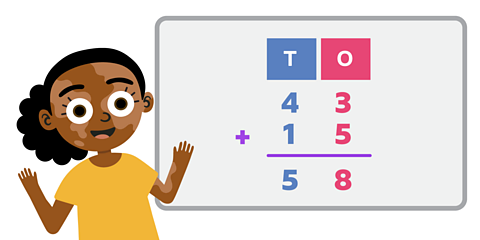
When you are adding larger numbers, it’s often better to use a written method.
Column addition is a good written method to add one number to another.
It involves putting the digits of each number into columns according to their place value.
You then add the digits, starting from the ones column on the right-hand side.
Activity: Adding 2-digit numbers
Complete this interactive activity to learn more about adding numbers using column addition and then put your knowledge to the test with a quiz.
Using column addition
When adding larger numbers together you can use column addition.
First you line the numbers up in the correct ones and tens columns.
Then start by adding the ones. If the ones add up to a total of more than 10, you can move these groups of 10 over to the tens column.
Then, add up how many groups of 10 you have.
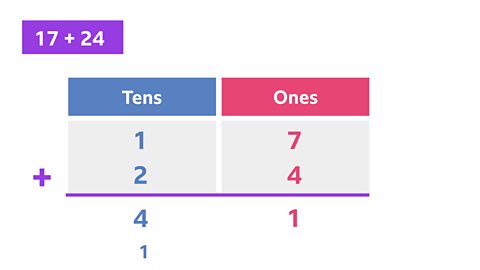
Let's look at how you can use column addition to solve 17 + 24.
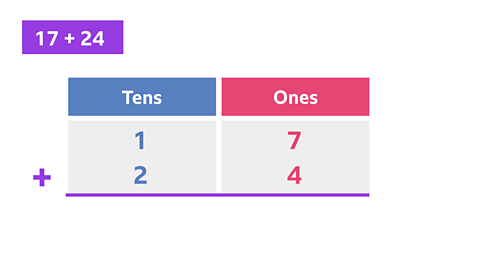
Image caption, First set out the calculation with the two numbers organised in columns according to the place value of each digit. 17 has 1 group of ten and 7 ones. 24 has 2 tens and 4 ones.
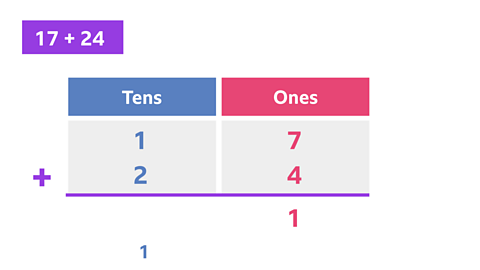
1 of 3
Example 1
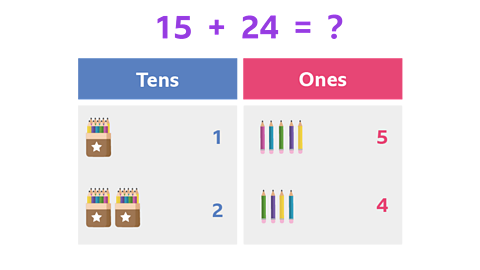
Here are 15 pencils and 24 pencils. How many pencils are there altogether?
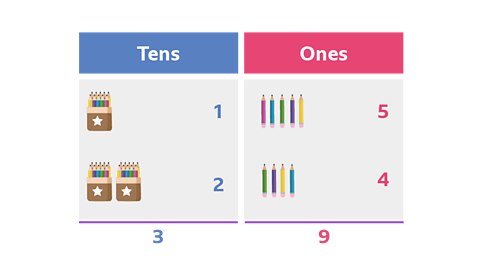
✓ You have 9 pencils in the ones column.
You have 3 groups of 10 in the tens column.
So you have 39 pencils altogether.
Example 2
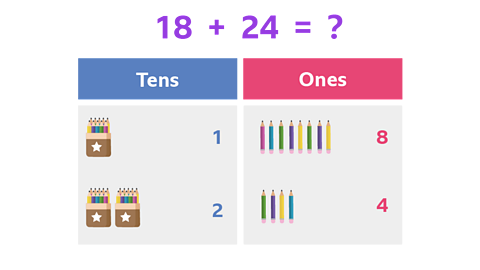
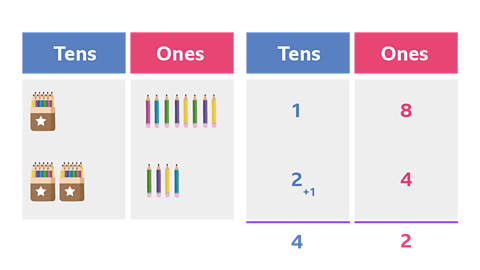
This time you have 18 pencils and 24 pencils. How many altogether?
✓ You have 12 pencils in the ones column, so this is enough to make up another packet of ten pencils.
This means that you now have 2 in the ones column.
You then have 4 groups of 10 in the tens column.
This means that you have 42 pencils altogether.
Example 3
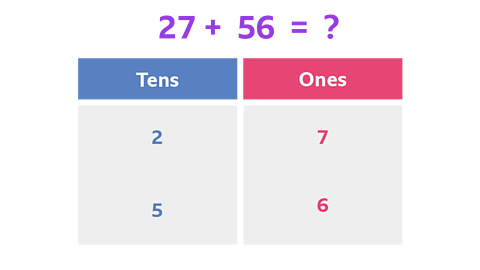
Can you add 27 and 56?
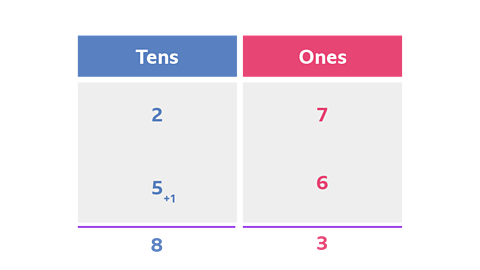
✓ You have 13 in the ones column so we need to put 10 of these into the tens column.
This means that you now have 3 in the ones column.
You have 2 + 5 + 1 groups of 10 in the tens column, so you have 8 groups of 10 altogether.
This means that you have 83 pencils altogether.
Primary maths teaching resources
Visit BBC Bitesize for Teachers to see videos, activities and more resources to use in maths classes for KS1 and KS2.

More on Adding and subtracting
Find out more by working through a topic
- count3 of 14

- count4 of 14
- count5 of 14
- count6 of 14