Subtraction methods
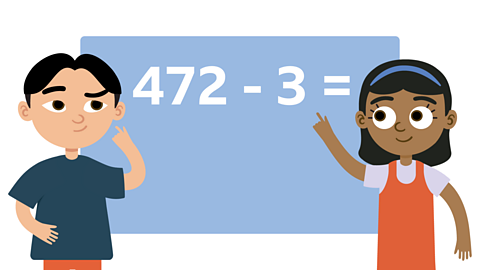
Subtraction is when you take away a number or an amount from another number or amount to work out what is left.
There are different things you can use to help you subtract. You can use number lines, place value charts and place value counters.
Knowing your number bonds and how to partition numbers can make subtraction easier. It can even help you to do it in your head.
Quiz: Subtracting a 1-digit number from a 3-digit number
Test out your knowledge of subtracting a 1-digit number from a 3-digit number with this quiz, then read on to complete the page.
Subtracting using hundreds, tens and ones
It can help to break a number down into hundreds, tens and ones when you are subtracting.
Let's take a look at an example.
'A class has 245 pencils. If Fred needs 7 pencils to draw his picture, how many pencils are left?'
Using the information in this question, you need to work out:
245 - 7
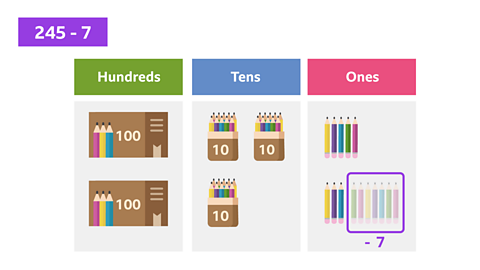
Let's start by breaking the number 245 into hundreds, tens and ones.
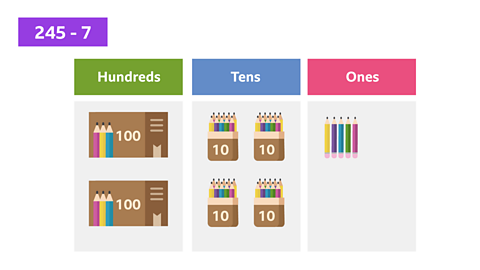
Image caption, Here are the 245 pencils arranged in a place value chart. You can see there are 2 packs containing 100 pencils, 4 packs containing 10 pencils and 5 individual pencils. There are 245 pencils in total.
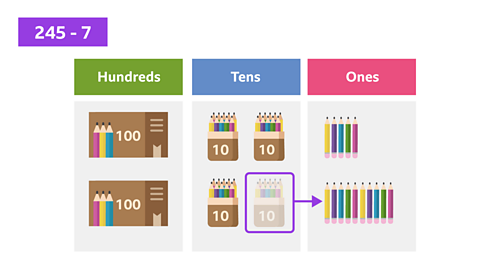
1 of 3
Subtracting using a number line
Knowing your number bonds to 10 can really help with subtraction.
Sometimes, you might need to cross over a ten to find the answer. This is called bridging a ten, which means going past the ten.
You can use a number line to help you count back and bridge a ten while subtracting.
Let's look at an example:
353 - 6
To work out 353 - 6, start on 353 and count back 6.
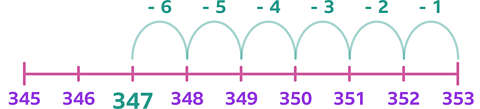
You'll bridge the ten at the number 350.
353 - 6 = 347
Another way to bridge a 10 when subtracting is to break up the 1-digit number.
Let’s work out the answer to another calculation:
595 - 7
Start by putting 595 on your number line.
Next, find the nearest ten below 595. That’s 590. Mark this on the number line and jump back.
595 is 5 away from 590. You have to jump back 5.
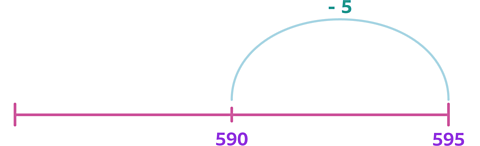
Now, you still need to take away 2 more. This is because the original 7 has been split into 5 and 2. You have only taken away 5 so far.
So subtract 2 from 590.
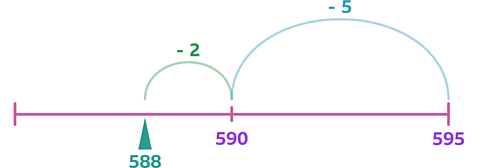
If you know that 10 – 2 = 8, you can use that to help.
590 - 2 = 588
Therefore the answer is:
595 - 7 = 588
Finding the difference
Here is a missing number problem.
To solve this problem you need to find the difference between 284 and 291.

There are two ways of working this out using a number line.
You can use subtraction…
Start at the greatest number, 291, and jump back to the nearest multiple of ten, which is 290. Then jump back to the smallest number, 286.
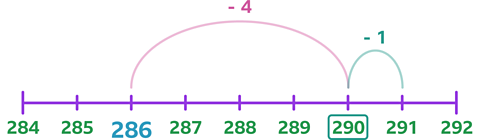
Using the number line you can see:
291 − 1 − 4 = 286
You have subtracted 5 altogether, so the missing number is 5.
291 − 5 = 286
Or, you can also use addition…
Start at the smallest number, 286, jump onto the next multiple of ten, which is 290, then jump on to 291.
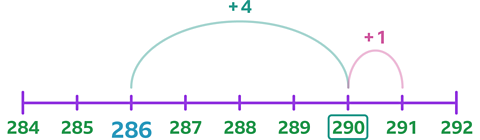
Using the number line you can see:
286 + 4 + 1 = 291
The answer is 5 again:
291 - 5 = 286
Example 1
Use your knowledge of hundreds, tens and ones to complete the number sentence shown in the picture below.
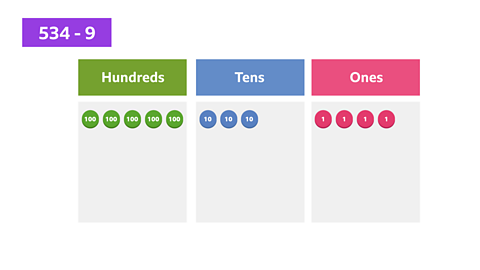
Image caption, Can you subtract using your knowledge of hundreds, tens and ones?
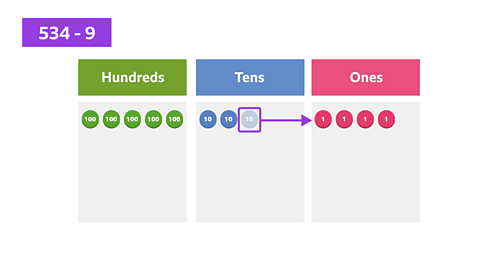
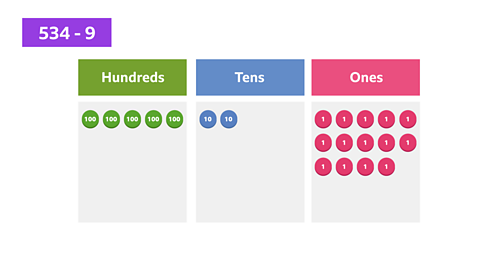
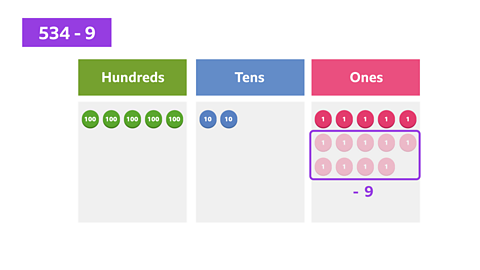
1 of 4
Work out the answer to the calculation: 534 - 9
If you need help, follow the steps in the slideshow above.
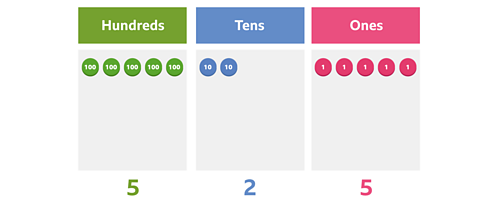
✓ The answer is 525.
534 - 9 = 525
Example 2
Use your knowledge of partitioning to solve this number sentence.

Work out the answer to: 601 - 5 =
This number line and a part-whole model will help you.
✓ To solve this number sentence, you could first jump back to the nearest multiple of ten, which is 600.
600 is 1 jump back on the number line.
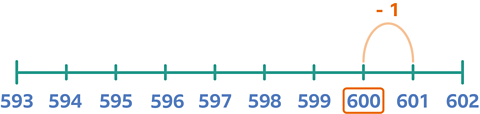
You have jumped back by 1 on the number line.
Remember, you need to take away 5 not just 1 from 601.
Use your partitioning skills to partition 5 into two numbers. You know that one of the parts is 1. So the other part will be 4.
You will need to take away 4 from 600.
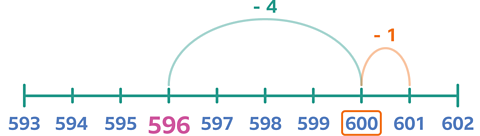
You can use your knowledge of number bonds to complete the final step of the calculation and jump back from 600.
You know that:
10 - 4 = 6
So, you can work out that:
600 - 4 = 596
Primary maths teaching resources
Visit BBC Bitesize for Teachers to see videos, activities and more resources to use in maths classes for KS1 and KS2.

More on Adding and subtracting
Find out more by working through a topic
- count7 of 14

- count8 of 14
- count9 of 14
- count10 of 14