What are number bonds?
Number bonds are pairs of numbers that add up to a target number.
Number bonds to 10 can be described in different ways. You can say '6 and 4 make 10', or '3 and 7 more equal 10', or even that 'double 5 is 10'.
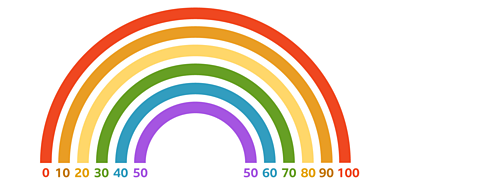
This diagram shows the connection between the numbers that form number bonds to 10.

Number bonds to 100 are pairs of numbers that when added together make 100.
You can use your knowledge of number bonds to 10 to find number bonds to 100.
There are many different combinations of numbers that make 100. The greater the number, the more number bonds it will have!
Activity: What are number bonds?
Complete this interactive activity to better understand number bonds to 100. Then put your knowledge to the test.
Number bonds to 100
Number bonds are numbers that come in pairs. They add up to a target number, like 10.
Knowing your number pairs to 10, will make it easier to work out your number pairs to 100. For example:
1 + 9 = 10
10 + 90 = 100
Can you see the link between pairs that make 10 and pairs that make 100?
A number line can help you find more tricky number pairs to 100.
For example, here is the number line with the number 63 marked on it.
Let's use it to find which number forms a number bond to 100 with 63?

You can start by jumping from 63 on to the next multiple of ten, which is 70.
64 to 70 is a jump of 2.
Next you jump on from 70 to 100, which is a jump of 30.
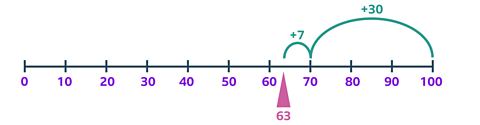
You then add the small jump and the big jump together.
7 + 30 = 37
So 63 and 37 are a number pair. You can check your answer by adding the two numbers together.
63 + 37 = 100
Example 1

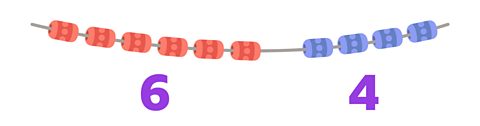
There are 10 beads on this string. What number bond is shown here?
✓6 + 4 = 10
This bead-string holds exactly 10 beads.
6 of the beads have been pushed over to the left.
You can see 6 beads and 4 beads.
Example 2
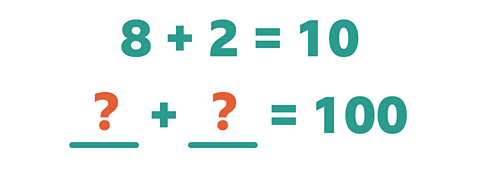
Using your number bonds to 10 and your knowledge of patterns, can you predict this missing number bond to 100?
✓80 + 20 = 100
Can you see 8 tens and 2 tens = 10 tens?
You could visualise this using straws.
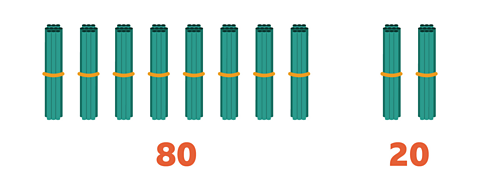
Each bundle of straws has 10 individual straws in it. You can also describe the straws as having 80 straws and 20 straws which equals 100 straws.
Example 3

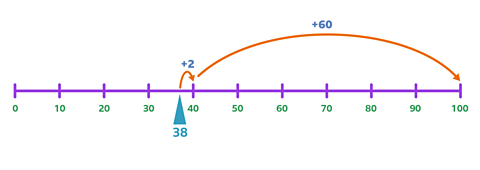
What number do you add to 38 to make 100?
✓62
One way to find the number needed is to use a number line.
Write the number you know on the number line, then jump up to the next multiple of 10.
Then jump in tens to 100.
The number you need is the distance you have travelled on the number line.
2 + 60 = 62
More on Adding and subtracting
Find out more by working through a topic
- count2 of 14
- count3 of 14

- count4 of 14
- count5 of 14