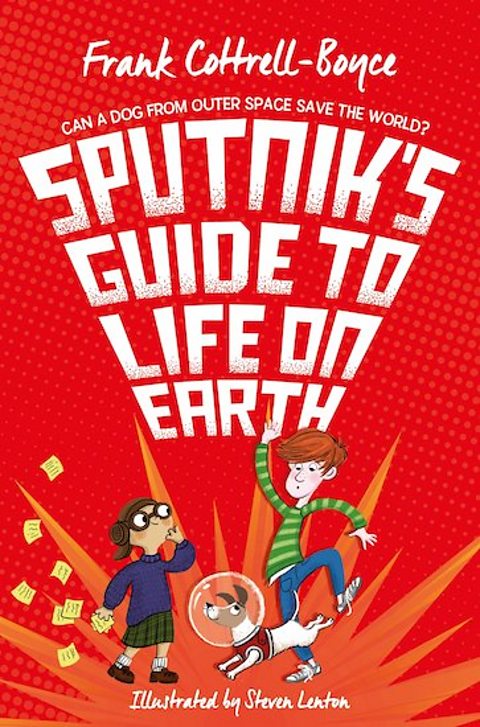
Frank Cottrell Boyce's book Sputnik's Guide To Life on Earth asks a big question - can a dog from outer space save the world?
Frank visited Authors Live to read from the book and talk about writing. He had lots of handy tips for anyone who'd like to try writing stories of their own.
Whether you have read the book or not, in this article you can learn about:
creating characters
using a real life or historical event to give you ideas
the things that you would include in a guide to life on Earth.
What's the story?
Sputnik's Guide to Life on Earth by Frank Cottrell Boyce is about a young boy called Prez, who is sent to live on a farm with a big foster family after an incident with his grandfather.
He's anxious and he's stopped talking, but one day he opens the door to Sputnik, an alien who can read minds. But the rest of the family seem to think Sputnik is a dog. Together with Sputnik, Prez has to come up with a list of ten great things about life on Earth, or the planet will be destroyed!
Watch
Frank reads from 'Sputnik's Guide To Life On Earth'
Cos she was the birthday girl, Annabel was the first one outside. She tumbled across the yard with her lightsaber in her chubby little hand, her friends all came behind her, skipping and screaming. The plastic diamonds on their big, floaty dresses twinkled in the sun.
'These children', said Sputnik, 'they're very… pink, and shiny, like cupcakes'.
'No, that's just their party clothes.'
'Are these children edible?'
'No, they're not edible! Children are not edible!'
'They look edible…' said Sputnik.
'They're definitely not edible. Do not eat the children.'
Ray bought the last children outside shouting, 'Annabel! Look what I found under my bed!' and he waved a green plastic lightsaber over his head.
'Who would like a lightsaber duel?'
'Me!' whooped Annabel, and she came straight for Ray and clobbered his virtuous green lightsaber with her evil red one.
'Ow!' Ray dropped his lightsaber.
The little girl with the blonde ponytail, who we don't see any more because of what happened next, grabbed it, and the two little girls had a Yoda versus Darth Maul lightsaber duel up and down the yard. Then, Annabel managed to get on top of a wheelbarrow and disarm her friend just by the shed.
Then, she waggled her lightsaber in Sputnik's face and threw it. Not very far, because she was only little, and she shouted,
'Go on, Sputnik. Fetch!'
Sputnik looked at me.
'Fetch, she said, Fetch!'
'Is she serious?'
'She thinks you're a dog, remember. Go on, she's only wee.'
'Sputnik does not fetch', said Sputnik.
'But it's her birthday.'
'Okay, just this once.' He trotted over to the lightsaber and examined it.
You said this was a lightsaber! It doesn't do anything. It must be broken!'
'It might need batteries, but she doesn't mind. Just fetch it.'
'Have you got the manual?'
'Just never mind the manual. It's just a toy. Just fetch it.''I won't fetch', said Sputnik, 'fetching is beneath me, but I will have a look', and he fiddled around for a while. And then he handed the lightsaber back to Annabel.
The little girl with the blonde ponytail, who we don't see any more because of what happened next, came at Annabel with the lightsaber. Annabel whooped and shook her lightsaber. A telescopic plastic blade should have popped out, but it didn't. Instead, a column of blinding, buzzing red light sliced through the air.
Everybody stared.
'Whoa. He really did make it work!'
'I am the Sputnik', said Sputnik.
Annabel's friend swiped at her with her plastic lightsaber. Annabel parried with her real lightsaber. Her friend's lightsaber exploded in a thick black cloud of stinking smoke, melted plastic dripped down the handle. Their friends squealed with delight and Annabel squealed with even more delight.
'Hang on, this could be really dangerous!'
'Yes, it could!' said Sputnik with a smile, as though really really dangerous was the very best thing any birthday party could ever be.
Annabel tore around the garden with her Darth Maul lightsaber looking for stuff to destroy. She started with the wheelbarrow, hot yellow sparks fireworked from the metal as she swung the blade. The handle fell smoking to the grass. Her friends screamed and begged for more, they did not seem even a little bit worried that they might be next after the wheelbarrow. They chased after her when she ran at the sheet of corrugated metal that held up the compost heap.
It is not wise to run under a climbing frame, while waving a fully functioning lightsaber over your head. It will cut the monkey bars in half and slam the jagged ends into the grass. The kids jumped back. They howled with laughter. They seem to think that being almost impaled by a smouldering monkey bar was the most fun you could ever have. They clapped while Annabel melted the corrugated metal. They cheered as drips rolled down its ripples like ice cream. Annabel swung round to take her bow.
The little girl with the blonde ponytail, who we don't see any more because of what happened next, saw the blade of light coming and ducked just in time to avoid having her head chopped off, but not quite in time to save her thick blonde ponytail which fell at her feet like a dead gerbil that was slightly on fire. Everybody stared in horrible silence.
'You could've cut her head off!'
'I said I could fix it!', said Sputnik.
'Smell that burning hair! This is a great party!'
'No, we've gotta stop this. Someone could get killed.'
'What did you give her a lightsaber for if you don't want her to use it?'
'It's supposed to light up and twinkle not cut people in half!'
'Twinkle? What's the fun in twinkle? This is a fantastic party.'
And he was right about that - having your hair cut by a fully-functioning lightsaber was the new face painting. A little girl held her pigtails out straight, while Annabel slashed at them, and the girl with a massive Afro stood with her eyes closed and let Annabel shave it off in a confetti of hot sparks.
Some of the characters in this book aren't what they seem. Prez is the only character who thinks Sputnik is an alien - his foster family, the Blythes, all think he is a dog. What do you think? Why?
Activity 1 - Characters from Earth and beyond!
Try to invent a character who has come to Earth from outer space. What would you write about them to bring them to life?
What do they look like?
- Are they like aliens from comics or films?
- Do they look like us, or other Earth creatures?
- Are they like nothing we've ever seen before?
Whatever you choose, thing of words or phrases you could use to describe them?
What are they called?
- Do they have a name like a person, or something very different?
- What does their name sound like or suggest?
Where do they come from?
- Are they from our solar system, another part of space you have heard of, or somewhere you've just imagined?
Why are they here?
- Did they mean to come here, or did they end up here by chance?
- Did they come alone or with others?
- Do they have friendly or unfriendly plans?
You could try drawing your character, adding in as much detail as you can.
If you're stuck, this video has some handy hints on how to create a character!
How to Create a Character
Every good story needs strong characters.You could write about characters you already know, from books, films or television, but it’s much more fun to start with a blank slate – then you are in charge of everything!
You could start anywhere – your character’s name, their job, where they live.How about physical appearance – what do they look like?
Firstly, is the character male or female?Let’s make her a female.Should she be tall?Not that tall!That’s better. And what if we give her biceps the size of footballs!
Maybe your character has an unusual feature – such as a scar – been done before!Or glasses – been done before too!
Don’t just list their height, build and features.Use descriptive language, including plenty of adjectives, as this will really help bring your characters to life.Similes can help give the readers a clear image of your character too.
What if she has cheekbones sharp as razors and her black eyes are like a shark’s?
What is it that this character actually does?Maybe a ballet dancer? Not with muscles like those.I think she would make a great bank robber!
Now what a character wears can reflect what they get up to in your story.She is dressed from top to toe in stretchy, black material that clings to her menacing muscles.
But what do you think her name should be?Mrs… Wilson? Maybe that's too normal.She looks like she would have a more memorable name like… Helga Van Schwarzenbrow. Perfect.
And where would Helga hide out?Hmmm. Something doesn’t seem quite right about this house.Think about how your setting can match your character.That’s more like it.
And let’s think more about Helga’s personality – what are her likes and dislikes?Maybe Helga has a passing interest in the arts.Maybe she has an unhealthy dislike for authority!
Now you have your character [POLICE SIREN] – what happens next is up to you.All in all, I think it might be best for Helga to be behind bars.Phew! That’s a relief.
Ultimately, the reader should be able to close their eyes and [SAWING] imagine your character clearly.Oh. Where did she go?And hang on, where’s my wallet!?
Laika the Space Dog
Sputnik gets his name from the first artificial satellites to orbit the Earth. The Soviet space agency successfully launched Sputnik 1 on October 4th, 1957 and Sputnik 2 a month later.
On board Sputnik 2 was Laika, a stray dog, who became the first living creature to orbit the earth in a spacecraft. They did not expect her to survive the mission. They wanted to test what would happen to living creatures in space, while on board one of their spacecrafts. She died a few hours into the flight.
Watch
Frank talks about the dogs who trained to be cosmonauts
Frank: We couldn't really research Sputnik. How could you, except by kind of thinking, 'what's good about the world?'
Janice: Yeah.
Frank: Or pretending to be a dog.
Janice: Indeed
Frank: Actually I did quite a lot of reading, I know about the dogs that were sent into space because Laika was the first dog that went into space. But there were lots of dogs that were trained to go into space and went up to the edge of space and came down in their parachutes and they've all got amazing stories.
Janice: And this all happened years before, long before you were all born, sort of when we were born. But it is one ofthose amazing things that happened that as I said, it is like science fiction, but this is actually true, what Frank is telling you.
Frank: They had this program where they sent, They tested rockets by sending dogs up into space and some of these dogs were… dogs are the first astronauts and they had cool little space suits, and some of these dogs became very famous, like Belka and Strelka, who went on lots of missions and then had puppies together, and because their rockets were called Sputniks their puppies were called Muttniks.
And one of their rockets came down in Siberia in the snow and it had a bomb on it so that people couldn't find out the secrets of how to build a rocket. So the scientists who love these dogs… went to rescue them. But the snow was so thick, and the blizzard was so wild, and they thought 'we can't do it'. And then they heard the dogs barking and they just got the dogs out in time before the rockets blew up, and all these amazing adventures that these dogs had, before Laika became the very first one to actually go into space itself.
Janice: You know everything about space dogs, don't you Frank?
Frank: Space dogs, I can go through the list!
Activity 2 - Inspiration
Frank got inspiration for his book from the real-life story about dogs who went into space. Historical events or facts can be a good place to start when you're trying to write a story.
Decide on a historical place, person or event that could be a key part of a great story. Do some research and think about a story that would fit with your choice.
Here are some ideas to help you get started!
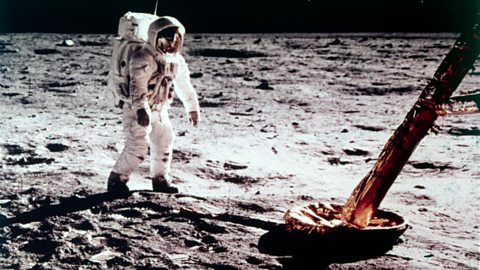
Image caption, Big events in history are great ways to start a story
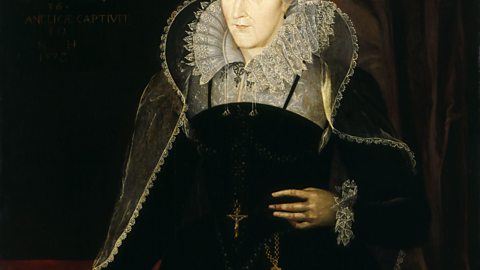
You could write a story set on the day of the first moon landings, or on the day of a famous football match. Maybe your story is set in the same place as a historical event - it doesn't have to be at the same time - your character could be at Bannockburn and thinking back to the battle there hundreds of years ago! (NASA)

1 of 3
Ten things worth doing on Earth
Activity 3 - Your list for Sputnik
In Sputnik's Guide to Life on Earth, Sputnik's mission is to save Earth by making a list of ten things that make our planet worth saving.
Prez helps him with this task, and their list includes some of the small things in life that really matter. Sometimes it's good to think about these things, and remind ourselves of them.
What would be on your list of special things about life on Earth? Do you agree with Prez's choices, or do you think you'd have given Sputnik a different list?
You could draw, write or even make a report with the things on your list, and describe why you've chosen them.
There are tips on writing a report in the video below.
A step-by-step guide to creating a leaflet
How to create a leaflet.
Leaflets are used for informing and persuading people about certain things like what to buy, where to go or what to support. But what makes a good leaflet?
Let's say that you have opened a cafe. What are the things that you need to think about when creating a leaflet to attract customers?Who is your leaflet aimed at? What are you selling? What is special about it? Why should people buy it? Where can customers find you and your product?
That's a lot of information. How on earth can you fit all of that into one leaflet?
Well, do a rough plan first and you'll soon find a place in your leaflet for everything you need.
Your text and images need to be laid out well so that the information engages the reader.
It should have a bold title to catch the reader's attention and make them want to read more.
That's not very inspiring. That's a bit more persuasive.
Try and summarise the key information with subheadings and short, snappy paragraphs underneath so it is easy to read.
You also need some eye-catching images to persuade people to visit. That looks good, but I think we can do better than that.
Now that's more like it. Delicious.
You need to tell people how to find you, when they can come or how to get in touch with you. And why not give them an extra reason to visit? What about a discount voucher?
There. All of the information your customers need.
Now, you just need to send the leaflets out and wait for the customers.
I just hope that have enough supplies to meet demand!
Frank Cottrell-Boyce on BBC Authors Live
Watch more clips from Frank's event
How to grow your gratitude
What are you thankful for? Here's Lorna Walker with some tips on gratitude
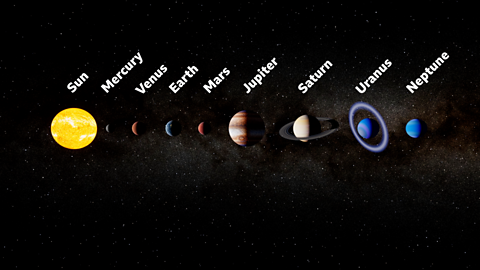
Planets of our solar system
Learn more about the planets that orbit our Sun
More on Stories and poems
Find out more by working through a topic
- count3 of 14
- count4 of 14
- count5 of 14
- count6 of 14