Catherine Johnson explains how to write historical fiction
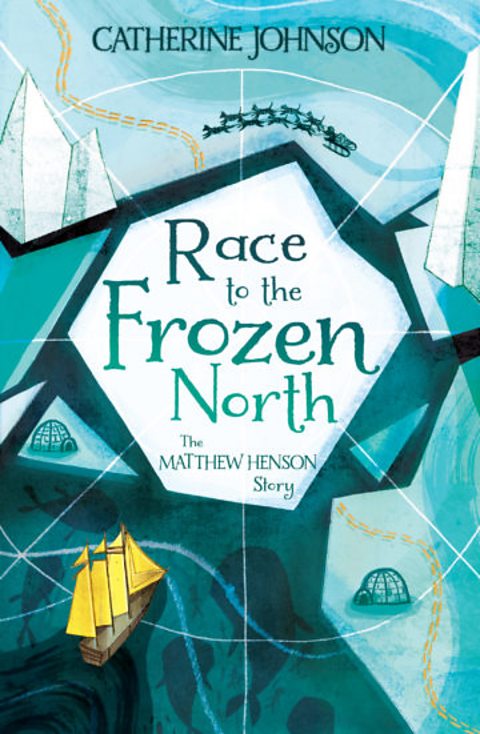
Race to the Frozen North by Catherine Johnson tells the incredible true story of Arctic explorer Matthew Henson.
Catherine visited Authors Live to read from the book and talk about how she wrote it. Whether you have read the book or not, in this article you can:
- find out more about Matthew Henson
- learn about the problems and prejudice he faced
- discover more about survival in the Arctic
- hear how Catherine uses real events and people to write exciting stories
- try writing about a real life person yourself
Title and cover
Activity 1 - Cover
There's an old saying, 'you can't judge a book by its cover', but you can often tell a lot about a book even before you open it!
Examine the title and cover illustration of Race to the Frozen North: The Matthew Henson Story by Catherine Johnson.
Try and answer these questions:
- What type of story do you think it is?
- What can you tell about where and when it is set?
Where is the book set?
Race to the Frozen North takes place in the Arctic. The Arctic is a polar region, found at the very north of the Earth.
It tells the story of Matthew Henson, who many people believe was the first man to ever have stood at the North Pole. Let's think about what that might feel like!
Watch this clip of Catherine Johnson reading from Race to the Frozen North. Listen to how she uses what her main character is doing, what he is thinking and what he has been told to tell us about the setting, rather than just describing it.
This bit is from the first time he goes to the Arctic. And the thing about Matthew Henson, which I will tell you a bit more about him later, is that he learnt a lot of stuff. He went with a man called Peary, who was a naval commander. They went to Greenland first of all, before they went on to the ice cap, because the North Pole is not… it's not land. It moves… and the Inuit, who live there, they knew how to survive in this place and a lot of the European or American explorers didn't bother so I'm going to read about how Matthew learned to drive a dog sleigh.
"The rest of the crew, even Peary, gave up trying to learn to drive a dog sled. Peary changed his plans. He decided he'd ask the Inuit to drive the sledges. But I kept on trying. It took weeks to learn to holler the commands exactly the way the Inuit did. Ahnalka and Ikwah showed me but after trying and trying I could crack the thirty-foot-long whip behind the lead dog as I shouted the commands in perfect Inuit.
There is nothing as exciting as driving a dog sledge across a clear snowy plane. There's something magical about all that snow stretching on for miles just like icing on a cake. But there was one problem. Where we was going the snow and the ice would not be smooth.
The Inuit almost never went out onto the polar ice cap. There was no solid land up there they told me, only a shifting skin of ice that melts every summer and freezes every winter. It can change or break up overnight Ahnalka explained there was a devil, an evil spirit who lived under the ice cap and could swallow people in one gulp.
Ahnalka told me about pressure ridges too, where the ice has been forced up into solid waves you can't sledge over. He also told me about leads -stretches of open water that can suddenly open up in between the ice. But worst of all, he told me were the crevasses. These are bottomless cracks in the ice. If you fall in one you'll never get out. One time he saw a whole pack of dogs and the sledge vanish into one. The thing about crevasses is they're often covered by a thin crust of fine snow so you can't see them till it's too late and you've been eaten alive by the devil in the ice."
Activity 2 - Setting
The Arctic and the Antarctic are extreme environments - tough places where it is very difficult for plants, animals or people to survive.
Watch this clip to find out more about polar environments and how they change through the year.
The Antarctic in the Southern Hemisphere and the Canadian Arctic in the Northern Hemisphere are part of the polar biome. Whilst these regions might not be your typical travel destination, despite their extreme conditions they have lots of wildlife. How have they evolved to survive the freezing conditions?
The polar landscape is extremely hostile, typically rocky and covered in snow and ice. The soils are frozen; this is called permafrost. You’ll always need to wrap up warm in the Polar biome as the average temperature drops to below 10C even during the warmest months. In Antarctica, temperatures can drop down to -50C and below in the winter! Yes -50C! The extreme cold results from the limited amount of sunshine received. There is complete darkness throughout the winter!
Polar regions also tend to be very dry with annual precipitation below 250mm. So in fact they’re cold deserts! So with these harsh conditions how do plants survive? In the Arctic only about 5% of the ground surface has plant cover. They cope with the very short growing season by flowering and setting seed very rapidly. To deal with the strong winds and intense cold they tend to form ‘cushions’ close to the ground. Along with lichens and ‘cushion’ plants, one plant that survives here is ‘Antarctic grass’. It is found in the Antarctic Peninsula area where conditions are slightly, only slightly, less extreme. It has the ability to photosynthesise at very low temperatures.
This lack of sunlight, combined with frozen soils and reduced vegetation make it difficult for animals to survive in polar environments, but some like the polar bear have evolved to cope. In order to retain heat they have a thick layer of fur, a 10cm of insulating fat and small ears. Their black nose and foot pads absorb sunshine and help to warm them. You wouldn’t think it would be an issue but to avoid overheating they move slowly and rest often and their white colour against the snow and ice acts as camouflage when they are hunting. Their side paws and claws swimming, catching prey and digging dens in the snow.
Now there’s no prize for guessing which bird loves the cold polar regions. Yep, it’s the penguins. Found in the Southern Hemisphere these feathered friends are well adapted to the cold aquatic environments. They have heavy bones allowing them to stay underwater, wings shaped like flippers and watertight feathers. These guys are pretty intelligent and they have learnt that huddling together can keep them warm and protect them from predators.
Despite the polar biome’s conditions there are many groups of people that a live in the Arctic. The largest group of people in the Canadian Arctic are the Inuit. They live along the coast and hunt seal, caribou and whales. The Inuit used to be know as Eskimos, which means “eaters of raw flesh”. The Inuit people dress very warmly in the winter because of the cold winds and blizzards. Their traditional clothing is made of caribou hide or sealskin. The Inuit eat traditional foods obtained by hunting and fishing. Some country foods are seal, walrus, whale, musk ox and Arctic hare. Because of the permafrost houses can’t be built on the ground so all the buildings are on stilts.
Polar regions are becoming increasingly attractive for the exploitation of resources, such as fish, oil, coal and other minerals. For example, Svalbard, 1000km north of Norway, has highly valued reserves of coal and its seas are rich in fish such as cod.
Well, from Antarctic grass to penguins, plants animals and humans have learnt to survive these icy cold conditions and flourish in this fascinating ecosystem.
Now imagine you had to write a story with the Arctic or Antarctic as your setting.
Think about the cold temperatures, the wind, all that snow and ice, the long days of summer and the months of winter darkness. Brrrrrrr!
Can you come up with different ways to describe these conditions?
Think about how all five senses experience the world around you
- What adjectives and adverbs (describing words) could you use?
- What could you compare your setting to? Can you use similes or metaphors to bring your scene to life?
Weather and time of year will be important parts of your setting
- How will these affect what you can see, hear, feel, smell or taste?
- How will they change the living things you might encounter?
- What challenges and dangers could they bring?
Who is it about?
Matthew Henson
Matthew Henson was an Arctic explorer. Some accounts state that he was the first man to reach the North Pole - the true story is still uncertain.
Henson went to the Arctic seven times with fellow explorer Robert E Peary between 1891 and 1909.
After reaching the North Pole in 1909, Peary, the leader of the expedition returned to the US as a hero. At the time, the USA was very racially divided. Black people faced discrimination, and as an African-American man, Henson received little of the attention or appreciation that Peary did. It wasn't until nearly thirty years later, in 1937 that Matthew Henson began to be recognised for his achievement.
In this clip, Catherine Johnson talks about Matthew Henson, what it was like to try and survive in the Arctic, and the prejudice and problems he faced when he returned to the USA.
Catherine Johnson discusses the life of Matthew Henson
This is Matthew Henson in his Arctic explorers' gear. Now, again, the thing that's hard for us to imagine is that, yeah, if you're going somewhere really cold, not like this BBC Glasgow studio, which is very hot, you'd wear loads of fur, you'd wear seal skin. These days we have all sorts of modern fabric. But in those days they didn't. There was either fur or there were like… there was wool and a lot of the European and American explorers actually just wore wool, which wasn't such a good idea and because Matthew was… He learnt, he listened to the local people. He learnt their language and he learnt to do what they did. So if they went somewhere really, you know, if you've got frostbite…
This is why I got interested actually in Arctic explorers. When I was your age, my brother had, I think it was a Blue Peter annual and it had about Scott, who was an English explorer and went to the Antarctic, which is the other place, but it was reading about the frostbite that made me go [GASP]. Why would you go?
It was so cold that sometimes the toes, the nerves in your fingers, in your toes, sometimes in your mouth, would freeze and one time, Peary, because Peary didn't take as much notice of the Inuit as Matthew Henson and the Inuit said: if you start feeling you're getting frostbite, the thing to do is never… Number one, like in that bit from the book, never go out on your own. Always make sure you've got somewhere else, someone else with you. And if you can feel your feet, you're losing the feeling in your toes, take your shoe off, take your socks off, take your boot off. Make your partner lie down and lift up his shirt and put your foot in their armpit. Also make sure if there's a seal around, kill it and drink its blood while it's still warm.
Now Peary didn't do this and one day he took his boot off and he took his sock off and his toes came with… out off with his socks, in his sock. So afterwards it was very difficult. It was a bit difficult for him to walk and because there was more than one journey. And that's why Henson was the first man to get to the Pole. In fact, because they each went, the last two of the expedition. Peary had two Inuit helpers. Matthew Henson had two helpers called Ootah and Seeglo and because Henson could walk and drive the dog sled, they got there quicker.
So can I have my next slide, please?
So this is, um, this is Henderson and the four Inuits, I think Peary is taking the picture, at the North Pole, which, again, moved about and they were the first explorers to get there. And the sad thing was that when they got back, there had been another expedition that had set off around about the same time led by a man called Frederick Cook and he got back to New York first and he was a big fat liar. His day job was as a milkman, not to say that milkmen can't go to the North Pole, but he's told everybody, "Yeah, we went to the North Pole." And they had the ticker tape parade and then Peary, who was a naval commander, and Henson came back and they said "no this guy just came here and you can't have got there because you know, don't tell me that a Black man got to the North Pole first. I don't want to hear it."So it took a long time for people to believe that they got there.
Can I have another picture, please?
So this is the other sad thing. So nobody believed it because there was such a lot of segregation in America. It was actually, in parts of America at the time, because this was 1909, which is a hundred and ten years ago, eleven, twelve years ago. At that time, parts of Americans it was actually the law that people couldn't mix and you can, you notice that it says "white men", "colored men" and that's the language they used at the time, which we wouldn't use nowadays. We just say black. Things have changed. Thank goodness. And these days in America, it is not the law, but it wasn't in fact, parts of America, Black people and white people could not go into the same shops, could not use the same facilities and even though they came back to New York and even after they believed that Peary and Henson had got to the North Pole. They gave everybody in the expedition who'd gone with Peary, they give everyone a medal in like 1912, I think a few years afterwards, but Matthew Henson didn't get a medal until 1954. I think we might have a picture at the end. Yeah. So this is, this is Matthew Henson, he's now an old man and he's at the White House with the then President, President Roosevelt. So he wasn't… People didn't give him a medal. People didn't recognise that he'd gone right 'til the end of his life. And when he came back to New York. He couldn't get a decent sort of job. The job that he had for a long time was just parking cars and when they did realise, yes, actually, this man was the first man… "Well, we're gonna y'know give you a slightly better job. You can work inside now, as a messenger boy in the office" and that's what he did until he died.
And when he died, he was an ordinary guy, didn't earn that much money, he was buried in an ordinary cemetery in New York. Not in the heroes' cemetery, which is called Arlington in Virginia. But when it came to about the 1980s and more people in America started realising in fact this was a really important explorer. They did move him and they did recognise him and they started… So in America, if you went to America now, you would find schools named after him and boats named after him. So he is a famous man. He is well-known now. I think people don't know about him in this country. You know we tend to know about explorers who were British. We tend to not know about people from other countries.
But what's important about Matthew Henson is that he overcame the fact that he started off not being able to read and write as a child and taking his own life in his hands and seeing the world on a ship and learning, reading, writing languages and then coming back. When he came back from being on the boat, he couldn't get a job then. And he was really lucky because he worked in like a shop and Peary was looking for somebody to go with him and the guy who owned the shop said, "This is the man you want." And it was a long relationship of about twenty years going to the North Pole, coming back, not making it to the North Pole, coming back, and it took them four or five goes. And every time they went they were away for years. So it was a big upheaval in his life and then nobody realising how important he was and Matthew Henson just sort of got on with his life and he did talk about it. He did some tours of Black universities, but like I said, most people didn't know.
And I loved writing this because I love… I mean we're hot now. I love it when it is really cold when you can come in and get warm. I wouldn't like it to be stuck there, to be in an igloo, to have to drink seal's blood. I like some hot chocolate and a hot water bottle, but it's just an amazing life. And that's why I think he's worth, definitely worth writing about, really worth reading about it. If you like a bit of adventure and he's just an incredible man.
Get creative
Catherine has shared some tips with us for anyone who would like to write about a real person from history.
Watch this clip to find out how she goes about researching real people from history - Thomas-Alexandre Dumas in her book To Liberty, and Queen Nanny in Queen of Jamaica.
How much do you research before writing?
The most important thing is the story.
So you have to start writing and you have to, I would say, know your background - solid readings of the time, of the character you're writing about and then when things come up, check. Check as you go along. Otherwise you'll just sit there and read, "Oh, this is interesting."
Activity 3 - Research
Now it is your turn!
Think about a figure you know about from history. It can be someone you admire, or someone you would want to avoid, or someone who you think did something amazing. You have all of history to choose from!
Once you have chosen a person, you need to find out some more information about them.
Remember - your research is to help your writing:
- look for details about what they did and the main events in their life
- think about where and when they lived. What was life like for them?
- find out who the important people in their life were
- are there places or objects that were important to them too?
What is historical fiction?
Race to the North Pole is historical fiction rather than a biography. Catherine Johnson has written a story that needs to keep us involved and bring the people she writes about to life.
Watch this clip to find out how Catherine makes sure her characters keep readers interested.
What makes a character believable?
What I think makes a character believable is that, especially when we're talking about real people here, so they are real, so why shouldn't they be believable…
But it's not just a question of listing, you've got to show, you've got to reveal what they do and how they do, how they live their lives.
You've got to sort of- they've got to have an emotional truth about them as part of- as well as just, "Oh they did this, they did that."
And obviously you don't know So it's hard without- when they're sort of real people.
But most people are the same underneath. I think that's how storytelling works. So I hope that's what I do.
Activity 4 - Write about your character
You've chosen a historical figure and done your research. Now it's time to start writing!
Write a scene or story about this person, based on an important event or place in their life.
- be accurate in the facts, but remember to use your imagination too
- you can start with some simple sentences that say what happened
- add some details and description to your sentences so the reader has a picture of what is going on
- don't just say what your character looks like or what they do
- write about what they are thinking and feeling so they seem more alive
Writing tips
How to make your reader feel involved in your writing
It's about showing the reader and it's about making the reader feel that they're a little bit ahead of the writer, so the writer doesn't tell the reader, "Look at this. This is important."
The writer makes a scene and within that scene there's something that's important, but maybe is not foregrounded.
But then you'll need to know about that later and reader will go, will put one, two and two together and go, "Ah ha!".
And then you're giving the reader the power, instead of going [hands move repeatedly] [sarcastically] which is of course a technical term…
What is a polar habitat?
KS1 Science - BBC Bitesize
What are fiction and non-fiction?
Learn about fiction and non-fiction with this guide from Bitesize - KS2 English.

More on Stories and poems
Find out more by working through a topic
- count6 of 14

- count7 of 14
- count8 of 14
- count9 of 14