Aberdeen and the Deeside Way
Aberdeen is Scotland's third largest city. It is home to the oil and gas industry but is moving to develop cleaner energy.
In this article you can learn:
- what the Deeside Way is
- how Aberdeen has grown and changed
- about the oil, gas and renewable energy industry
- about urban, suburban and rural areas
- about Scotland's public parks
This article is suitable for learning about People, Place and Environment topics in primary school.
Video - Aberdeen and the Deeside Way
Watch Isla and Connor explore the Deeside Way and discover how Aberdeen has changed over the past 900 years.
CONNOR: Look at all the ships here at Aberdeen harbour in the mouth of the River Dee.
ISLA: Yeah, this busy port has shaped the city for nearly 900 years!
Back in the 12th century, Aberdeen began as a trading port.
By the mid 1800s, there were over 200 fishing boats based here.
It also once had a large ship building industry.
In the 1960s oil and gas were discovered in the rock under the North Sea bed.
Since then, drilling for oil and gas has been one of Aberdeen's biggest industries.
People operate oil and gas rigs, huge platforms out at sea that drill into reservoirs deep underground.
These fossil fuels are extracted by pumping them to the surface to be processed into fuels we can use.
CONNOR: But fossil fuels release carbon into the atmosphere when they're burned which contributes to climate change.
A lot of people want towns and cities built on the oil and gas industry to focus on green, renewable energy instead.
ISLA: There's a new development on the harbour, The Energy Transition Zone, which will focus on more sustainable energy.
CONNOR: I think we'll learn a lot about how Aberdeen has changed if we walk along the Deeside Way, following the River Dee up through the city.
ISLA: Here it is, the Deeside Way, a route for walkers and cyclists starts here and runs for 41 miles from Aberdeen to Ballater in the Cairngorms National Park.
CONNOR: We're in Duthie Park, a haven of green space in the city.
Cities develop when industry builds up around the centre, like Aberdeen's harbour.
Because lots of people come to work in those industries, it makes sense to live nearby, so housing is built too, growing the city further.
Lots of people and industry can make city centres crowded and polluted, so areas like Duthie Park are so important as a break from that for good mental health, for fun, and for wildlife and nature.
The Park dates back to Victorian times.
Even back then, people realised the importance of green space.
ISLA: On a map, you can see the difference between the urban areas, that's the built up busy city, the suburban areas, the more spread out area which is mostly houses around the city, and then rural, which is open countryside with fewer buildings.
Look how the roads fan out from the harbour.
A railway line used to take people back and forth into the city.
Some of the Deeside Way uses the now disused Deeside train line.
It's flat, ideal for walkers and cyclists, so people can still use it to commute to the city.
CONNOR: Good paths encourage people to walk or cycle, this can reduce pollution and road traffic, making it safer in the city centre.
That's great for Aberdeen's green future.
We're in Milltimber a suburb of Aberdeen.
ISLA: It feels really different; mostly residential, houses and flats, and everything is a bit more spaced out.
CONNOR: Because city centres got crowded, people who could afford it moved outside the centre into the suburbs, so suburbs grow and spread around the outside of a city.
Lots of people live in the suburbs, but travel into the city for work.
It's called commuting.
ISLA: Yeah, and routes like the Deeside Way, help connect the suburbs to the city centre.
Not just for work but for all sorts of shops and services.
Aberdeen is full of museums and galleries, good food, cinemas and incredible history.
Cities are big hubs for fun and culture as well as business.
CONNOR: And we can use routes like the Deeside Way to walk or bike from right out in the countryside into the heart of all that.
The best of both worlds!
ISLA: Shall we head back now for some of that fun and good food?
CONNOR: You're on!
What is the Deeside Way?
The Deeside Way is a 41 mile path that links Aberdeen and Ballater. It is a great route for walkers and cyclists.
The Deeside Way follows the route of the old Royal Deeside Railway. It is separated from roads and traffic and the gradient is gentle, which makes it suitable for all abilities.
How has Aberdeen grown and changed?
What are Aberdeen's energy industries?
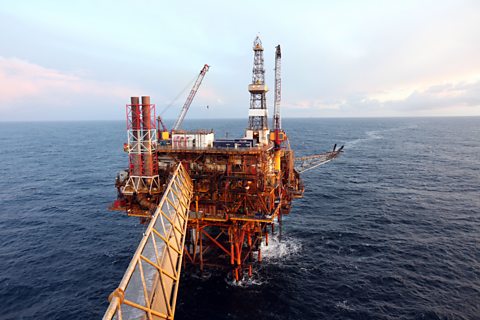
The oil and gas industry has a huge impact on Aberdeen.
At the end of the 1960s, oil and gas were found under the sea bed of the North Sea. The first oil flowed into Scotland in 1975. Oil companies based themselves in Aberdeen and the harbour became Europe's main port providing support and supplies for oil rigs in the North Sea.
Since around the year 2000, the amount of fuel produced in the North Sea has gone down. Oil and gas under shallower water have been used up, so companies need to drill under deeper parts of the North Sea. This is more difficult and expensive.
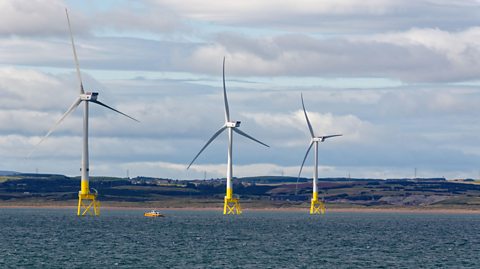
Oil and gas are fossil fuels which contribute to climate change. Scotland is moving to cleaner energy sources.
Aberdeen has companies and workers who are moving to producing renewable energy. Building and running offshore windfarms uses many of the same skills as supporting oil and gas rigs.
Aberdeen Bay windfarm is just off the coast of Aberdeen and helps generate some of Scotland's renewable energy.
Find out more about renewable and non-renewable energy.
Scotland's public parks
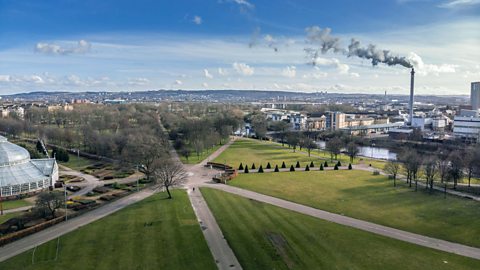
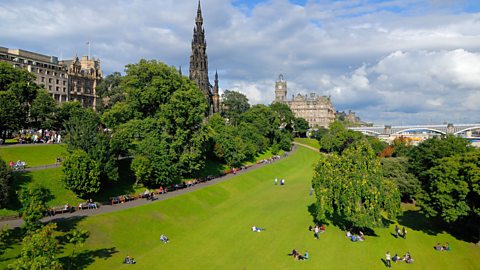
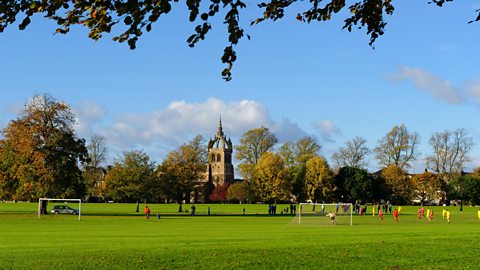
Scotland’s towns and cities have lots of public green spaces. Many of these green spaces were created in the Victorian era and gave people in the crowded cities open spaces to enjoy.
Today these parks still play an important job – they are great for good mental health, fun and wildlife and nature. Look through the slideshow to find out more about some of Scotland's public parks.
Learn more about how Scotland changed during the Victorian era here: How Victorian Scotland changed
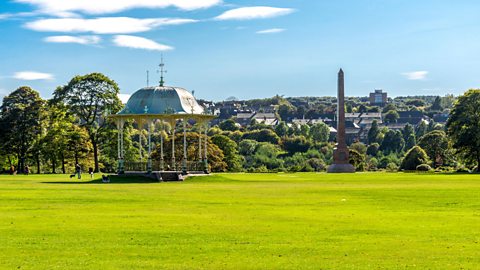
Image caption, Duthie Park, Aberdeen
Duthie Park opened in 1883 after it was gifted to the city by Miss Elizabeth Crombie Duthie in 1880 for the ‘wellbeing and recreation of Aberdeen inhabitants.' (Anastasia Yakovleva / Alamy Stock Photo)
1 of 4
Urban, suburban and rural areas
More than one third of people in Scotland live in cities and large towns. All cities and their surroundings are different but most can be divided into three types of area:
- urban
- suburban
- rural
Urban
Cities and big towns are described as urban.
Urban areas often have a busy centre where there are larger businesses, shops and offices, and places to visit like cinemas, restaurants or museums. These are often in taller buildings because there is limited space. Streets can become busy with traffic as many people come to work or visit in the town or city centre.
Space for houses can be limited in urban areas too. Some people live in flats, tenements or terraced houses that are built close together with small gardens.
Suburban
Suburban areas grow around cities and towns. They usually have some shops, offices and other businesses but most land is taken up by houses. These are usually in lower buildings and are more spread out, with bigger gardens, more green space and quieter streets.
The suburbs are also home to shopping centres and supermarkets that are easier for people to drive to than the city centre.
Rural
Rural areas means the countryside. Most rural land is open space, which could be farmland, forest or wild places.
People in rural areas often live in villages or smaller towns. Near cities, these might be commuter villages - people live here but travel into the city for work or to use shops and services.
Businesses in rural areas include farms and local shops and services in towns and villages. There are sometimes larger businesses like factories or warehouses which can take up more space on cheaper land.
Key words about energy and landscapes
Check your connection, refresh the page and try again. - Fossil fuels were formed over millions of years from the remains of dead animals and plants. These became buried underground and pressure and heat turned them into oil, gas and coal.
Check your connection, refresh the page and try again. - Types of energy that will not run out, including wind, wave, tidal and solar energy.
Check your connection, refresh the page and try again. - The change in the usual conditions of weather (temperature, wind, rainfall etc.) on Earth over a long period of time. The climate has changed throughout the history of Earth, but current climate change refers to an increase in global temperature.
Check your connection, refresh the page and try again. - In or from the countryside rather than in a city or town.
Check your connection, refresh the page and try again. - In or from the area around the outside of a city.
Check your connection, refresh the page and try again. - In or from a city or large town.
Test your knowledge
Quiz
Challenge

Find urban, rural and suburban areas where you live.
Explore the local area of your school on foot, online or with maps.
Can you work out if the area is urban, rural or suburban?
What clues show you this?
More on Landscapes
Find out more by working through a topic
- count2 of 25
- count3 of 25
- count4 of 25