Sound waves
Sound waves are:
created by vibrating sources
A wave that moves in the same direction as the direction in which the particles are vibrating.
Sound waves cause particles to vibrate parallel to the direction of wave travel. They need a A material through which a wave can be transmitted (propagate). to transmit because they are carried by molecules. The Repeated movements back and forth (about a fixed point). travel through solids, liquids or gases. The speed of sound depends on the medium through which it is travelling.
When travelling through air, the speed of sound is approximately 330-350 metres per second (m/s). Sound cannot travel through a A volume that contains no matter. because there are no particles to carry the vibrations.
Extended syllabus content: Compression and rarefaction
If you are studying the Extended syllabus, you will also need to know about compression and rarefaction, as well as how sound travels differently in solids, liquids and gases. Click 'show more' for this content:
Compression and rarefaction
Longitudinal waves show areas of compression and rarefaction:
Compressions are regions of high pressure due to particles being close together.
Rarefactions are regions of low pressure due to particles being spread further apart.
Longitudinal waves are often demonstrated by pushing and pulling a stretched slinky spring.
How sound travels
In general, sound travels faster in solids than in liquids and faster in liquids than in gases.
Audible sound
Video: How do vibrations in the air lead to a sound we can hear?
In this video, Professor Sophie Scott uses a tuning fork and a high-speed camera to show what is physically happening when we hear sounds.
The ear
The human ear detects sound. Sound waves enter the ear canal and cause the eardrum to vibrate. Three small bones transmit these vibrations to the cochlea. This produces electrical signals which pass through the auditory nerve to the brain, where they are interpreted as sound.
Properties of sound
The The number of waves produced each second. The unit of frequency is hertz (Hz). of a sound wave is related to the pitch that is heard:
High frequency sound waves are high pitched.
Low frequency sound waves are low pitched.
The The maximum height of a wave from the middle of the wave to its peak or trough. of a sound wave is related to the volume of the sound:
High amplitude sound waves are loud.
Low amplitude sound waves are quiet.
A device used to record signals that change regularly, such as sound or other vibrations. traces showing the following sounds:
Quiet, low pitch sound.
Loud, low pitch sound.
Loud, high pitch sound.
The cochlea is only stimulated by a limited range of frequencies. This means that humans can only hear certain frequencies. The range of typical human hearing is 20 Hertz (Hz) to 20,000 Hz (20 kHz).
Echoes
Sound waves can reflect off surfaces. Reflected sound waves are heard as echoes. Hard, smooth surfaces are particularly good at reflecting sound - this is why empty rooms produce a lot of echo. Soft, rough surfaces are good at absorbing sound - this is why rooms with carpets and curtains do not usually produce echo.
Measuring the speed of sound in air
The air is made up of many tiny particles. When sound is created, the air particles vibrate and collide with each other, causing the vibrations to pass between air particles. The vibrating particles pass the sound through to a person's ear and vibrate the ear drum.
Light travels much faster than sound through air. For example, a person fires a starting pistol into the air. A distant observer stood 400 metres (m) away records the time between seeing the trigger being pulled (the light reaches the timekeeper immediately) and hearing the sound of the pistol (which takes more time to cover the same distance).
The speed of sound can be calculated using the equation:
\(speed = \frac{distance}{time}\)
\(v = \frac{s}{t}\)
This is when:
speed (v) is measured in metres per second (m/s)
distance (s) is measured in metres (m)
time (t) is measured in seconds (s)
Example
An observer 400 m away records a 1.2 s time difference between seeing the trigger being pulled and hearing the bang of the starting pistol.
\(v = \frac{d}{t}\)
\(v = 400 \div 1.2\)
\(v = 333~m/s \ (3 \ sf)\)
The accepted value for the speed of sound in air is 330 m/s.
However, this experimental method is flawed as humans do not use timers identically to one another. One person might stop the timer a fraction of a second later than another person. The values recorded will be dependent on the reaction time of the observer and will not be entirely accurate. This explains why the answer of 333 m/s is slightly above the accepted value for the speed of sound in air.
Ultrasound
Sound with a frequency greater than 20,000 Hz (20 kHz). waves have a frequency higher than the upper limit for human hearing - above 20,000 Hz (20 kHz). Different species of animals have different hearing ranges. This explains why a dog can hear the ultrasound produced by a dog whistle but humans cannot.
Extended syllabus content: Uses of ultrasound
If you are studying the Extended syllabus, you will also need to be able to describe the uses of ultrasound. Click 'show more' for this content:
Uses of ultrasound
Ultrasound sound can be used in non-destructive testing of materials such as metals and plastics.
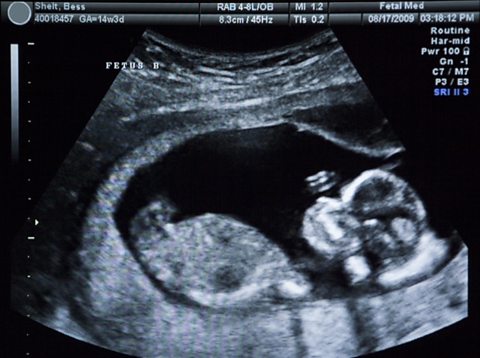
Ultrasound imaging creates a picture of something that cannot be seen directly, such as an unborn baby in the womb, or faults and defects inside manufactured parts.
These uses rely on what happens when ultrasound waves meet the boundary between two different materials. When this happens:
- some of the ultrasound waves are reflected at the boundary
- the time taken for the waves to leave a source and return to a detector is measured
- the depth of the boundary can be determined using the speed of sound in the material and the time taken
Sonar
Ultrasound is also used in sonar instruments on boats and ships.
High frequency sound waves can be used to detect objects in deep water and to measure water depth.
The time between a pulse of sound being transmitted and detected and the speed of sound in water can be used to calculate the distance of the reflecting surface or object.
The process is very similar to ultrasound imaging.
For deep water, 50 kHz is the preferred frequency of the ultrasound.
This is because water absorbs sound waves at a slower rate than for lower frequencies and so the signal can travel farther before becoming too weak to use.
This technique is applied in sonar systems used to measure the depth of the seabed and to find shipwrecks, submarines and shoals of fish.
SONAR stands for SOund Navigation And Ranging.
Bats and dolphins use a similar method, called echolocation, to detect their surroundings and to find food.
Example
A sonar system on a boat sends an ultrasound pulse towards the seabed. The pulse is reflected, and it is detected 0.1 s later by the system.
Calculate the depth of water if the speed of sound in water is 1,480 m/s.
Answer
Distance = speed × time
Speed = 1480 m/s
Time for ultrasound to travel to seabed and back again = 0.1 s
Time for ultrasound to travel to seabed = \(0.1\) \(s\) ÷ \(2\) = \(0.05\) \(s\)
Distance to seabed = \(1480\) × \(0.05\) = \(74\) \(m\)
The depth of water is 74 m.
Quiz
Test your knowledge with this quiz on sound waves.
Teaching resources
Are you a physics teacher looking for more resources? These video clips from BBC Bitesize for Teachers explore the topic of sound - from free falling through the sound barrier to finding out if a singer can smash a glass using sound waves.
More on Waves
Find out more by working through a topic
- count5 of 5
- count1 of 5
- count2 of 5
- count3 of 5