Evolution
Evolution explains how the living things on our planet today have slowly developed from simpler life forms that lived millions of years ago.
The first person who explained how evolution happens was Charles Darwin with his scientific theory of evolution.
Watch: Explaining evolution
Fran: Have you ever noticed that some species of the same animal can look very different?
In 1835 a scientist called Charles Darwin noticed that finches, so a type of bird, found on different islands had different shaped beaks even though they were the same species of bird.
Now Darwin theorised that this was due to a process called natural selection which works on the principal of survival of the fittest.
The idea is that animals with certain features are more likely to thrive in an environment that suits those features, so a place with flowers would suit a hummingbird's long, thin beak, but not the hard curved beak of a parrot.
Now the hummingbird is more likely to then mate and pass on their long beak to their chicks.
The parrot will do better elsewhere.
And Darwin proposed that over many, many years animals and plants have adapted and changed to survive and thrive in their environments.
And this is his theory of evolution.
And evolution takes a very long time to evolve lasting changes.
Over to one of my investigators to see what they've learned about adaptation.
Child: Scientists believe that birds evolved from dinosaurs.
I've got some pictures of different dinosaurs, let's have a look at them!
This is a model of a dinosaur that lived about 130 million years ago.
It was around 9 metres long, so it was much bigger than birds are today, and it had fluffy feathers like a chick.
Then this next one lived about 125 million years ago.
It is definitely shaped more like a bird.
It had a smaller head, shorter thinner legs, and proper wings, but scientists believe it was too large to fly.
This one looked a lot more like birds do today.
It lived around 86 million years ago.
It was a lot smaller than previous dinosaurs, so scientists believe they could fly.
It had sharp teeth and large jaws like a dinosaur, but they're inside a beak like birds we see today.
Fran: Over time small adaptations, they build up, leading to big evolutionary changes.
For example, the woolly mammoth and the Asian elephant both came from a common ancestor, but they evolved into different looking creatures.
Woolly mammoths lived in the ice age, when the earth was very, very cold, so that's why they had a thick woolly coat.
Watch: Evolution over time
Watch an animal evolve over millions of years.
Emmet: Greetings, Emmet here! Evolution is the way that living things have developed and changed over time. Just watch this!
All animals within a species are slightly different from each other, but have you ever seen a fella as fast and strong as this?
He’s a born winner! But it’s a tough world out there. It’s the reason we don’t see, er, the less successful in a species sticking around for too long.
Oh, poor fella. Now, when our champ had kids, he passed on his successful traits - his long legs and powerful muscles - to his children.
So, only the fittest, or best adapted survive and, over millions of years, the different species gradually changed, until they’ve become the horses we see today.
And that’s how species evolve! Go on! Giddy up!
Fascinating facts
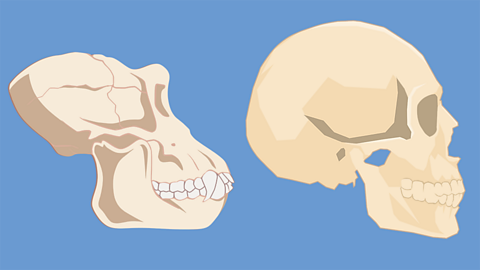
Humans didn't evolve from apes, we just share a common ancestor.
Charles Darwin developed his theories on evolution whilst on a five-year sea voyage aboard HMS Beagle from 1831 to 1836.
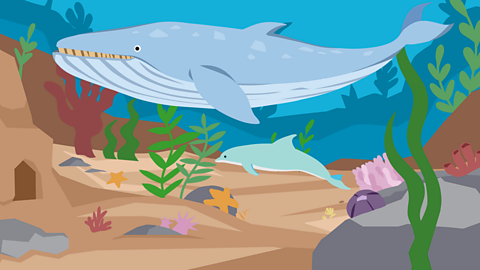
Dolphins and whales evolved from mammals that walked on the land.
No two animals are exactly the same, every single one is unique.
Every species of dog evolved from one, now extinct, species of wolf.
Humans are still evolving. Blue eyes have only developed in the last 10,000 years or so.
Fossils can provide us with evidence of extinct species and also of how a species has evolved over millions of years.
We can also learn about evolution in different species by studying their DNA.
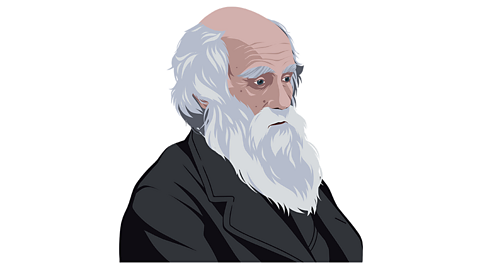
Who is Charles Darwin?
Charles Darwin observed that although individuals in a species shared similarities, they were not exact copies of each other; there were small differences or variations between them.
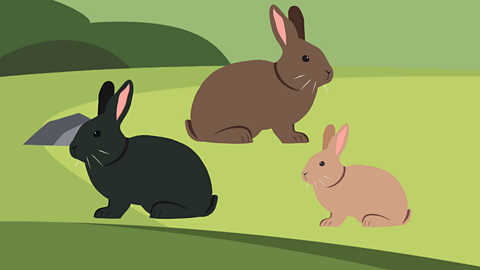
For example, imagine a group of rabbits. Some may be faster, some might be slower and some might have different colour fur. He also noticed that everything in the natural world was competing to survive.
Due to natural selection, the winners were those which adapted or adjusted their characteristics to increase their chance of survival in the environment they were in.
For example, if they were stronger, faster, cleverer or more attractive than others in their species, they were more likely to reproduce and pass on their useful characteristics to their offspring.
Individuals that were poorly adapted were less likely to survive and their characteristics were not as likely to be inherited.
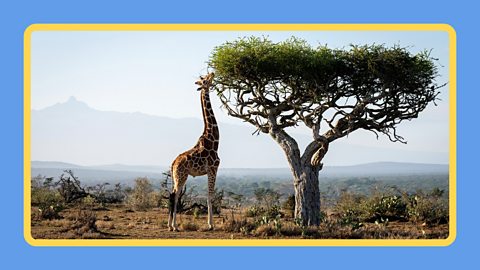
Over time, the characteristics that help survival become more common and a species gradually changes. Given enough time, these small changes can add up to the extent that a wholly new species can evolve.
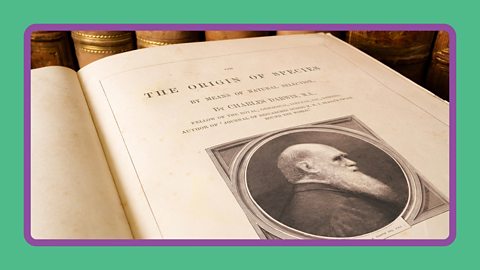
Charles Darwin published his scientific theory of natural selection in a book called ‘On the Origin of Species’ in 1859.
Darwin’s theory explained how every living thing is connected in a huge family tree that stretches back billions of years to the beginning of life on Earth.
Charles Darwin and the theory of evolution
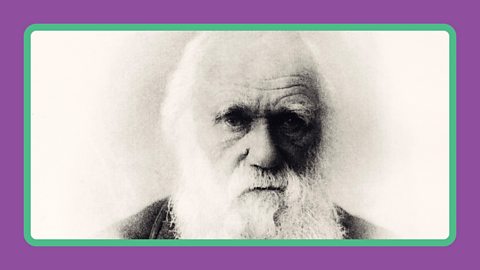
Image caption, Charles Darwin
A photograph of the scientist Charles Darwin (1809 – 1882) who developed the theory of evolution.
1 of 6
Did you know?
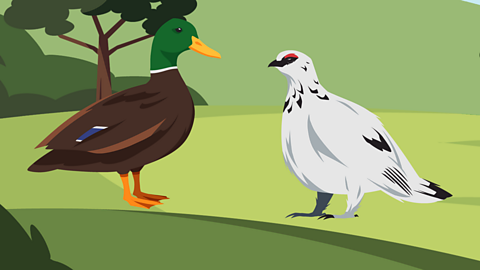
Instinct is an important tool for animals to survive and make it through natural selection.
This is why birds migrate across continents throughout summer and winter.
Important words
Charles Darwin – Darwin was a scientist and naturalist, he published his revolutionary book ‘On the Origin of Species’ in 1859.
Evolution – The theory that explains how the living things on our planet have slowly developed from simpler life forms that lived many millions of years ago.
Instinct - A way of behaving or thinking without being told to. Instinct is an important tool for animals to survive and make it through natural selection.
Evolve – The way species can change over time to adapt and survive.
Inherited – Characteristics passed down through successive generations of a species.
Natural selection – The process in which species have to adapt to their environments or die.
Offspring – An animal's young.
Reproduce – The way that animals create offspring.
Species – A population of a group of animals or plants.
Variations – The differences between individual animals or plants in a species.
Activities
Activity 1 – Fill in the gaps
Activity 2 – Evolution quiz
Activity 3 – Write like Charles Darwin
You can learn more about Charles Darwin by watching the clip below and reading these sheets from Terrific Scientific .
Watch: Chares Darwin and Alfred Wallace
Learn more about the work of Charles Darwin and Alfred Wallace
CHARLES DARWIN: Hi fans, followers and friends, Charles Darwin here, the man who's going to give you the theory of evolution and natural selection. My theory is plants and animals do not stay the same, they change over time. Natural selection is the adaptation of organisms to their environment and the conditions in which they live.The better they adapt, the more likely they are to survive and reproduce passing on those good genes and characteristics to their offspring.
ALFRED WALLACE: Excuse me Charles, unbelievable, you seem to have started without me. Always trying to take all the credit for our joint theory of evolution aren't you?
CHARLES DARWIN: Keep your hair on, Wallace, I was just trying to make a start.
ALFRED WALLACE: Clearly.
ALFRED WALLACE: Natural selection is the survival of the fittest. We have evolved over time from simple specimens that first lived over three billion years ago.
CHARLES DARWIN: So, how did we come up with our theory on evolution and natural selection?
ALFRED WALLACE: Well, for some time now myself and Charles Darwin have both been independently and unknowingly investigating the connection between animals and humans, asking the scientific question what the origin of plants and animal species is, where we came from, and how we all came to be.
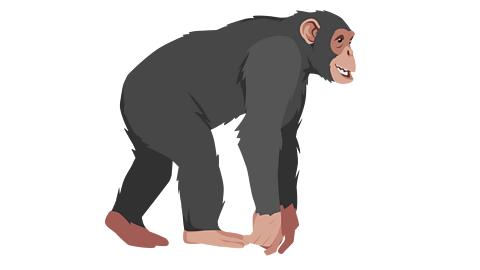
CHARLES DARWIN: Yes, and would you believe, humans shared a common ancestor with chimpanzees millions of years ago. [imitates monkey]
CHARLES DARWIN: To prove this hypothesis was correct I set off on my voyage on the HMS Beagle to Australia and the Galapagos Islands. While I was there I started to put into practice my scientific method, this was through-ALFRED WALLACE: -experimentation in the form of observation.
CHARLES DARWIN: Yes, observation and documentation was key to this discovery. For example, I observed adaptations of finches' bodies, beaks, and claws on the Galapagos Islands. I carefully recorded that, depending on the food source, the finches had different features in order to survive.
ALFRED WALLACE: Likewise, whilst I was in Brazil in 1848, in the Amazon, collecting specimens of butterflies, insects and birds, I observed the different species and recorded my findings accurately. I also found variations in different species depending on their living conditions and the environments they inhabited.Sadly, all the specimens I collected never made it home as the ship caught fire destroying them all.
CHARLES DARWIN: Dreadful ordeal for you, Wallace, but it didn't stop you did it?
ALFRED WALLACE: No, it didn't, I set sail in 1854 on an eight-year trip around Singapore, Malaysia and Indonesia where I carried out observations on species. I observed how they'd adapted to their environment and I categorised them based on their characteristics.When I returned, I started to write up my findings, summarising the reasons as to why I thought some animals became extinct and that's when I contacted Darwin and we realised we'd discovered and determined the same theory of evolution and natural selection.
CHARLES DARWIN: Yes, I was over 250,000 words into writing my natural selection book when I received your letter backing up my theories.
ALFRED WALLACE: Our theories you mean!
CHARLES DARWIN: Well, that's it for today's vlog.
ALFRED WALLACE: Hey, maybe next time you guys are outdoors, you could observe a bird, an insect or a mammal and document how it's adapted to survive to its environment. Look at their beaks, claws and other features.
CHARLES DARWIN: And remember there's hundreds of thousands more species waiting to be discovered, and who knows, if your records are really good, one day, you could find one. They might even name one after you. Oh and don't forget to subscribe to my channel, it's Charles Darwin Da Man.
ALFRED WALLACE: Really?!

Research Charles Darwin and his discovery.
Pretend you are Charles Darwin living two hundred years ago.
Write a letter to your friend explaining about your ‘new’ theory of evolution.
You could always stain your letter to make it look old using a teabag.
New game! Horrible Science: Stinky Space. game
Join Pipette on her epic mission and learn some revolting facts about space along the way.
More on Evolution and inheritance
Find out more by working through a topic
- count4 of 4
- count1 of 4
- count2 of 4