What are fossils?
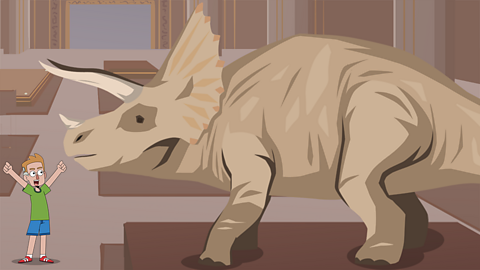
Fossils are the preserved remains or traces of dead organisms.
They show us how living things and the environment have changed since the time they were alive.
Fossils have been found in rocks of all ages, going back billions of years. However, most of the species found in the fossil record have died out or become extinct.
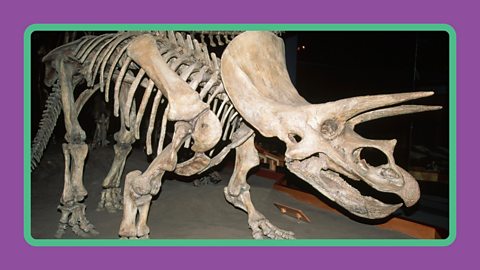
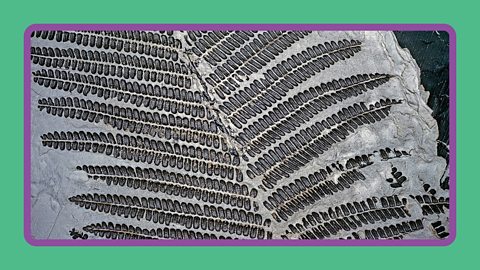
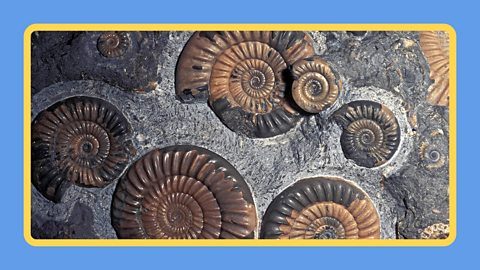
Image caption, Fossils are the preserved remains or traces of dead organisms, like this fossil of the dinosaur triceratops.
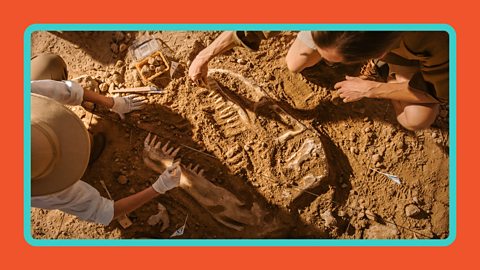
1 of 4
Did you know?
Fossils can tell us about geographical changes to our landscape.
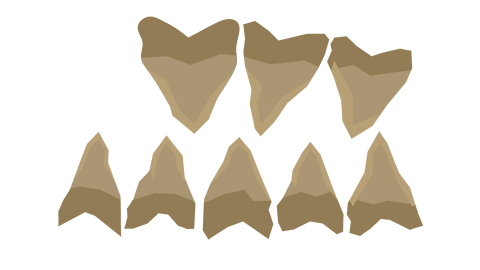
A megalodon is an extinct species of giant shark which lived in the Earth's oceans many millions of years ago. Megalodon fossils have been found in Utah in the United States which is landlocked, which means that it is not connected to the sea or ocean.
This shows us that some of the land that we now walk on used to be covered in seawater and was vibrant with life.
Watch: What do fossils tell us?
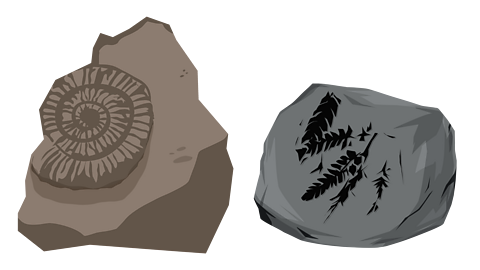
Fran: This is an ammonite fossil.
Millions of years ago an ammonite, which was a creature, died, and it fell to the seabed.
Now, the soft parts of the ammonite rotted or were eaten, leaving just the shell which was then covered in a layer of silt or sand.
Over many years the shell was then buried under lots of layers of sediment which eventually compacted and squashed together to make rock.
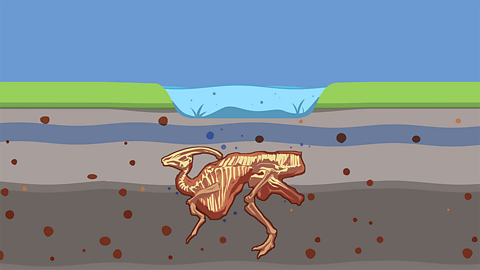
Water then seeped in, dissolving the bone and instead, filling where the bone was with minerals.
Then when the seas and earth moved over time, this ammonite fossil ended up on dry land.
Then wind, rain and ice eroded away the layers of rock that had built up until finally it was uncovered and found.
So let's see what my investigator has discovered about their fossil.
Child: This is a trace fossil.
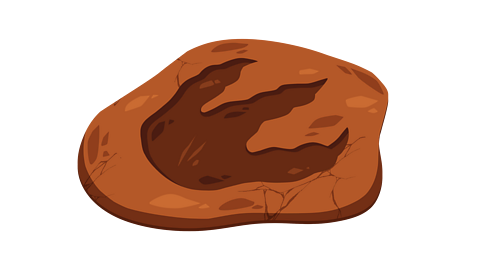
It's a print of a living thing that was left in this Earth millions of years ago.
Now, is it a plant or an animal?
These shapes could be the wing of a bird, the fin of a fish or maybe it's the leaves from a plant.
If I look with my magnifying glass, I can see some texture.
The texture makes me feel like it's the leaf of a fern… let's see if I'm right.
I was right!
It's a trace fossil from a fern from the Jurassic period.
I wonder what kind of dinosaurs brushed past the plant that made this fossil?
Fran: Fossils give us clues about animals in the past.
And sometimes these are similar to animals today
So, look at these two skulls.
One is from a modern crocodile.
The other is from a Sarcosuchus – which lived around 112 million years ago.
The jaw shape of both animals are similar, they both have lots of teeth but look at this large snout and the eye sockets on the top of the head.
Now they're perfect for hiding in the water.
And some modern-day crocodiles, they hide in the water don't they, and attack passing prey, and scientists think that the Sarcosuchus probably did the same thing, only with a jaw that's around 6 feet or 180 centimetres long!
Now that would have been a big meal!
How are fossils formed?
Fossils provide a snap shot of the past and allow us to study how much or how little organisms have changed as life developed on Earth.
Only organisms that die in specific conditions will go on to become a fossil. In fact, the fossilisation process is incredibly rare as you will find out in this video.
Dig deep to uncover the facts about fossils.
Greetings! Emmet here, and I'm about to witness an extremely rare event – a fossil being made!
Some animals, many millions of years ago, were buried quickly after their death in substances like sand, volcanic ash or mud.
Did you see that? Fantastic!
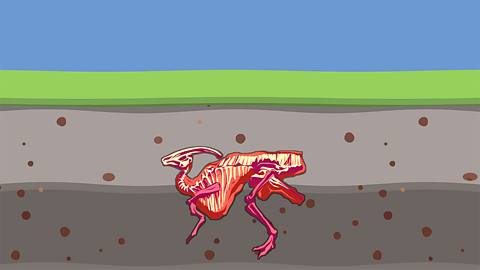
Usually the soft parts, like the muscles, rot away leaving the hard parts, like the skeleton, behind.
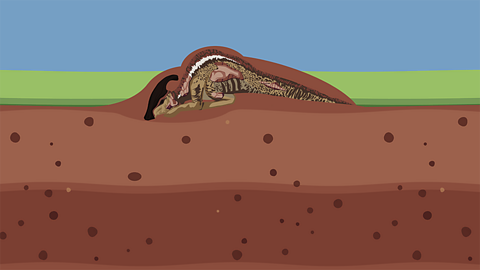
Then, over time, more layers of sediment cover the remains. That's why fossils are only found in sedimentary rocks.
Now, this guy's been under a whole lot of pressure and, in that time, the sediments around the bone has compacted to form rock.Water has seeped into the bone and dissolved it completely.
Minerals, in the water, are then deposited inside this mould and ta-da! Our fossil is made!
Then, over millions of years, the rock rises to the surface and is worn away by erosion.Man, I dig fossils!
Fascinating facts
- Dinosaur fossils have been found on every continent on Earth.
- You can find fossils made off animal poo, these are called coprolites. Stinky!
- The word fossil comes from the Latin word fossilis, which literally means ‘dug up’, from the word fodere, which means ‘to dig’.
- Dinosaurs lived in many different environments and climates, from deserts to tropical forests.
- Dinosaurs were reptiles.
- Scientists believe that many species of dinosaurs had feathers, including the velociraptor.
- Fossils aren't actually bones, the bone is replaced by rocks and minerals over millions of years.
- Fossilisation is a rare event, it only happens in unique conditions before the bones can decompose.
Stages of fossilisation
It is very rare for living things to become fossilised because when an animal dies its body usually rots away and nothing is left behind. This is the same with plants.
However, when the conditions are just right a fossil can form. The most common fossils found are of creatures that lived in the sea, because the sediment moves quickly in water and so any creatures that die are usually covered up quickly by layers of mud and sand.
This is why fossils are found in sedimentary rock.
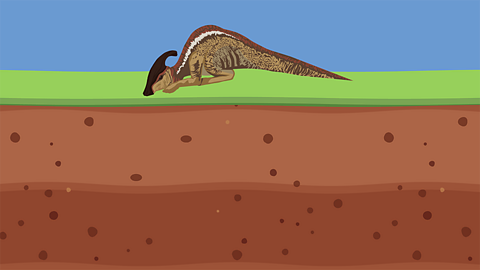
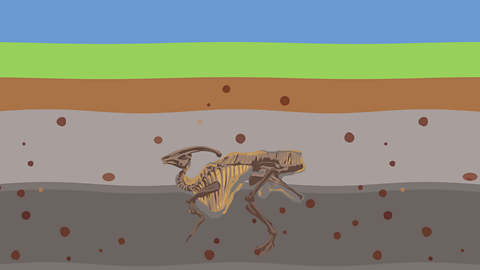
Image caption, 1. Death
The animal dies and falls to the ground. The soft parts of the body decompose or are eaten by scavengers. The hard parts of the body, such as bones and teeth, remain intact.
1 of 5
Did you know?
The oldest known fossils are stromatolites which were found in Western Australia.
They were estimated to be about 3.4 billion years old.
Stromatolites are formed by colonies of microorganisms, such as bacteria, which were some of the earliest forms of life on Earth.
A fossil record
Watch: Looking at the fossil record
Fossils can be found in surprising places and they can tell us about the past.
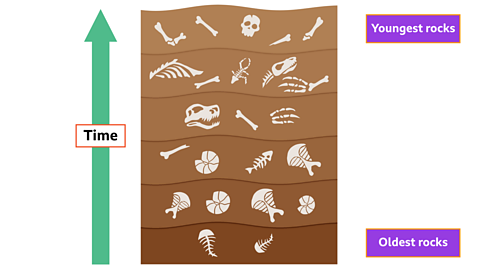
We call all of the fossils we have found the fossil record. This record shows us how living things have changed from simple life forms billions of years ago.
Not all fossils have been found and some may have been destroyed so there are gaps in the fossil record.
Understanding what we can learn from fossils.
EMMET: Greetings! Emmet her and this is my fossil record, a rock record of all my evolutionary ancestors stretching back billions of years.
I’ve found fossils of all these guys. They show how the earth, and everything that’s lived on it has changed over time.
For example, this fella. He once lived in a nice, warm tropical sea, and when he died his body become fossilised in rock. Then, over millions of years, the whole environment changed.
Brrr. That means we can find fossils in surprising places, like sea creatures at the top of mountains!
Fossils show us some of the incredible animals and plants that have inhabited our planet, but most of these species have died out or become extinct, like our pool old friends the dinosaurs.
Oh! It seems I’ve out stayed my welcome!
That was incredible! Oh, did you see that! Ha ha!
Did you know?
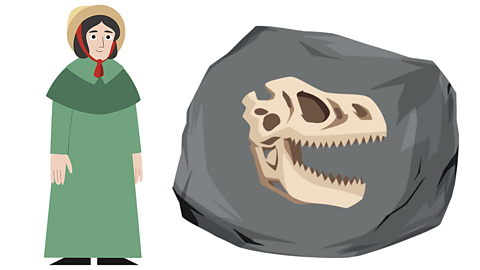
Mary Anning (1799-1847) was a British fossil collector and palaeontologist.
Anning was a pioneer of collecting, and displaying fossils. She identified several fossils of ichthyosaurs, plesiosaurs, and pterosaurs.
In the 19th century women like Mary Anning weren't allowed to be members of the Geological Society of London, so she didn't always receive credit for her scientific work.
Important words
Extinct – An organism that is no longer in existence. Dinosaurs have been extinct for many millions of years.
Fossils – A fossil is the preserved remains or traces of a dead organism.
Fossil record – A record of fossils that shows how living things have evolved over time.
Fossilisation process – The name of the process that organic materials go through over millions of years to become fossils.
Geographical – The features of the Earth's surface.
Organism – Any living thing, including insects, plants and animals, is an organism.
Palaeontologist – Scientists who study fossils.
Activities
Activity 1 – Order the fossilisation process
Activity 2 – Fossil record quiz
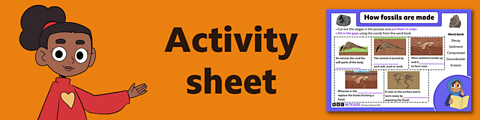
Activity 3 – How fossils are made
New game! Horrible Science: Stinky Space. game
Join Pipette on her epic mission and learn some revolting facts about space along the way.
More on Evolution and inheritance
Find out more by working through a topic
- count2 of 4
- count3 of 4
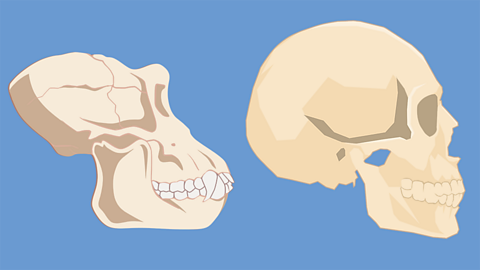
- count4 of 4