The design process
We all love coming up with ideas and solutions to problems, but if we do not carefully consider our approach to the development of the solution, what we manufacture may not meet the client’s needs.
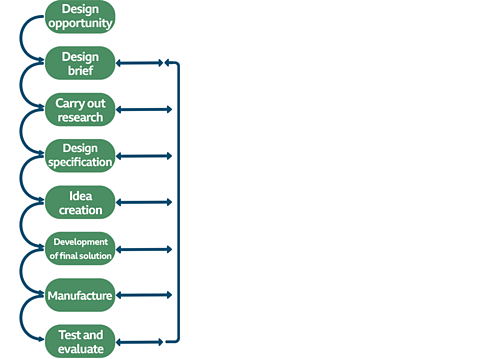
The design process provides us with a series of important stages during the design and development of a solution.
Note:
The order of these stages is not fixed and will change depending on the design opportunity.
The process is often considered as a design cycle. The designer evaluates and improves their design ideas repeatedly until a solution is developed.
JOE
Hi there and welcome to
another episode of Tech Bitez. As usual, we have your two favourite tech tinkers to take you through everything you need to know about technology and design.We have a very exciting episode lined up for you all today. I have come up with a game changer invention. That means you will never lose any of your valuables ever again.As you can see from my design here, you simply attach one of these buzzers to any of your valuables. Then when you misplace one of them, you simply just press the button on the home box and the buzzer will make a sound allowing you to easily find whatever you're looking for.
SANDY
Okay, Joe, I've got to hand it to you. That idea isn’t half bad. Well, it's a good start at least. We need to go through a rigorous design process.
JOE
Design process? Surely you mean the manufacturing process? I've already done the design.
SANDY
The manufacturing process is one part of the design process, but there is a lot more to it. The design process isn't exactly linear, meaning that it doesn't have to be done…
…in a certain order. However, each step can still play a very important role in the process as a whole.We would normally start with a design opportunity. This could be a client coming to you asking for a certain product to be manufactured or like in your instance, Joe, the engineer themselves have a stroke of genius. If you believe there is a design opportunity or gap in the market for your product, the next stage should be research.
JOE
Well, I'm pretty sure nothing like my product exists, so this part should be handy.
SANDY
Have you checked?
JOE
Oh, okay. So maybe there is a couple of similar products.
SANDY
Anyway, the next step after your research would be to come up with a design brief and specification. Once you have decided which ideas you would like to borrow, you can come up with a detailed brief about exactly how and what your product will do in your specification. You can then start to detail out more specifics like size and shape.
JOE
Okay I guess I can see why doing each of those steps can help. Can I start cutting stuff yet?
SANDYJust one last step, please. Put that down. The final step before manufacture is idea, generation and development. It's at this point that you can come up with your design as well as how you plan to manufacture it.I know this is where you had initially started, but hopefully those extra steps and the design process will help the manufacture run a lot smoother.
JOE
So I could start now.
SANDY
I suppose.
JOE
Yes!
Stages of the design process
Design opportunity
Design opportunities arise out of real-life situations. These can be a problem that already exists or a new idea to deal with a situation.
The designers will set out to solve a problem or create a solution that meets the needs identified in the design opportunity.
Design brief
This is a short statement that outlines the problem to be solved. The designer will use information in the design brief to carry out further research and develop possible solutions.
Research
Research will involve looking closely at the design opportunity to clarify exactly what the client needs.
Research will also help gain new knowledge into areas that will help design the solution.
Areas of research may include
analysis of similar solutions
investigation of suitable materials
consideration of suitable manufacturing processes
Design specification
A specification will contain in detail, the requirements of a developed solution. It is a list of the things that a product needs to address.
It can include some or all the following: size, materials, cost, operation, and appearance or aesthetics
Information in the specification will be used to help develop possible solutions.
Idea generation (possible ideas)
Possible design ideas/solutions for the design brief will be generated based on your research and specification. Make sure you combine your own ideas with information from your research.
A range of different designs developed using sketches and drawings with annotations will help you choose the best solutions.
Development of final solution
The development of your solution will be based on an idea you have selected from your generated ideas.
You might create a model to help refine how your design looks and operates. Models can be made from card or cheaper woods. Models can be tested to find design refinements.
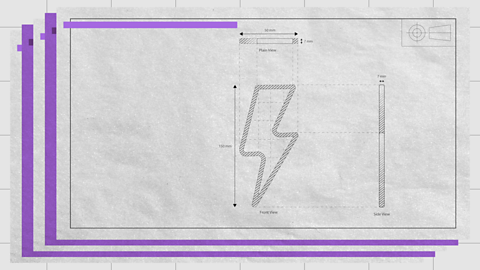
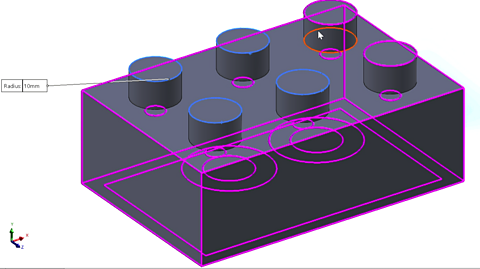
Working drawings should be made either by hand or using computer aided design (CAD) at this stage. Accurate dimensions and details of materials should be included to help manufacture your developed design idea.
Manufacture
Manufacture will use the information in your working drawing and the tools, processes, and materials available in your Technology and Design workshop.
You must learn how to use the tools and machines safely before manufacturing your product.
Test and evaluate
Your finally manufactured design solution will be tested on how it meets the design specification.
Ask questions like:
- How well does it function?
- Does it work reliably?
- Can it be used safely?
- What modifications would you make to your design?
Activity
Which stage of the design process is being described?
Which stage is being described?
1. Alex is having trouble keeping her mobile telephone safe when riding on her mountain bike.
Design opportunity
2. Design a phone holder for use on a bicycle.
Design brief
3. Consideration of mobile phone holders on the market. Investigation of possible materials.
Research
4. The developed mobile phone holder should:
- hold one phone securely,
- be made of plastic,
- allow the phone to be used while holding the phone,
- be attractive to teenage phone users.
Design specification
5. Sketches of possible solutions with annotations.
Ideas generation
6. Working drawings with dimensions
Development of final solution
7. Use of a workshop including materials, tools, and resources.
Manufacture
8. Consideration of how well the manufactured solution meets the design specification
Test and evaluate
More on Design and communication
Find out more by working through a topic
- count2 of 4
- count3 of 4