Key points
There are different types of fractions - a fraction can be A fraction where the numerator is less than the denominator, eg 3⁄5, A fraction where the numerator is greater than the denominator, eg 9⁄4 or a A number that is written using a whole number and a fraction, eg 3 4⁄5.
- A proper fraction has a Number written at the top of a fraction. The numerator is the number of parts used. Eg, for 1⁄3, the numerator is 1 that is less than its Number written on the bottom of a fraction. The denominator is the number of equal parts. Eg, for 1⁄3, the denominator is 3.
- An improper fraction has a numerator greater than its denominator. An improper fraction is always greater than one whole.
- An improper fraction can also be written as a mixed number. This is an Integers are numbers with no fraction or decimal part. They can be positive, negative or zero. 42, 8, and 10000 are examples of integers. and a fraction next to each other.
- Proper fractions, improper fractions and mixed numbers can be represented by a diagram or written in figures.
- To process calculations, different types of fractions are used. Improper fractions are used when multiplying and dividing. Mixed numbers may be preferred for adding and subtracting.
What are mixed numbers, proper and improper fractions?
A fraction can be a proper fraction or an improper fraction. An improper fraction written as an integer with a fraction is called a mixed number.
- A A fraction where the numerator is less than the denominator, eg 3⁄5 has a numerator that is less than the denominator. In a diagram a proper fraction is shown as less than a whole shape.
- An A fraction where the numerator is greater than the denominator, eg 9⁄4 has a numerator that is greater than the denominator. In a diagram an improper fraction is shown as greater than one whole shape.
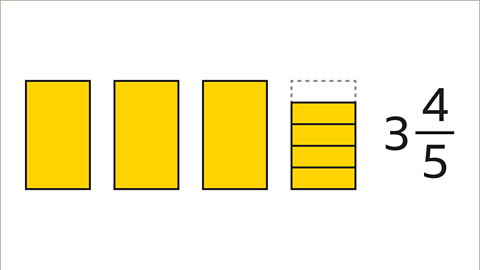
- A A number that is written using a whole number and a fraction, eg 3 4⁄5 is an integer written with a fraction. In a diagram a mixed number is shown as a combination of complete shapes and parts of a shape.
Example: types of fractions
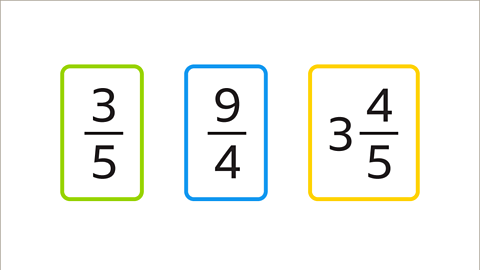
Image caption, A fraction can be a proper fraction or an improper fraction. A value greater than one whole can be an improper fraction or a mixed number.
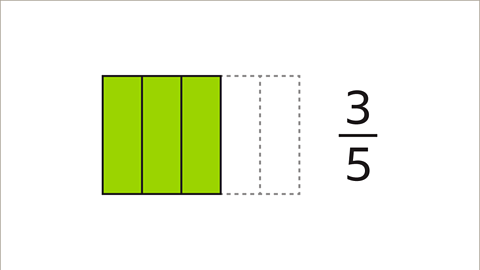
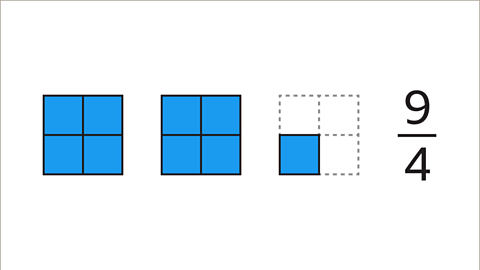
1 of 4
How to convert a mixed number to an improper fraction
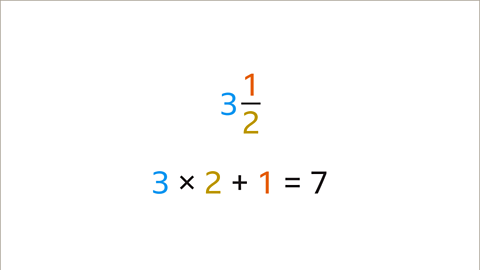
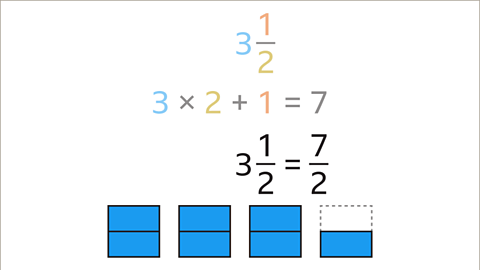
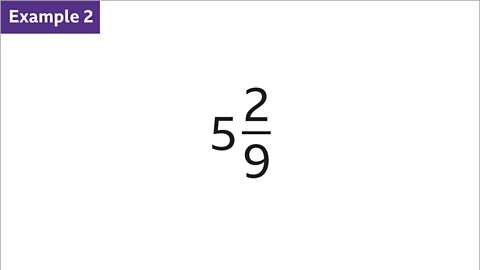
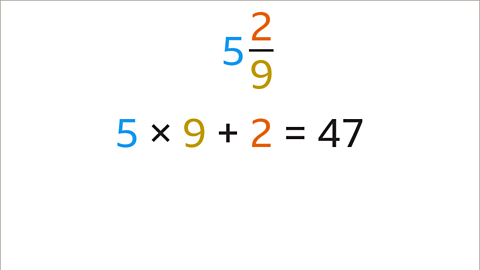
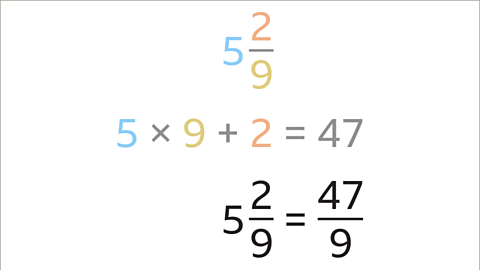
- Multiply the Integers are numbers with no fraction or decimal part. They can be positive, negative or zero. 42, 8, and 10000 are examples of integers. by the denominator and add the numerator.
- This gives the numerator of the improper fraction.
- The denominator stays the same.
Example: convert 3 1⁄2 and 5 2⁄9 to improper fractions
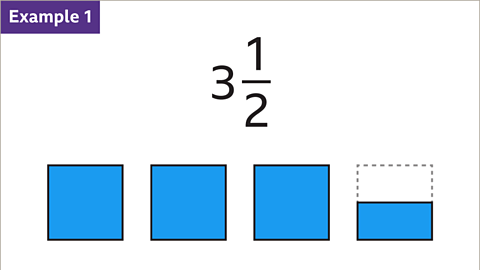
Image caption, Convert 3 1⁄2 to an improper fraction.
1 of 6
Question
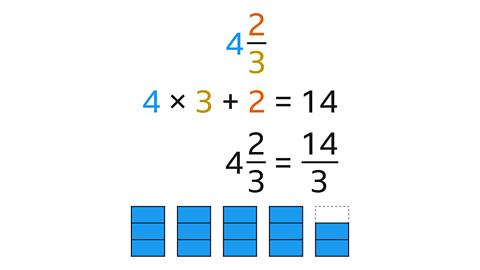
Convert \( 4 \frac{2}{3} \) to an improper fraction.
Multiply the integer (4) by the denominator (3) and add the numerator (2). This equals 14
4 × 3 + 2 = 14
The numerator of the improper fraction is 14. The denominator (3) does not change.
\( 4 \frac{2}{3} \) converts to \( \frac{14}{3} \) as an improper fraction.
How to convert an improper fraction to a mixed number
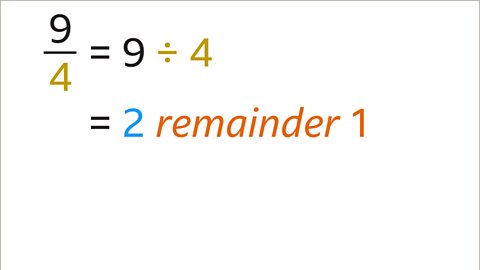
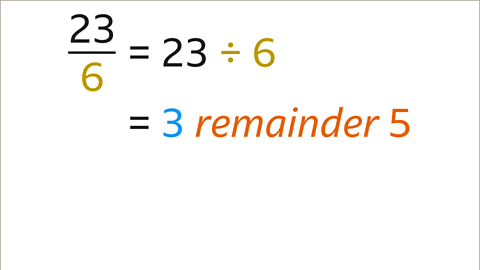
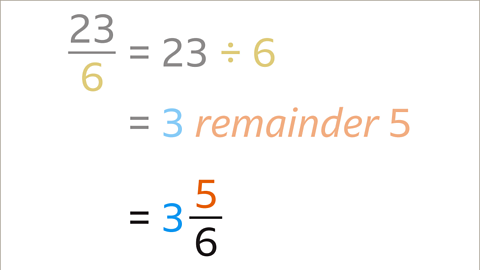
- Divide the Number written at the top of a fraction. The numerator is the number of parts used. Eg, for 1⁄3, the numerator is 1 by the Number written on the bottom of a fraction. The denominator is the number of equal parts. Eg, for 1⁄3, the denominator is 3.
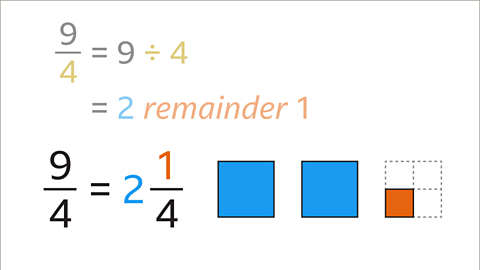
- The whole number is the Integers are numbers with no fraction or decimal part. They can be positive, negative or zero. 42, 8, and 10000 are examples of integers. part of the mixed number.
- In a mixed number, the The amount remaining after division. Eg, 30 divided by 7 is 4 remainder 2 is the numerator of the fraction.
- The denominator stays the same.
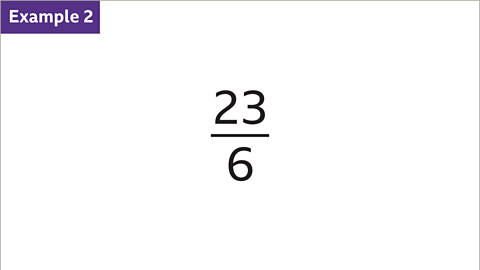
Example: convert 9⁄4 and 23⁄6 to mixed numbers
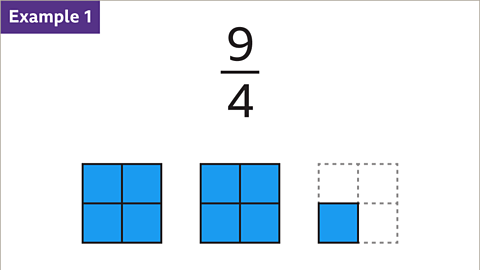
Image caption, Convert 9⁄4 to a mixed number.
1 of 6
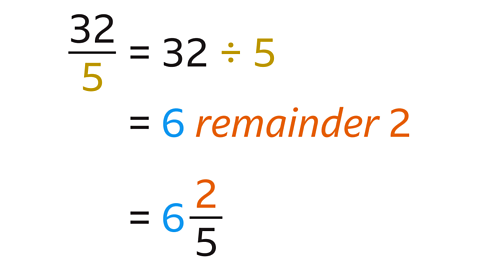
Question
Convert \( \frac{32}{5} \) to a mixed number.
Practise converting mixed numbers and improper fractions
Try practising recognising and converting mixed numbers and improper fractions with this quiz. You might need a pen and paper to solve some of these questions.
Quiz
Real-world maths
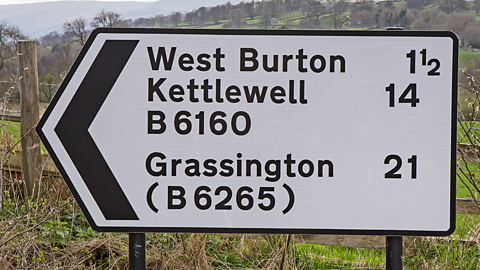
Mixed numbers and improper fractions are often used in the real-world.
For example, motorway road signs usually give distances as whole numbers.
However, road signs on smaller roads or signposts on rural routes will often use mixed numbers as the distances are much shorter.
Converting between mixed numbers and improper fractions can be used when considering things like ordering food and deciding how many pizzas you need to order for a friend’s party.
- Each person wants \( \frac{1}{3} \) of a pizza. If there are 20 people, that is \( \frac{20}{3} \)of pizza.
- To work out how many pizzas to buy, it is helpful to convert the improper fraction into a mixed number.
- 20 ÷ 3 = 6 remainder 2. So \( 6 \frac{2}{3} \) pizzas are needed.
- To have enough pizza for the party, you need to buy 7 pizzas.
Play Sudoku with BBC Bitesize!
Every weekday we release brand new easy, medium and hard Sudoku puzzles. Perfect for testing your skill with numbers and logic.
More on Fractions
Find out more by working through a topic
- count5 of 14
- count6 of 14
- count7 of 14
- count8 of 14