Key points
- To To reduce a fraction to its simplest form, also known as its lowest terms. a fraction, The process of simplifying a fraction by dividing both the numerator and the denominator by the same number. it down by dividing the Number written at the top of a fraction. The numerator is the number of parts used. Eg, for 1⁄3, the numerator is 1 and Number written on the bottom of a fraction. The denominator is the number of equal parts. Eg, for 1⁄3, the denominator is 3 by the same number. The numerator and denominator have been written with the lowest whole number possible. This is said to be in its When the numerator and denominator are both divided by their highest common factor, the fraction is said to have been cancelled down to give the equivalent fraction in its lowest terms. .
- Simplified fractions have no A whole number which is a factor of two or more numbers. Eg, 2, 5 and 10 are common factors of 30 and 20 other than 1
- Knowing multiplication and division The word 'fact’ is related to the instant recall of knowledge about a number. A multiplication fact for 20 could be 4 x 5. A division fact for 20 could be 20 ÷ 5 = 4 is useful for recognising common factors for division. This can be a useful skill for simplifying fractions.
- Fractions can be simplified in one step using the The largest factor that will divide into the selected numbers. Eg, 10 is the highest common factor of 30 and 20. Highest common factor is written as HCF. (HCF) of the numerator and denominator.
- Fractions can be simplified in more than one step by dividing by common factors other than the HCF. This method may be used if the HCF is harder to find, eg if the number is bigger.
Simplifying fractions using HCF - one step
Use division to To divide the numerator and denominator by a common factor to reduce the fraction to its lowest terms. a fraction to its When the numerator and denominator are both divided by their highest common factor, the fraction is said to have been cancelled down to give the equivalent fraction in its lowest terms. .
Find the The largest factor that will divide into the selected numbers. Eg, 10 is the highest common factor of 30 and 20. Highest common factor is written as HCF. (HCF) of the numerator and denominator.
Divide both the numerator and denominator by their HCF.
The fraction has now been simplified.
Knowing multiplication and division facts may make simplifying fractions easier.
Example: simplifying fractions in one step
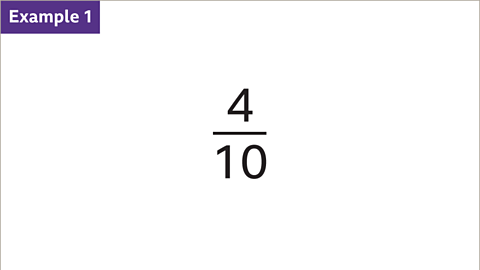
Image caption, Simplify 4⁄10
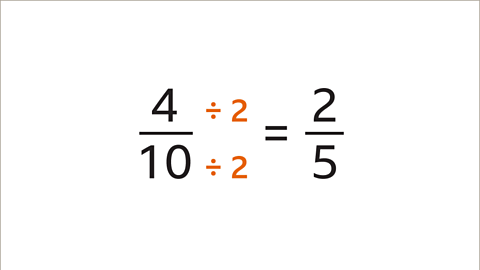
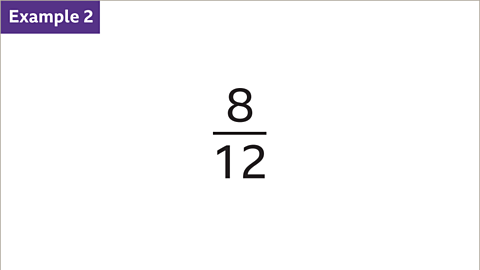
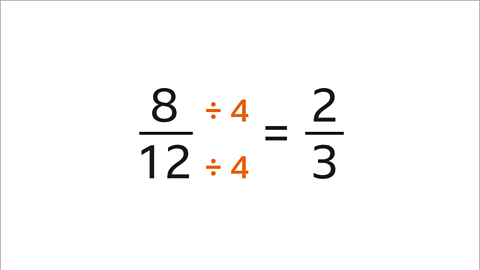
1 of 6
Simplifying fractions using common factors - more than one step
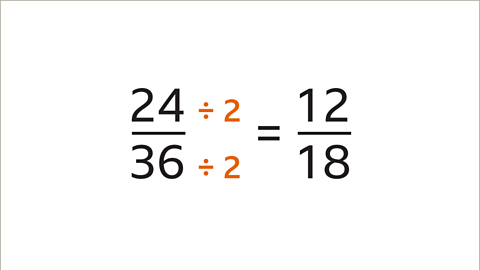
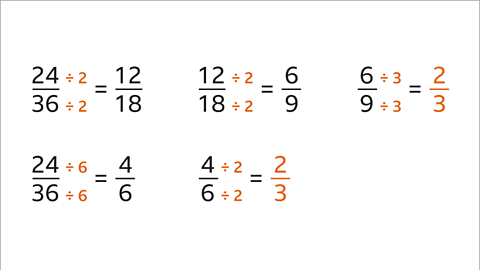
It is possible to simplify a fraction in more than one step.
Find a A whole number which is a factor of two or more numbers. Eg, 2, 5 and 10 are common factors of 30 and 20 of the Number written at the top of a fraction. The numerator is the number of parts used. Eg, for 1⁄3, the numerator is 1 and Number written on the bottom of a fraction. The denominator is the number of equal parts. Eg, for 1⁄3, the denominator is 3. This must be greater than 1
Divide the numerator and denominator by that common factor.
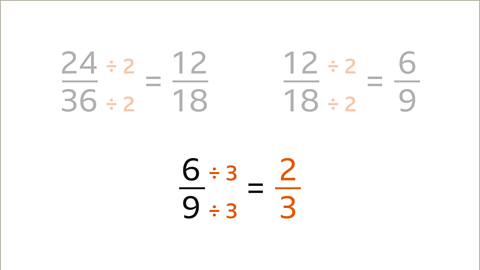
Find another common factor greater than 1 and divide again.
Repeat this process until their only common factor is 1
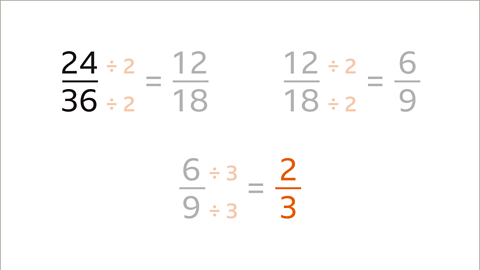
The fraction is now fully simplified. The order of The process of simplifying a fraction by dividing both the numerator and the denominator by the same number. does not matter.
Example: more than one step
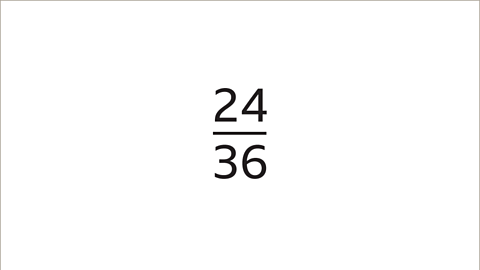
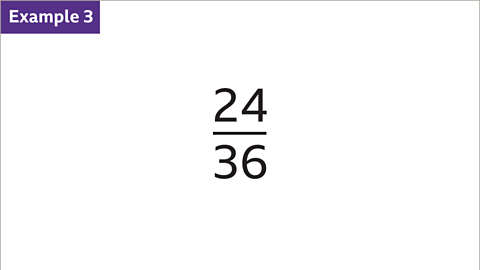
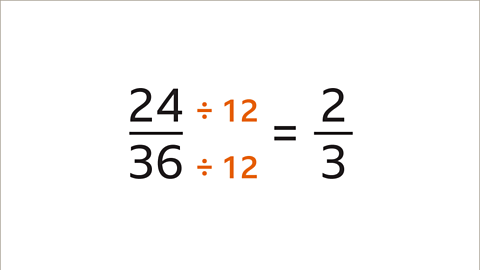
Image caption, Simplify 24⁄36

1 of 6
Question
Simplify \( \frac{45}{75} \)
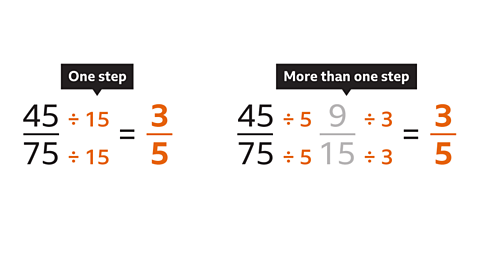
\( \frac{45}{75} \) simplifies to \( \frac{3}{5} \)
It can be simplified in one step:
- Divide the numerator and denominator by the highest common factor (15) to simplify to \( \frac{3}{5} \)
Or it can be simplified in more than one step:
It is also correct to find a common factor of the numerator and denominator. Then find another common factor.
Divide the numerator and denominator by 5. Then divide the numerator and denominator by 3 to get \( \frac{3}{5} \)
The answer is the same - the order of cancelling down does not change the outcome.
Game - Simplifying fractions
Try these questions from our Divided Islands game and practise your simplifying fractions skills.
Play the full Divided Islands game.
Practise simplifying fractions
Simplifying fractions quiz
Practise simplifying fractions with this quiz. You may need a pen and paper for your workings out.
Real-world maths

Simplifying fractions makes them easier to visualise and work with.
A data scientist may need to simplify fractions in their work. When collating and presenting a large amount of data, they may use fractions in their lowest terms to present their findings to make them easier to understand.
For example, they might simplify a large fraction such as \( \frac{2740}{8220} \) to \( \frac{1}{3} \). This will make their findings easier to visualise in a report.
Play Sudoku with BBC Bitesize!
Every weekday we release brand new easy, medium and hard Sudoku puzzles. Perfect for testing your skill with numbers and logic.

More on Fractions
Find out more by working through a topic
- count4 of 14
- count5 of 14
- count6 of 14
- count7 of 14