Separating mixtures
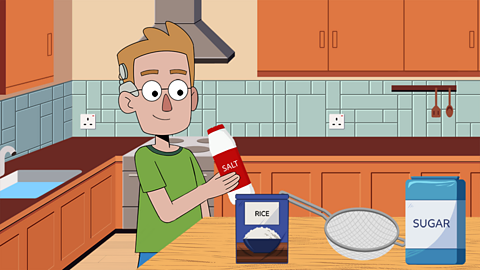
In science, we know that mixtures are made up of different substances that are mixed together.
Some of these substances can be separated again because each substance keeps its own properties.
This is called a reversible change.
This means that even though things are mixed together, we canseparate them back out if we need to.
Watch: Separating a mixture
Discover how the process of separation works.
Narrator: Oh I do like to be beside the seaside. Ooh fish and chips, and some sea salt. Very posh. Aah I feel so relaxed.
Woah, spoke too soon. Eurgh! Is that… a toenail collection?
Ah, now you’ve got sandy water and watery salt! What are the chances of that happening? Seriously though, what are the chances?
Well anyway, luckily you can reverse these changes using separation to get them back.
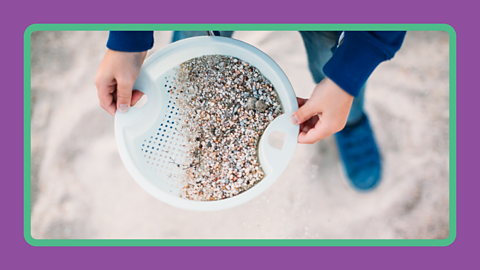
With a sieve we can separate the… toenails… that are mixed with the sand. The toenails are bigger than he holes in the sieve so he sand falls through but the toenails don’t.
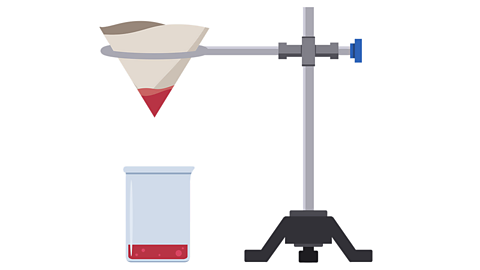
Ah excellent. By pouring your sandy water through a paper filter you can separate the water and sand. Look at the sand residue left on that filter paper.
And look… mmmm… clear water, delicious.
Brilliant! By heating the salty water to 100 degrees you can evaporate the water, leaving you with just the salt that was dissolved in it.
Well done everyone. All is well, hooray!
Oh… uk… we’ll leave you to it.
Ways of separating substances
There are several ways we can separate substances.
Let's look at evaporating, filtering and sieving.
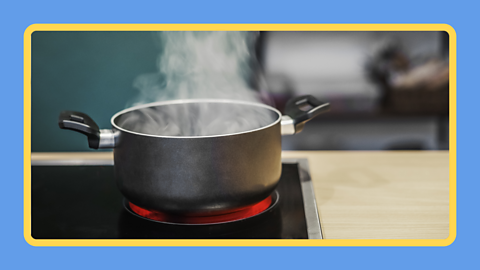
Image caption, Evaporation
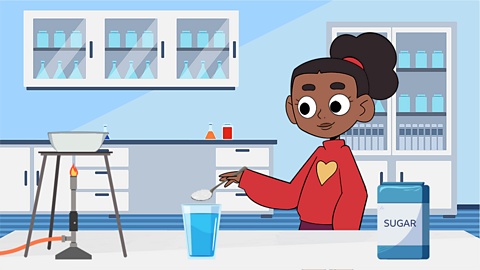
By dissolving salt in water you make a solution. You can separate the salt from the water again by boiling the solution. The water will evaporate until it is all gone. The salt will be left behind.
1 of 3
Fascinating facts
In the water cycle, the Sun evaporates water where it becomes clouds.
Evaporation accounts for about 90% of the moisture in the Earth's atmosphere.
Oceans, seas and other bodies of water are the source of about 90% of this evaporation, with the remaining 10% coming from other sources like plants.
On average, an evaporated drop of water spends around 10 days in the air before condensing and falling as rainfall.
A water purifier is a system that removes contaminants in water, usually through filtration.
Gold panning is a method of finding gold in sandy or rocky water, by sieving the water in a pan.
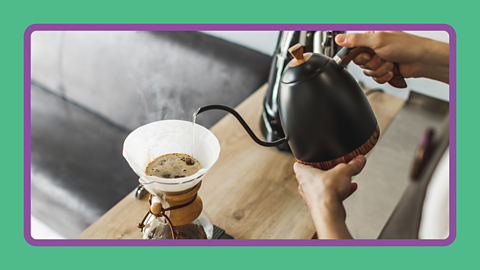
Filter paper holds solids and allows liquids to flow through it. That's why it's perfect for everyday tasks like making coffee.
We can see an everyday example of sievingwhen we cook, whether it's sieving flour for baking cakes, or draining water from pasta or rice.
Irreversible change
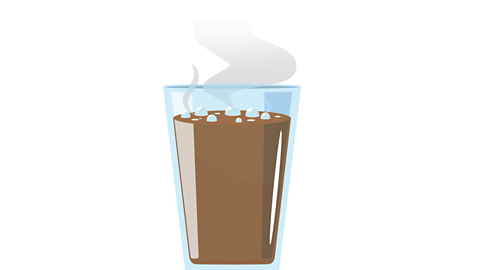
Mixing substances can cause an irreversible change, which is something that you cannotseparate again.
For example, when vinegar and bicarbonate of soda are mixed, the mixture changes and lots of bubbles of carbon dioxide are made.
These bubbles and the liquid mixture left behind cannot be separated back out into vinegar and bicarbonate of soda again as a chemical change has taken place.
Important words

Evaporation – When a liquid turns into a gas slowly, at temperatures below its usual boiling point.
Filtration – A way of separating particles of a solid such as sand, from a liquid like water.
Irreversible change – A change that cannot be undone or reversed.
Mixture – A mixture of substances that can be elements, compounds, or both. It contains different substances that are not chemically joined to each other.
Reversible change – A change that can be undone or reversed.
Separate – To split two substances from an original substance.
Sieving – A way of separating solid substances using a mesh called a sieve, which allows the smallest particles to pass through, but not the largest particles.
Activities
Activity 1 – Identifying ways to separate
Activity 2 – Take the quiz
Activity 3 – Reversible and irreversible changes
New game! Horrible Science: Stinky Space. game
Join Pipette on her epic mission and learn some revolting facts about space along the way.
More on Properties and change of materials
Find out more by working through a topic
- count3 of 5
- count4 of 5
- count5 of 5
- count1 of 5