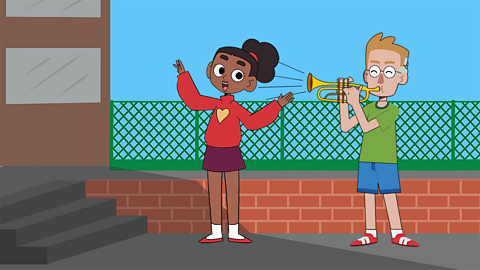
Sounds are vibrations

Sound is a type of energy made by vibrations.
When an object, such as a guitar's string, vibrates it causes air particles around it to vibrate too. This causes the air particles next to those to vibrate, and the ones next to those and so on and so on. This is called a sound wave.
Imagine throwing a stone into a pond and watching the ripples - that is similar to how sound waves work.
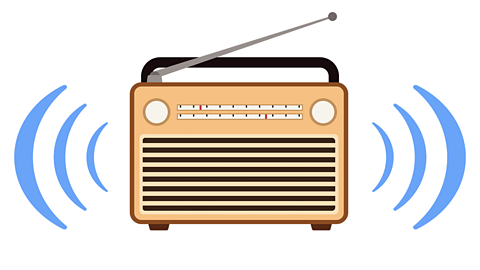
When sound waves reach your ears they vibrate a part of your inner ear called your eardrum, and your brain interprets this into sounds.
Sound waves travel through gases, such as air, but they can also travel through liquids (such as water) and solids (such as metal, stone and wood).
Watch: What is sound?
Video Transcript for 'Sound'
SEYMOUR: Hello! Seymour Science here with my musical friend Davina…and today we’re talking about…SOUND! La, la, la la la la la laaaa….
DAVINA: Err, thanks Seymour! So, how are sounds made? Well, sounds are made when objects - like this string - vibrate. When it vibrates it makes a sound…and when it’s not vibrating it makes no sound at all! Every time an object vibrates, it sends invisible sound waves through the air to our ears, which changes those waves into little messages that our brain understands as sound! So let’s try that string again!
SEYMOUR: But some things sound low and some things sound high. How does that work?
DAVINA: Well, if we use a thinner string, it will vibrate faster when we strum it. The faster something vibrates, the higher the sound will be. If the sound is loud, or quite low, people who cannot hear sounds can sometimes feel the vibrations.
SEYMOUR: And sounds can help keep us safe too!
DAVINA: Yes they can, just think of the beeps we hear when we cross the road… or the sirens on fire engines as they whizz past…
MUM: Mum: Seymour, is that you two making all that noise?!
SEYMOUR: Eek, best go!
Fascinating facts
The three bones inside your ear: the malleus (hammer), the incus (anvil), and the stapes (stirrup), are the smallest bones in the human body.
When sounds bounce off a surface, the vibrations are reflected and you can hear them again. This is what creates an echo.
Sound waves travel slower than light waves. That is why you see lightning before you hear thunder during storms.
In space there is no sound, as sound waves cannot travel through a vacuum. There are of course sounds on other planets, moons and asteroids.
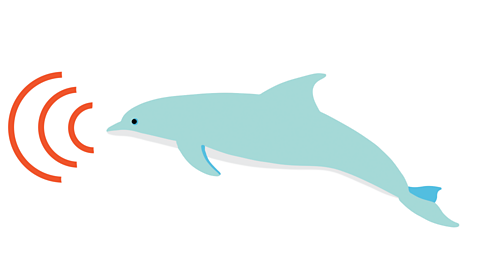
Sound travels around four times faster in water than in air. Because of this, whales and dolphins can communicate over long distances.
Watch: How sound enters your ears
Sounds are made when objects vibrate the air around us and send waves of energy to our ears.
Discover how sounds are made.
Why can't we hear this alien scream in space?
And have you ever wondered, when you make a sound, like, ooooooooooooo, how does the sound actually get into your ears?
Watch what happens when the spaceship crashes on Earth.
That’s more like it.
So why is it than we can hear the alien scream now?
Well, sounds are made from vibrations.
We can't see vibrations, but if we did they would look a little like this.
Sounds are made when objects vibrate.
Soundwaves make the air around vibrate and the air vibrations enter your ear.
You hear them as sounds.
In space, there is nothing for the soundwaves to travel on.
That's why we couldn't hear the alien scream.

Did you know?
Mice and rats communicate with each other using ultrasound.
Ultrasonic sound makes waves that vibrate so quickly that only animals with especially sensitive hearing can pick them up.
How do we hear sound?
When an object vibrates, like when a drum skin is hit with a stick, the vibrations of the object causes the air particles, which are all around us, to vibrate too.
These vibrations pass from air particle to air particle and create a sound wave that then reaches your outer ear. The outer ear catches the sound wave and channels it down to the eardrum (a thin layer of skin inside your ear).
When the vibrations reach your eardrum, they cause the eardrum to vibrate, vibrating tiny bones in our ears which create electrical signals which our brain can interpret as sound.
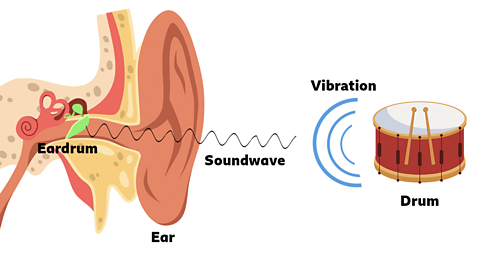
How the ear works
Important words

Air particle – Air particles are tiny particles of liquid and solids that are suspended in the air.
Echo – The repetition of a sound due to reflection off another object.
Sound waves – A sound wave is a vibration that travels through a solid, liquid or gas such as the air or water.
Ultrasound – Ultrasonic sound that makes waves which vibrate very quickly. Some animals like mice and rats can hear them and we can use them to look inside the human body.
Vibrations – When an object moves back and forth very quickly.
Activities
Activity 1 – Fill in the gaps
Activity 2 – Quiz
Activity 3 – Sound vibrations investigation
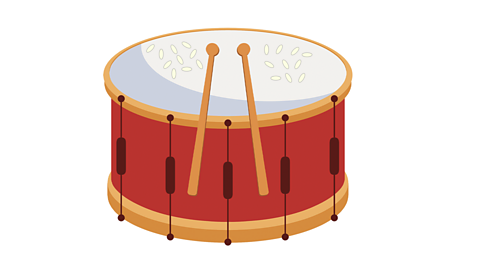
Investigate sound vibrations.
You will need: A cup of rice, a drum (or flat surface), a drum stick or pencil.
- Pour the rice over the drum skin.
- Hit the drum gently. How does the rice move?
- Now hit the drum hard. Does the rice move in the same way?
- Now try hitting the drum with different strengths to see how the sound vibration changes.
What did you discover?
Activity 4 – Drawing sound waves
New game! Horrible Science: Stinky Space. game
Join Pipette on her epic mission and learn some revolting facts about space along the way.

More on Sound
Find out more by working through a topic
- count1 of 4
- count2 of 4

- count3 of 4