High pitch and low pitch

The pitch of a sound is how quickly the sound wave travels.
If a sound wave is travelling quickly, we say that it is a high sound.
If a sound wave is travelling slowly, we say that it is a low sound.
A high sound has a high pitch and a low sound has a low pitch.
A tight drum skin gives a higher-pitched sound than a loose drum skin because it vibrates faster.
Pitch is measured in Hertz (Hz) or Kilohertz (KHz).
Watch: Pitch and sound waves
Check out this explorer's special goggles that help him to see sound waves.
Sounds can be high pitched, like the squeak of a mouse.
Or low pitched, like the roar of a lion.
But what is it that makes these vibrations different?
This explorer is wearing special goggles.
They let him see sounds in the air all around him.
The sounds he sees are like waves.
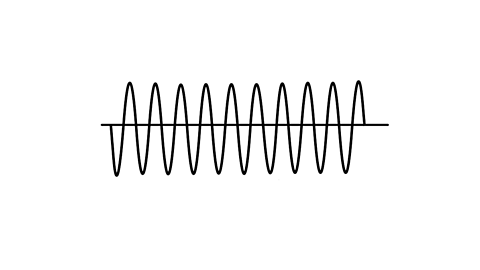
Some of them are tight squiggly waves, like this.
A drum with a very tight skin makes this sort of wave.
It's what we call a high pitched wave.
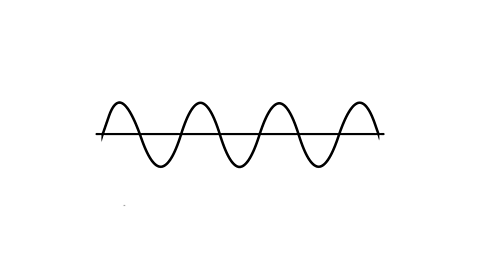
And some of the waves are long, loose rolling waves, like this.
A drum with a loose skin makes this sort of wave.
It's what we call a low pitched wave.
Excuse me? Excuse me?
I think you maybe need to take the glasses off. You're about to walk into…
Oh. Too late.
Fascinating facts

The unit of frequency, the hertz, is named after the German scientist Heinrich Hertz.
As you get older the range of pitch that you can hear often decreases.
Listening to too much loud music or loud sounds can damage your hearing, so be careful!
String instruments can range from a high (violin) pitch to a low (double bass) pitch.
Frequency is the scientific measurement of sound.
Bats can use high frequency sound to find prey and travel in the dark at night, we call this echolocation.
Investigating different pitches
We can investigate how to make sounds with different pitches using different lengths of string.
Watch: How to conduct a pitch investigation
An investigation using pieces of string to produce sounds with different pitches.
On this board is a string which is fixed at one end and attached to weights.
Listen to the sound the string makes when it's plucked.
LOW-PITCHED VIBRATION
We can see that the string is vibrating to produce the sound.
Now listen again after an extra weight is added.
HIGH-PITCHED VIBRATION
The sound has a higher pitch.
The weight makes the string tighter so it vibrates faster.
You can change pitch in other ways.
These strings are different lengths.
The vibrating length of string is between the black strips of wood.
VIBRATIONS GET HIGHER IN PITCH
The weight is the same.
The longer strings create a lower
The shorter length strings are vibrating faster than the longer.
These strings are the same length and have the same weight.
The difference is their thickness.
The strings get thicker.
The thinner strings make a higher pitch than the thicker strings.
The thicker strings are heavier and don't vibrate as quickly.
- A tighter string = higher pitch. This is because it vibrates faster.
- A shorter string = higher pitch. This is because it vibrates faster.
- A thinner string = higher sound. This is because it vibrates faster.
- A looser string = lower pitch. This is because it vibrates slower.
- A longer string = lower pitch. This is because it vibrates slower.
- A thicker string = lower pitch. This is because it vibrates slower.
What is a sound wave?
A sound wave is a longitudinal wave. When an object vibrates it produces a longitudinal wave which travels through air to your ear.

For a sound to be heard you need three things:
- A vibrating object.
- A material for the sound wave to travel through, such as air. This is called a medium.
- Something to detect the sound, for example your ear.

Did you know?
The pitch of sound is measured using a unit of frequency known as the hertz (Hz). Humans can hear sounds with a frequency between 20 Hz and 20,000 Hz.
Many animals though are able to hear much higher and lower pitches of frequency than humans can.
Dogs for instance can hear sounds between 40 Hz and 60,000 Hz, while bats can hear sounds up to 700,000 Hz. The calls of blue whales can be as low as 15 Hz.
Important words

Hertz (Hz) / Kilohertz (kHz) – The pitch of sound is measured using a unit of frequency known as a hertz. 1000 hertz is equal to 1 kilohertz.
High – When sound waves travel fast, they make high-pitched noises like an alarm, or the squeak of a mouse.
Longitudinal – Things that travels lengthways.
Low – When sound waves travel slowly, they make low-pitched noises like a bass guitar, or the rumble of a lorry.
Medium – A material for the sound wave to travel through, such as air.
Pitch – The pitch of a sound is how high or low the sound is.
Sound wave – A longitudinal wave of sound caused by an object vibrating.
Vibrates – To move rapidly to and fro.
Activities
Activity 1 – Pitch quiz
Activity 2 – Pitch investigation
You will need:
- 3 or 4 glasses or bottles
- Water
- A spoon
Firstly, fill each glass or bottle with a different amount of water.
Then, gently blow across the top of each bottle or tap the glasses once with a spoon.
- What do you notice?
- Which produces the highest pitch? Which produces the lowest pitch?
- Can you draw what the sound waves for the highest and lowest pitch may look like?
Activity 3 – Sort the sounds

New game! Horrible Science: Stinky Space. game
Join Pipette on her epic mission and learn some revolting facts about space along the way.

More on Sound
Find out more by working through a topic
- count2 of 4

- count3 of 4
- count4 of 4