How are sounds made?

Sound is a type of energy made by vibrations.
When an object, such as a guitar’s string, vibrates it causes the air particles around it to vibrate too.
This is because the vibration of an object causes air particles to vibrate, which causes the particles next to them to vibrate and the particles next to them to vibrate and so on and so on.
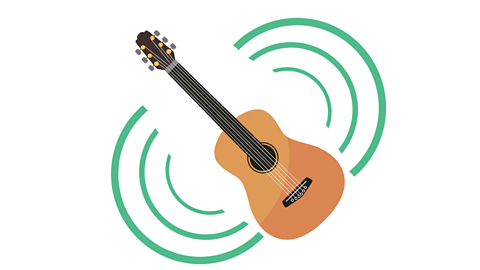
When sound travels, it creates sound waves.
Imagine standing up a set of dominoes all in a line and pushing the first one over – that’s what a sound wave is like.
Watch: Sound and vibrations
Here's what you need to know about sound.
We can stretch an elastic band over a tub like this to make a music instrument.
When you pluck the band, it makes a sound.
We can see the band wobbling or vibrating. Sound are made by vibrations.
Look at this. We banged the tuning fork on the table. We can hear the sound it makes.
Now watch what happens when I put the tuning fork in the water.
You can see the vibrations in the water because the sound vibrations have made the water move.
Fascinating facts

Sound waves travel slower than light waves. That's why you can see lightning before you hear thunder during a storm.
Sound travels faster in water than air, because of this, whales and dolphins can communicate over long distances.
Dogs, bats and dolphins can all hear sounds higher than humans. Pigeons are thought to be able to hear infrasound, which is a lower frequency than humans can hear.
The three bones inside your ear: the malleus (hammer), the incus (anvil), and the stapes (stirrup), are the smallest bones in the human body.
In space there is no sound as sound waves cannot travel through the vacuum. There are of course sounds on other planets, moons and asteroids.
Flies do not have ears, but are able to detect sounds through their antennae.
When sounds bounce off a surface, the vibrations are reflected and you can hear them again. This is what creates an echo.
How do we hear sound?
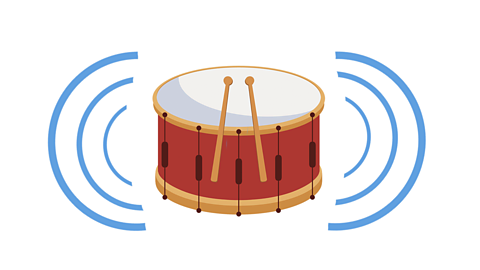
The first step in hearing a sound is for an object to vibrate. This could be the skin on the top of a drum, a guitar string, a car’s exhaust or even your vocal cords.
The vibration of the object causes the air particles, which are all around us, to vibrate too.
These vibrations pass from air particle to air particle until they reach your outer ear (the pinna). The pinna catches the vibrations and channels them down to the inner ear.
When the vibration reaches your eardrum (a thin layer of skin inside your ear), they cause your eardrum to vibrate too.
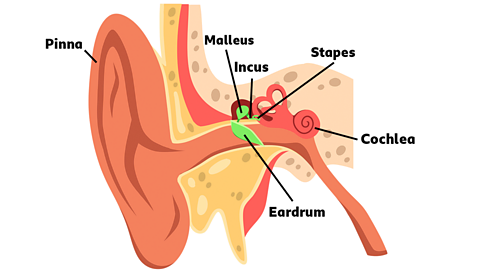
The vibrations pass through three bones in the middle ear: the malleus (hammer), the incus, (anvil), and the stapes (stirrup). These bones make the vibrations larger (amplify).
The vibrations travel to the cochlea, in the inner ear, that's filled with fluid. The vibrations cause the fluid to move, which converts the vibrations into electrical signals.
These signals are sent to your brain. Your clever brain then identifies this signal as sound. If it has heard the sound before, and knows what it is called, it recalls it and you recognise it as a dog’s bark for example.
How does sound travel?
Sound waves can travel through solids (such as metal, stone and wood), liquids (such as water) and gases (such as air).
Watch: How the ear is designed to hear
Travel into this man's ear and learn how sound is detected.
To show you how sound is detected, this lovely lady is going to drive her spaceship into this gentleman's ear.
Whoa, whoa, stop! Stop! Stop!
Don't you think you've forgotten something important? You've got to use the shrinkifier.
Honestly! Ah that's better.
Now, we can see that the ear is just the right shape for picking up sound vibrations.
Excuse me, can you put on your special goggles? Good.
We can see those sound waves as they come in. They use the air to travel through.
And just down there we can see the ear drum. When sound waves touch it, it vibrates and sends a message to the brain.
What's that? You didn't know that's how ears worked?
Well, you'd better drive out very carefully, because ears are quite fragile…
Did you know?
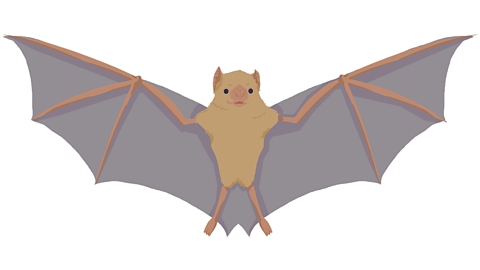
Animals use the principles of sound waves to help them see and navigate their environment. This is called echolocation.
Whales and bats emit a sound wave, which bounces off an object, returning an echo that provides information about the object's distance and size.
The ear
Sound is detected when the vibrations enter your ear and send messages to your brain. Click on the image below to learn more about the different parts of the ear and the roles they play.

Did you know?
Some man-made objects, like fighter jets and rockets, can travel faster than the speed of sound.
When an object travels faster than the speed of sound it is called 'breaking the sound barrier' and can cause a very loud booming noise called a sonic boom.
Watch: Investigating how sound travels
Watch the clip below to see how sounds travels through an experiment with the Science Museum Group.
Learn how sounds travels with the help of the Science Museum.
My name’s Sam and today we’re going to be looking at how sound travels.
If Alexandra knocks on a wall or a table you’d be able to hear the sound.
But then if we do it again with her ear pressed to the surface did it sound any different? Did it sound louder?
Sound travels through vibrations and when you have your ear pressed the surface the sound can go straight through that solid surface into your ear.
So if sound travels by vibrations and it travels better through solids than it does liquids or gases.
Let’s have a look at what it does to this really cool mixture we have here. So this is just cornflour and water mixed to make a slime that’s also known as oobleck.
Alexandra’s putting force on the oobleck and it’s acting like a solid. But when she leaves it alone it acts like a liquid and flows.
So we are going to pass vibrations of sound through it and see how it acts like a solid and when there’s no sound going through it, it should act like a liquid and we’re going to use a speaker to do that.
So the movement of the speaker is going to do some fun stuff to our cornflower slime.

Did you know?
An eruption on the volcanic island of Krakatoa in 1883 was the loudest natural sound ever recorded.
The massive explosion could be heard over 3000 miles away!
Important words
Air particle – Air particles are tiny particles of solids and liquids that are suspended in the air.
Amplify – To expand, make bigger or larger.
Echo – The repetition of a sound due to reflection off another object.
Incus – Also known as the anvil, the incus is one of three small bones in the middle ear.
Malleus – The malleus, or hammer is the largest of three small bones in the middle ear.
Sound waves – A sound wave is a vibration that travels through a solid, liquid or gas, such as the air or water.
Stapes – The stapes or stirrup is the smallest bone in our body, and is found in the middle ear.
Vibrations – When an object moves back and forth very quickly.
Volume – The volume of a sound is how loud or quiet the sound is.
Activities
Activity 1 - Quiz
Activity 2 - Guided reading

New game! Horrible Science: Stinky Space. game
Join Pipette on her epic mission and learn some revolting facts about space along the way.

More on Sound
Find out more by working through a topic
- count4 of 4

- count1 of 4

- count2 of 4