Overview of Hotel room, 12th floor by Norman MacCaig
The poem Hotel room, 12th floor ponders:
- the balance between light and dark
- good and evil
- humanity’s role in a developing urban society
It was first published in 1968 in MacCaig’s Rings on a Tree collection.
Though the poem begins with light-hearted imagery, with the Empire State Building compared to a "jumbo size dentist’s drill", the mood gradually becomes more sombre and reflective, with the ominous conclusion that "no stockades can keep the midnight out" as humans seek shelter from the "uncivilised darkness" that night brings.
MacCaig makes reference to the technological advances and achievements of modern-day America, such as New York's skyscrapers. However, he also considers the violent past of America, particularly the Wild West, and compares this aggression to the country’s present.
By tracing the thread of violence throughout American history to the present, MacCaig suggests that technological progress has not resulted in societal civility. In this sense, this is a bleak poem that predicts that evil will always exist as a part of human life.
Hotel room, 12th floor by Norman MacCaig is available to read on the Scottish Poetry Library website.
Context
In the mid to late 1960s, Norman MacCaig made several visits to New York. During these trips, he read and discussed his poetry and attended conferences. There was considerable interest in Scottish Literature in America and MacCaig often travelled with other Scottish writers, notably Hugh MacDiarmid.
As well as his professional responsibilities, MacCaig's personal experiences in New York would influence his writing for years to come. Hotel Room, 12th Floor was inspired by his time there.
Form and structure of Hotel Room, 12th Floor
Hotel room, 12th floor is written in Poetry that doesn't have an intentional rhythm or rhyme, but instead can sound more like speech, an approach that Norman MacCaig began to use more widely from the publication of 'Surroundings' in 1966.
Free verse allowed MacCaig to explore themes without a restrictive, defined structure. Hotel room, 12th floor is a good example of this.
Hotel room, 12th floor does not have a rhyming scheme.
The poem is made up of three stanzas:
Stanzas one and two are of nine lines each
Stanza three is just three lines
Stanza one reflects how the city looks in the morning and focuses on the bright, modern appearance of the city. MacCaig moves to night at the close of the stanza to suggest a darker, more dangerous city.
Stanza two explores this threatening night world in more detail and links it to the Wild West.
The shortest of the stanzas, stanza three is an effective summary of the poem's themes, bringing together societal concerns. By giving the two sentences that comprise stanza three a stanza of their own, MacCaig gives significance to their content.
Hotel room, 12th floor is written in the A first-person narrative is when the story is told from the point of view of one person using the pronoun 'I'.. It documents a personal experience of Norman MacCaig’s, like Aunt Julia and Basking Shark.
Like both of these poems, its concerns are not limited to MacCaig – he uses the poem, and his own experiences described, to pose broader questions about humanity.
What does the title of Hotel room, 12th floor tell us?
The title of Hotel room, 12th floor* tells us the speaker is away from home.
Staying in a hotel suggests all the following about the speaker:
- He is visiting somewhere.
- The visit is temporary rather than long term.
- He is somewhere that he doesn't belong.
- There is a sense of separation from his surroundings.
Being on the 12th floor lets us know we are viewing the surroundings from high up. This makes clear that we are in a modern city, while also adding to the sense of a high viewpoint from which one can observe your surroundings without being part of them.
The combination of a hotel room and its height give a clear impression that the speaker is an isolated observer, who is not part of the scene they are describing and passing judgement on.
Stanza one
Norman MacCaig opens Hotel room, 12th floor at a specific time, just as the title puts us in a specific place.
This morning I watched from here
While the first scene described pictures the morning, and therefore takes place in daylight, "I watched" makes it clear that it is now later in the day, and the speaker is looking back.
Together with the use of real landmarks, this makes the poem feel like a genuine, real experience. This creates a sense of immediacy that is consolidated later in the opening stanza with "But now". With these two quotes, he suggests that the themes of the poem need to be discussed and are relevant to the time of writing. It also gives the impression of the speaker (who appears to be the poet himself, although this is never certain) speaking directly and presently to the reader.
In the second line, modern technology is immediately introduced and criticised:
A helicopter skirting like a damaged insect / the Empire State Building
A A simile is a word or phrase used to make a comparison for dramatic effect, using 'like' or 'as'. compares the helicopter to an insect, suggesting that it is insignificant - it appears small among the buildings. The image of an insect could also suggest something that buzzes around and is annoying. Not only is it annoying, but in this simile it seems "damaged". This modern invention is therefore like an inferior copy of nature that doesn't quite work.
A helicopter may commonly be associated with wealth, and MacCaig may be making a subtle social comment here: perhaps it is society that is ‘damaged’ by the ever-increasing pursuit of technological and material wealth. With this comparison, MacCaig poses questions about the worth of certain technological achievements.
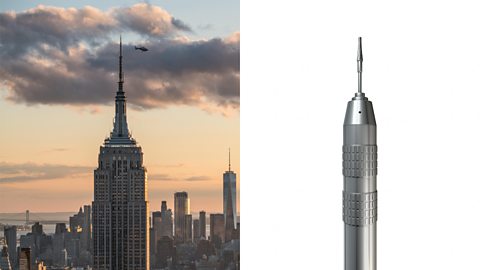
A A metaphor is a figure of speech that describes something by saying it is something else. It's not actually true but it gives the reader a clearer idea of what it is like. states that the Empire State Building (the city’s tallest landmark at the time) is a "jumbo sized dentist’s drill". This is a humorous image – what use would a dentist have with a drill of this size? The suggestion is that a building, or drill, of this size is pointless. MacCaig seems to be criticising the (stereotypically American) view that ‘bigger is better’. On a more aesthetic level, he is clearly showing his disdain towards the appearance of the building.
The dentist drill also has A word used to describe the ideas or feelings that a word might suggest. For example, a skull conjures up thoughts of fear, mortality and death. of pain and suffering. Again, he may be making a deeper point regarding the inequality of society and the suffering of groups of people who are left behind by progress. It can also be read as a tool, or weapon, that is used in the fight against decay. This is a bright, modern image that is soon surrounded by darkness.
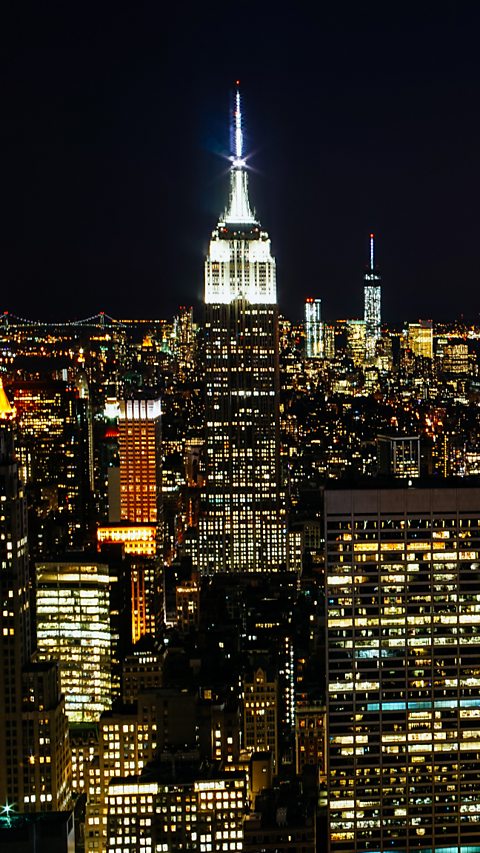
Towards the end of stanza one, the focus shifts to night-time New York.
But now midnight has come in/from foreign places
"But" acts as an obvious turning point around which the time shifts from morning to the middle of the night. The mood of the poem changes to something more solemn as the night comes in.
While "midnight" literally refers to a time, it also metaphorically introduces the idea of darkness and the unknown and, consequently, fear. This idea of fear and conflict is re-enforced later in the stanza with:
- "foreign places"
- "uncivilised darkness"
The use of the word "foreign" here may highlight the strangeness of the landscape to the speaker, but there is also a possible suggestion in this extended metaphor that modern America does not trust anything that is “foreign” or that doesn’t tie in with its view of what is civilised.
This conflict is extended when MacCaig writes:
Its uncivilised darkness / is shot at by a million lit window
This brings to mind the USA’s close association with guns, made famous in Western films.
The image suggests the buildings of the city in battle with the surrounding darkness. Here, darkness, with its associations of evil and the unknown, is in battle with artificial light, alongside its A word used to describe the ideas or feelings that a word might suggest. For example, a skull conjures up thoughts of fear, mortality and death. of life, knowledge and progress. This raises questions about humanity’s ability to use its own inventions (electric light in man-made buildings), combat the inevitable return of night and darkness, and possibly humankind’s most instinctive, perhaps destructive, desires.
The stanza ends with a neat description referencing the grid-like nature of the rows and rows of streets, buildings and windows spread out before him, piercing the darkness:
all / ups and acrosses
However in stanza two he goes on to suggest that violence is occurring elsewhere, down in the streets below. "Acrosses", with its inclusion of the word “cross” carries a religious connotation. The image suggests the Christian image of good fighting evil and darkness.
Explore the difference between the denotations and connotations of words:What is word choice?
Stanza two
Stanza two begins by consolidating the pessimistic tone.
But midnight is not / so easily defeated
The repeat of "But" at the start of the sentence links back to and emphasises the “but” used as turning point in stanza one. This continues the image of battle between good and evil. In this stanza, an extended metaphor portrays the violence of the city as a fight in the Wild West.
The speaker tells the reader:
I lie in bed, between / a radio and a television set
This suggests that we are surrounded by technology and by these stereotypical images from cinema and television. Alternatively, it could also suggest the speaker trying to use technology to drown out the sounds of violence from the city outside.
The sounds that MacCaig describes in this stanza are key in developing the poem’s thematic concerns.
The wildest of warwhoops continually ululating/ through the glittering canyons and gulches
He hears, possibly from the radio and/or television, "the wildest of warwhoops". The word choice of the superlative "wildest" has connotations of lawlessness, as well as a direct link to the "Wild West", a familiar trope in Western films. This idea is extended through alliteration with the word "warwhoops", the war cries associated with Native Americans in these films.
These warwhoops are described as "ululating". Here MacCaig uses onomatopoeia to suggest the repeated stereotypical “woo-woo-woo” sound that Native Americans would be shown making in a Western film or TV show. It compares these repeated noises with the constant howl of sirens in the city streets.
MacCaig then describes the setting of these historic battles. He writes of the
glittering canyons and gulches
This contrasts with the natural landscape of the west with the affluent city. The canyons may now be "glittering" but they are still canyons.
From his hotel bed, MacCaig hears police cars and ambulances racing to deal with the results of violence. He uses synecdoche to show the impact:
- "broken bones"
- "harsh screaming"
- "blood glazed"
People are reduced to damaged body parts, noises, spilled fluids. This suggests the place of humans in this society has been lost.
Video - What is synecdoche?
Norman MacCaig uses synecdoche to emphasises the impact of violence in stanza two of Hotel room, 12th floor. Revise this technique with this short video clip.
Norman MacCaig uses a technique called synecdoche in Hotel Room, 12th Floor but what is synecdoche?
MacCaig states that the "harsh screaming" emits from "coldwater flats". This literally refers to the less luxurious, more primitive flats in the city, but MacCaig is making a broader point here:
- technological advances are not benefitting all. Think about the flats that don’t have hot water, and the contrast between them and the illustrious, imposing skyscrapers
- certain elements of society have been left behind in the pursuit of materialism and "progress"
The destitute nature of living for some then translates to the streets. The skyscrapers may be glazed with windows but the sidewalk is "glazed" with blood.
Stanza three
Norma MacCaig closes Hotel room, 12th floor in a short stanza comprised of two sentences. Each makes a negative but definite statement and they leave us with a pessimistic tone.
The frontier is never somewhere else. And no stockades can keep the midnight out
Like the Empire State Building, or indeed the city, a frontier is often an artificial construct. In the Wild West, a frontier was often used to describe a border between societies, most commonly between those that were considered to be civilised and those that were not. MacCaig may be suggesting here that uncivilised acts are intrinsically linked to all human societies.
By saying that the frontier is never somewhere else, MacCaig suggests that what we see as "uncivilised" is always with us, always a part of us.
Continuing his use of language linked to conflict and the tropes of Westerns, MacCaig writes:
And no stockades / can keep the midnight out.
Again, a stockade is a constructed barrier, designed to protect. When MacCaig again writes of "midnight" in this stanza, he repeats his reference to the metaphorical danger and distress that it can bring – it is perhaps even symbolic of evil.
By stating that no stockades can keep this out, MacCaig takes the pessimistic view that humanity, despite its apparent progress in technological advances (represented in this poem by the skyscrapers), will always be impacted by uncivilised, basic human instincts. The disconnection that these things bring from community, nature, and ultimately each other, are inevitable.
What are the themes in Hotel room, 12th floor?
Like Basking shark, Norman MacCaig explores the theme of the human condition in Hotel room, 12th floor. Whereas New York may appear to be the centre of modern western civilisation with its skyscrapers and prosperity, MacCaig wonders just how civilised society actually is, and how far the country has come from its bloody past.
Hotel room, 12th floor is a pessimistic poem that questions humanity’s ability to defeat primitive impulses. MacCaig concludes the poem by suggesting that, despite our advances, humanity cannot completely eradicate the evil that has plagued societies for generations.
MacCaig also explores the moral value of our materialistic society in this poem. It is possible that he feels that our rush for progress has left some behind. It is important that the "harsh screaming" emits from "coldwater flats" – MacCaig may be suggesting that a material-obsessed society harms the poor the most.
Hotel room, 12th floor explores the thin line between modern society and basic human instincts of violence and destruction, and the dangers of urban society.
Comparing Hotel room, 12th floor to other Norman MacCaig poems
On first glance, Hotel room, 12th floor has more to contrast than compare with many of Norman MacCaig's poems, which have rural settings and focus often on the natural world. But the poem shares many themes and preoccupations with the rest of MacCaig's work.
The natural world is a major concern for MacCaig in this poem - the helicopter is described as a "damaged insect" and the entire metaphor of the poem revolves around the light and darkness of a day, which is universal whether you're in a busy bustling city, or in a rural idyll. This connection shows that these things are never far from MacCaig's mind, regardless of what environment he finds himself in.
Ultimately, the human condition is what interests MacCaig keenly and here, as in On Lachie's croft, there is a sense of complete isolation from the rest of humanity and a deep sense of darkness and dread.
The "black air" in On Lachie's croft has hints of the darkness referred to in Hotel room, 12th floor.
In Aunt Julia, we see two kinds of darkness - the cosy, warm "absolute darkness/of a box bed, listening to/ crickets being friendly" and the "absolute black/of a sandy grave". The tone in Aunt Julia is loving and fond, and the setting is familiar, rural and quiet, which contrasts with the speaker in Hotel room, 12th floor lying in bed "between/A radio and a television set", hiding from the noise and violence on the streets below.
In Old Highland woman we also find an isolated figure, who enjoys when the neighbours come to call with gossip, "relishing the life in it."
MacCaig's preoccupation with loneliness is ultimately about dissociation from what makes us human - human connection, nature, our heritage, our communities.
In Basking shark, when he asks, "So, who is the monster? The thought made me grow pale", he is questioning man's place in the natural world.
In Hotel room, 12th floor, people are reduced to "broken bones", "harsh screaming" and "blood", they are so violent towards each other and disconnected from community and nature that they have become dehumanised. The tone of the poem is menacing rather than questioning and ends with a definite statement that this march of technology and violence is inevitable: "no stockades/ can keep the midnight out."
Revise Hotel room, 12th floor by Norman MacCaig
Revise Hotel room, 12th floor and other poems by Norman MacCaig with interactive quizzes and flashcards for National 5 English.
Quizzes - Norman MacCaig. quiz
Test your understanding of Norman MacCaig poems with a series of interactive quizzes for National 5 English.

More on Norman MacCaig
Find out more by working through a topic
- count4 of 7

- count5 of 7

- count6 of 7

- count7 of 7