Overview of Old Highland woman by Norman MacCaig
Old Highland woman by Norman MacCaig paints a picture of an old woman confined to her home, unable to be a part of her community as she once was but still full of life and vitality.
More than that, though, she is filled with traditions passed down: a living example of history and rural life and culture.
The poem deals with themes of:
- isolation
- aging and life
- heritage and identity
You can read Old Highland woman by Norman MacCaig on the Scottish Poetry Library website
Form and structure of Old Highland woman
Old Highland woman is written in three stanzas; two of six lines and one of ten.
- Stanza one - We learn the old woman is confined to her house.
- Stanza two - She is described as being filled with a whole history of Gaelic life and traditions.
- Stanza three - The final, longer stanza sees the woman regain her life and place in the community when she receives visitors, although the poem ends with a sense of times past.
The use of Poetry that doesn't have an intentional rhythm or rhyme, but instead can sound more like speech provides a feeling of fitting simplicity and conversation, as if we are one of the old woman’s neighbourly callers.
There are points of Repeating a word or phrase in a sentence can emphasise a point, or help to make sure it is fully understood. and this creates some Rhythm can be described as the beat and pace of a poem. Rhythm is created by the pattern of stressed and unstressed syllables in a line or verse. even though there is no formal The number and type of rhythmic beats in a line of poetry. in the poem.
In the third stanza the repetition of "relishing" and "that once" not only place emphasis on these points, but create a building momentum towards the end of the poem.
Stanza one
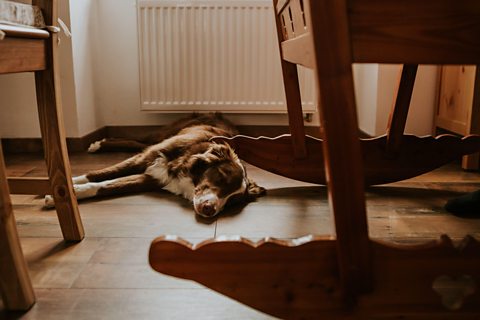 Image source, Tomáš Hudolin / Alamy
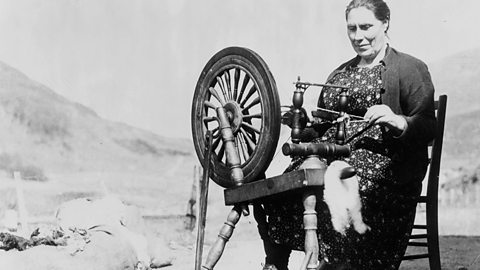
The opening statement of the poem describes a simple, basic existence, sitting ‘all day by the fire’, and we understand from the following question (which runs across multiple lines) that the woman is confined to her house due to her old age.
The length of the question hints at the length of time since she has "opened the door/and stepped outside". The number of actions listed contrasts with the single act of sitting by the fire, stressing the change from her busy past life and her current existence.
The separation from the outside world is enhanced by the suggestion that she is not only house-bound but confined mainly to her chair as:
Her walking days are over.
This statement feels unsentimental and factual, rather than sad, and perhaps hints at her own stoicism - she has seen all she needs to, and been everywhere she wanted to go. We could also take the impression that she is a practical woman, not used to dwelling on problems or making a fuss. This fits with the way of life suggested in the stanza.
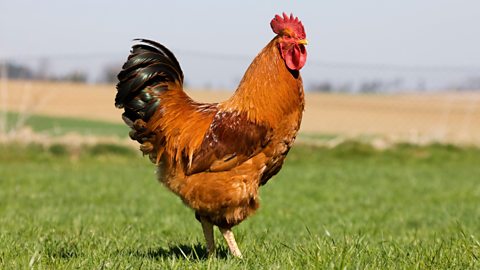
We understand from ‘scuffling hens’ and ‘the collie / dreaming of sheep’ that she used to lead a very traditional, rural lifestyle of crofting. We imagine that she once spent a lot of her day outdoors, so this confinement and isolation is a major change in life for her. That the collie can only dream of sheep suggests that their work together was some time in the past. Perhaps the woman sits by the fire recollecting her old way of life, just as the dog remembering its role.
Image source, Tomáš Hudolin / AlamyStanza two
Stanza two starts with a figurative statement that highlights that she is so much more than an old lady sitting by a fireside:
She has come through centuries
This gives the impression that she is so connected to the past and to her traditions that she sums up a particular way of life. This is continued in the image:
Her people/are assembled in her bones
This not only implies an ownership of her ancestry and past but that what and who came before her have made up the very fibre of her being. She is a pure distillation of all of this history, as we see in the statement
She’s their summation
The list of ‘Gaelic labour and loves / and rainy funerals’ gives us a wide spectrum of the cycles of life - "labour" could carry the double meaning of childbirth and working life. The words imply that she has seen it all and withstood the test of time, to the extent that we are told that, really, there is no such thing as "Before her time". This alludes toa common phrase about events that happened before someone was born. The phrase is in italics, to suggest it has been said by someone in ignorance of the woman's link to her ancestors. To the speaker she seems to have lived for all time.
Stanza three
 Image source, Viktoriya Kotlyarchuk / Alamy
 Despite her age and connection with history, stanza three corrects any potential misunderstanding that she is at all old in spirit.
wicked cackle / with love in it
This phrase draws to mind a mischievous, almost childlike naughtiness and this is coupled with the ‘relishing’ she does over ‘sly…gossip’, illustrating that she is still very much full of love, life, and laughter. The repetition of "relishing" suggests how much the woman enjoys the talk and gossip. One of the things she relishes is "malice". This helps round out the woman's character. She is not some idealised, saintly old woman. The fact she is flawed makes her seem more real and more full of complex life, and the same can be supposed of the culture that is so much part of her.
Her love of human connection is coupled here with an image:
with her hands / lying in her lap like holy psalms
This simile connects her with something sacred and ancient, like she is herself a book of prayer and worship - so much part of Gaelic culture. She is at once a living, breathing woman and also an embodiment of so much more.
Religion itself has been lost from her, as we learn in the repetition of ‘that once’ in line 20, as have the songs of the psalms, ‘tunes / she used to sign long ago’. It is notable that until the third stanza, we are almost led to believe the woman could be eternal, a motif of so many aspects of her culture and heritage. So when, in the third stanza, it is clear that she has lost her religion and no longer sings the psalms, we can also see this loss of her faith and song as an erosion of that culture that she had been the "summation" of in the second stanza.
Image source, Viktoriya Kotlyarchuk / Alamy What are the themes in Old Highland woman?
Isolation and community
The woman portrayed in the poem is an individual - and alone in her home, apart from some neighbours who visit. However, it is more complex than this, as she is also taken by the speaker as a figurehead of the community she is from - "Her people/are assembled in her bones". She is a metaphor for "centuries" of culture and community - right up to the present day where she loves to hear the local gossip.
It throws her physical isolation into stark contrast, and raises a common preoccupation of MacCaig's - what happens to an individual when they are disconnected, from their community, culture and natural surroundings?
He ponders this idea throughout this poem and places suggestions of her isolation ("that once had a meaning for her", for example suggesting she has lost her faith) alongside communal images ("she used to sing long ago", in reference to traditional Gaelic psalm singing which is unaccompanied by instruments and sung in a group). The thing that sustains her isn't faith, it is the connection with her people, both through a connection with the past, and through neighbours who now appear in the form of her visitors.
Aging and life
At the opening of the poem, it is clear the woman is physically declining - barely able to move from the fireside, never mind leave the house or tend to her croft. Yet the old woman is revealed to be full of life and vigour still, and finds great joy in hearing sneaky gossip about local scandals. Although she can take less active part in her community, her very existence is filled with the history of her culture, "Her people", and she is described as being essentially timeless and filled with something immortal because of this.
As a metaphor for the community, the age and history of the local traditions are valued and part of their importance. The speaker suggests that she too should be valued, in her position as someone who has seen it all "Before her time/has almost no meaning".
The poem ends by reflecting on time and aging - the woman is both full of her history and culture, such as psalm singing, but as she has grown old has possibly lost her faith, as well as her ability to act out this important tradition.
Heritage and identity
The strength of the old woman’s heritage and connection to her local community is undeniable; it is "assembled in her bones". She becomes one with that heritage at the opening of the second stanza:
She has come through centuries
This phrase implies that she has always been present, living through life cycles and a witness to all the community has endured. In the end, when she is hearing the gossipy tales of local life, this is part of that bearing witness to local life. The reference to her losing her faith, and singing the Gaelic psalms "long ago" can also be taken as the community's loss of these things - the decline in a very specific culture that she embodies throughout the poem.
Comparing Old Highland woman to other Norman MacCaig poems
Aunt Julia also has a strong crofting woman at its centre. We don't see her physical decline, although as with in Old Highland woman she embodies something wider than herself - in the case of Aunt Julia, she is so connected with working the land, and her language that the speaker of the poem hears her welcoming him with a "seagull's voice".
In Landscape and I, the speaker never becomes the landscape or the community in the way that the protagonists of these other rural poems do, but instead the landscape becomes an equal character that they converse with throughout. The connection to the natural world, and lack of human superiority, is uppermost in MacCaig's mind.
On Lachie’s croft also deals with similar themes of aging and decline in a rural setting. Old Highland woman connects more with the woman's history and tradition, and she doesn't seem to feel aggrieved at any loss of power or agency. On Lachie's croft has more despair in it ("I, too, feel bedraggled and haphazard") and seems to specifically be interested in the decline of certain types of masculinity.
Similarly, the world of the bustling city in Hotel room, 12th floor is miles away from the old lady's fireside in Old Highland woman, but in both poems there is a physical isolation while life goes on outside - and the theme of dissociation in Hotel room 12th floor serves as a direct contrast to the complete embodiment of the old Highland woman's surroundings.
Revise Old Highland woman by Norman MacCaig
Revise Old Highland woman and other poems by Norman MacCaig with interactive quizzes and flashcards for National 5 English.
Quizzes - Norman MacCaig. quiz
Test your understanding of Norman MacCaig poems with a series of interactive quizzes for National 5 English.

More on Norman MacCaig
Find out more by working through a topic
- count6 of 7
- count7 of 7

- count1 of 7
- count2 of 7