Overview of On Lachie’s croft by Norman MacCaig
On Lachie’s croft is a personal poem by Norman MacCaig which details the narrator’s feelings of:
- inadequacy
- loss of identity
The poem uses a rural setting and image of a weakened old cockerel to draw comparisons about masculinity and power.
The poem deals with themes of
- identity and isolation
- memory and loss
- masculinity and power.
Looking for some quick revision? Try the interactive Norman MacCaig quizzes for National 5 English.
You can read On Lachie’s croft by Norman MacCaig on the Scottish Poetry Library website
Context
Norman MacCaig was born in Edinburgh in 1910. Throughout his life he visited the North West of Scotland, feeling a strong connection to the landscape and Gaelic culture and people, to whom he was connected on his mother's side.
MacCaig was a lifelong pacifist. His opposition to war saw him register as a conscientious objector and spend time in prison having refused to serve in the military during World War II. His anti-war beliefs could be borne in mind when considering the military imagery used in this poem.
On Lachie's croft was written when MacCaig was 76 years old. In the latter part of his career, many of his poems became more reflective on death and the loss of family and friends.
What is a croft?
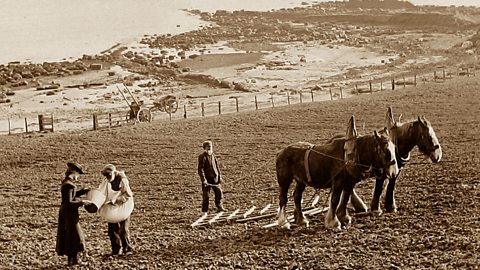
Crofting is unique to Scotland and is an important part of life in the Highlands and Islands. Crofts are small land holdings, which can also include buildings or a house. Crofters work these small areas of land to produce food crops. Common grazing areas are often shared by several crofts for sheep and cows. This type of community activity is part of the culture of crofting, where crofters work together to complete tasks and look after their land.
Learn more about farming and industry in Scotland here:Landscapes: farming and industry
Learn more about crofting in the past and what happened to crofters in the Highlands and Islands here:Victorians: The Highland Clearances
- Image source, Chronicle / Alamy
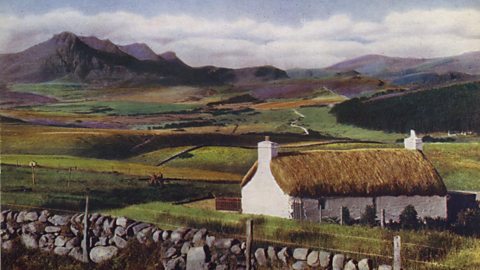
Image caption, Crofts were small areas of land where people lived and worked as farmers.
1 of 2
Form and structure of On Lachie’s croft
Written in Poetry that doesn't have an intentional rhythm or rhyme, but instead can sound more like speech and with moments of When the sentence runs onto the next line instead of neatly finishing at the end with a full stop or comma, occurs a few times in the poem. One such example is in lines two, three and four, when she refers to “the depth and breadth and height/ My soul can reach when feeling out of sight/ for the ends…” – it is as if the love she describes is so vast it cannot be neatly contained by the structure of the lines, instead bursting forth and spilling onto the next line. contrasting other more statement-like lines, the poem has a conversational feel to it.
This is furthered by the four stanzas of varying lengths and the lack of The number and type of rhythmic beats in a line of poetry..
This gives the impression that the speaker is confessing intimate thoughts to us after a visit to the croft. His thoughts appear spontaneous, and natural, but they are also often short and to the point.
- Stanza one: the speaker describes the bedraggled rooster.
- Stanza two: the speaker compares himself to the bird and notes his own loss of direction.
- Stanza three: the rooster attempts to crow but can only croak
- Stanza four: the speaker describes himself as being the rooster, noting a sense of loss and lack of power.
Stanza one
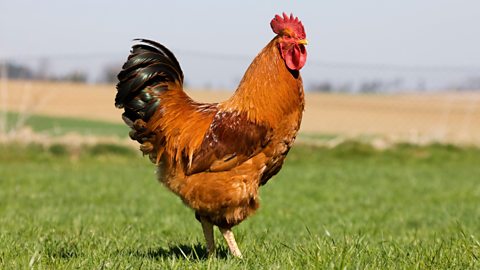 Image source, Connect Images / Alamy
On Lachie’s croft opens with the speaker contemplating a weathered cockerel, sheltering under a wheelbarrow.
The low, hidden position undermines the proud, masculine image we often associate with roosters, which is hinted at in the alternate name, "cock", in line one. This is coupled by the informal, uncertain nature of the question:
What’s wrong?
It is unclear exactly what is wrong, but from this note onwards we know that something uncertain isn’t quite right. This introduces the speaker’s ambivalent feelings about themselves.
The word "bedraggled" has associations of weariness and shabbiness, as if the bird has somehow let itself fall into a state of neglect. This is immediately contrasted with, again, the expected powerful, proudly masculine images of roosters:
Where are his military elegance, / his gauleiter manners, his insufferable conceit?
While "military elegance" could suggest a positive image of a young, upright army officer, showing off in colourful uniform, the other images here are clearly negative.
The German word "gauleiter" continues the military image of the bird. Gauleiters were Nazi officials in charge of governing districts. The third-highest rank in the party, the word therefore brings to mind arrogant fascist power and authoritarian discipline. However, the word forms part of MacCaig’s question about where these characteristics have gone, reminding us that even men of significant power can fall, as this rooster now has.
With "insufferable conceit", the speaker clearly judges the normal behaviour of a cockerel harshly. This could be MacCaig's opinion on younger males - be they birds, men, or possibly himself.
Image source, Connect Images / AlamyStanza two
The speaker now directly compares himself to the rooster with a confessional statement to open the second stanza:
I, too, feel bedraggled and haphazard
The word "bedraggled" is repeated here for emphasis and to draw the parallel clearly between the two figures. He continues:
something / has filched my compass, I'm breathing black air.
The metaphor in "something/has filched my compass" tells us that he has lost direction in life. ""Filched"" shows that he feels this has been stolen from him. We imagine that he once saw himself, like the rooster, as proud and strong, and can’t figure out why he doesn’t feel this way any longer.
"I’m breathing black air" is a metaphor first introduced here and later revisited in stanza four. It brings to mind a sense of struggle and suffocation. This could be the physical effects of aging but the use of "black" suggests a sense of depression or despair. The speaker again can’t find any true root cause of his feelings, nor can he see a way to escape.
I look at that rooster, I look at me.
The repetition of "I look" in line eight draws an even stronger parallel between the two male figures. The speaker explicitly tells us that he sees so much of himself in the rooster, if we were at all unsure of this he is making the comparison between the two very obvious.
Meanwhile, the hens go about their business. Although described as "his", they seem oblivious to the suffering, aging rooster, as if he is of no longer part of their lives. While he seems to be falling apart, the hens are described warmly, with their "motherly sounds", and the domestic, comforting imagery of the The lack of conjunctions between phrases.
so cosy, so fireside
Stanza three
Stanza three of On Lachie’s croft is a short stanza with one piece of narrative action.
But he opens his gummy eyes, looks at me
We see a Relates to pathos - used to evoke emotions in the audience, particularly feelings of pity, sorrow, or sympathy. image of the once proud bird opening "his gummy eyes" - painting the unwell, tired impression of a bird who finds even the most simple task exhausting - and uttering "a barren croak" instead of the usual loud and powerful "trumpet call" cockerel cry.
Again we see a military image in "trumpet cry" undermined, and instead the weakness of "croak" is compounded by the desolate connotations of "barren". We imagine that the speaker too finds that he lacks a voice, and that the confessions we are hearing in this poem are the first time he’s been able to put what is wrong into even uncertain words.
Stanza four
On Lachie's croft ends with a switch in narration. Where the speaker first described the rooster as "he", he now inhabits the bird, using the first person "I" to describe its actions and feelings.
I breathe black air, I poke at / my rumpled feathers,
The man identifies so strongly with the bird that they have become the same figure, and the stifling "black air" makes a return. We are reminded of the weariness and physical decline of the old bird in the phrases "rumpled feathers" and "can’t stand on tiptoe". Instead of preening himself and keeping up his proud appearance, he can now only "poke at" his feathers, suggesting his actions have no effect. This gives the impression of a decline in the physical and mental state of the speaker, that the black air has become all encompassing and now he can't separate himself from the rooster.
Concluding, the speaker uses repetition to emphasise how much is missed in the "cosy brown hens", which here act as a metaphor for any previous comfort, intimacy, or emotional connection before he found himself ruined. This could suggest relationships with people the aging speaker has lost, or a more general sense of disconnection from women, or from life that he observes but which carries on without him.
How I miss my cosy brown hens. / How I miss their motherly clucking.
The final line of the poem is a twist on William Cowper’s famous line "I am monarch of all I survey", which comes from the poem The Solitude of Alexander Selkirk. It details a man who has lost everything feeling desperate isolation on a deserted island:
I'm master of nothing I survey.
Here, the quotation is inverted, and the power hinted at in the word ‘master’ is lacking. The speaker finds that he has lost even the strength to rule over simple chickens. All he can do is watch them get on with life without him.
What are the themes in On Lachie’s croft?
Identity and isolation
The poem details a man’s struggle to come to terms with a loss of his identity. It is clear from the comparisons that, like the rooster, he once felt himself to be a strong, powerful, masculine figure, but he is left wondering who he truly is now that those things are no longer true. In the end, the only conclusion that he can come to is that he has lost who he once was and now has nothing.
The effect is isolating, the rooster and the speaker are both solitary characters, unlike the hens who are in a group and unaffected. There is a profound sense of loneliness throughout the poem, which makes the reader wonder if these yearnings for lost power are actually a need for connection and communication.
Memory and loss
This entire poem seems to be looking back to something not entirely identified that has been lost.
In the last stanza, the speaker reflects on how he misses his hens, and how he has nothing. We are never told what the speaker has lost, how he has ended up in this place, but he appears to be alone, with nothing to show. The implication of him missing the hens, and the final line ‘I am master of nothing I survey’ is that he once had something – a family, possibly, or people who loved him (the repeated reference to ‘motherly’ might be a clue here) – and now he does not.
MacCaig was 76 when he wrote this poem, so it could be read as his reflections on his own aging, and the loss of youth, loved ones and connection with life that can come with growing old.
Masculinity and power
The mentions of masculinity and power in this poem are very traditional, with references like:
- "military"
- "conceit"
- "trumpet call"
The loss of any feelings of power leave both the rooster and the man adrift, without direction or identity. This perhaps suggests that much of traditional masculinity is empty display, and serves as a warning that there is more to being a man, or a rooster, than wielding power. It is telling that the hens continue to peck and scratch, untroubled by any such crises of identity.
Comparing On Lachie’s croft to other Norman MacCaig poems
Rural settings are found in many of Norman MacCaig’s poems, including Old Lachie’s croft. Contemplation of identity and the wider human experience is also found in several of these poems.
A good example is Basking shark, which asks questions not just about masculinity but about man’s place in the world (“I saw me, in one fling/Emerging from the slime of everything”) and poses the question of what power truly is (“So who’s the monster?”)
However, there is also a pervading sense of isolation to be found in an urban setting in Hotel room, 12th floor, where the speaker lies in bed alone, listening to “the harsh screaming/ from coldwater flats, the blood/glazed on sidewalks”, and in Old Highland woman, the lady portrayed "sits all day by the fire".
Memory, and specifically memory connected to the landscape is also crucial in a number of these poems – in Old Lachie’s croft the speaker misses his “cosy brown hens” and their “motherly clucking”, which we can interpret as a longing for a time when he had some company, or even power.
In Aunt Julia, the speaker still hears her voice and there’s a similar wistfulness for the past:
But I hear her still, welcoming me / with a seagull’s voice / across a hundred yards / of peatscrapes and lazybeds”
When the speaker reveals in the final stanza that he misses his hens, we feel there is a loss underpinning his bleakness. Loss is also directly present in Aunt Julia, where the main character dies but there is also a thread throughout the poem of maintaining a cultural memory that is in danger of being lost without people like her.
Revise On Lachie's croft by Norman MacCaig
Revise On Lachie's croft and other poems by Norman MacCaig with interactive quizzes and flashcards for National 5 English.
Quizzes - Norman MacCaig. quiz
Test your understanding of Norman MacCaig poems with a series of interactive quizzes for National 5 English.

More on Norman MacCaig
Find out more by working through a topic
- count7 of 7

- count1 of 7
- count2 of 7

- count3 of 7