Overview of Sorting Through by Liz Lochhead
Sorting Through is a poignant poem in which the speaker reflects on the memory and loss of their mother whilst clearing out her belongings after her death.
This generational rite of passage prompts the speaker to consider their mother’s life before marriage and children. The poem describes the speaker’s mother as a young woman and the impact of her (now) absence on the speaker’s life.
Each reader will interpret what a poem means to them in their own way. Everyone's response is different. While Sorting Though may be a personal poem about the death of Lochhead's mother, the reader can separate the poet from the speaker and words of the poem and think about how they contribute to wider themes or feelings.
The poem contains themes of
- grief and loss
- memory
- identity
Looking for some quick revision? Try an interactive quiz for Higher English.
You can read Sorting Through by Liz Lochhead on the Scottish Poetry Library website.
Form and structure of Sorting Through
Like much of Lochhead’s work, Sorting Through is in Poetry that doesn't have an intentional rhythm or rhyme, but instead can sound more like speech, a single stanza with irregular line lengths.
The structure mimics the fact that memory and grief are not linear but instead can be disjointed and lack order. The use of The use of run on sentences with no punctuation at the end of lines or across stanzas. allows a free flowing of feelings and conveys the idea that the speaker is almost thinking aloud as they work through the task of clearing their mother’s belongings.
The use of imagery and sound techniques help to convey a sense of the vitality of the mother when she was a young woman and also the reality of the loss for her daughter.
The chronology is straightforward:
- in the first three lines the speaker acknowledges their mother’s death.
- the poem then moves on to reflect on the life the mother had as a young woman.
- the final part of the poem presents the speaker’s feelings of melancholy about their mother’s personal belongings, which are being discarded. This symbolises the significant impact her loss will now have on the speaker's life.
Lines 1-8
The poem opens with the blunt “The moment she died” conveying the speaker’s acceptance that their mother’s physical presence has gone. Whilst looking at her “dance dresses” the speaker considers how she would have looked wearing them and concede that they aren't reminiscing but reimagining their mother:
turned from the colours they really were/ to the colours I imagine them to be
In the following lines, the speaker thinks about their mother’s youth and depicts her as sociable and carefree:
bumptoed silver shoes/ swinging from their ankle straps.
The use of The repeated use of the ‘s’ sound in the beginning, middle or end of nearby words. reinforces the mother’s love of dancing and creates a playful, light-hearted mood. The speaker imagines her coming home after a night out, "her dad" (the speaker's grandfather) waiting on her return. This conveys that she was loved, as her father is waiting to ensure that she gets home safely, but also suggests the vibrancy of youth, and a sense of rebelliousness or rule-breaking behaviour:
swaggered/light-headed from airman’s kisses
This imagined picture of the mother, provides the speaker with a different perspective to the one they knew. This highlights the theme of identity, as the speaker considers different aspects of her mother's life and personality, and reflects how people assume different roles throughout their lives.
Lines 8-14
The poem moves back to the present day as the speaker reflects on their mother’s absence from the family home (“what I’ll have to learn to call my father’s house”). This suggests the death is fairly recent, and the speaker knows it will take time to adjust to this momentous life change.
The mention of "my father" so soon after "her dad" suggests both difference (the contrasting words) and a connection (similar phrases, both in italics) between the two women.
The conversational tone of this section suggests the speaker’s thoughts are unrestrained and without order. Each item that is mentioned conjures up an image of the mother as a young woman and “prints her even more vivid” in the speaker’s mind.
The short sentences “Old lipsticks. Liquid stockings.” convey the idea of a running commentary of personal items, which once held importance, now being tossed in the bin. There is a hint of glamour in these items, while the During World War II, manufacturing of nylon stockings ceased, so some women painted their legs with 'liquid stockings' a skin-toned cosmetic that created the appearance that they were wearing tights. Some women would even draw the line of a seam on with a pencil for a more realistic effect. links to a very specific time. Even if the items are mundane their significance makes this an emotionally charged experience.
The listing of vintage brands of clothing “Harella, Gor-ray, Berketex” set the time period around the 1940s, already suggested by the liquid stockings, and again links to the theme of identity as the speaker connects with the young woman their mother once was.
Line 14 rounds off this section in a very matter-of-fact tone as the speaker puts these once important items in “binbags for Oxfam”. There is stark contrast between the list of once glamorous brands, the rough action suggested by "manhandle", the binbags, and named charity shop. This shows that, whilst material possessions may hold sentimental memories, they ultimately become of little use to those left behind.
Lines 15-22
In the final section of the poem, the poet uses Personification is when a writer gives human characteristics to something that isn’t human. to emphasise the evocative nature of the items of clothing the speaker is ‘sorting through’.
“the sadness of dispossessed dresses which no longer have someone to wear them, highlighted by the use of The repeated use of the ‘s’ sound in the beginning, middle or end of nearby words., echoing the use of it earlier in the poem.
"the decency of good coats” which were only worn on formal occasions conveys the emotional connection they felt to their mother through these items.
"the gravitas of lapels" could refer to dressing appropriately for serious occasions, such as funerals.
The word choice suggest these formal clothes are publicly mourning the death of the mother. Perhaps she herself wore them to funerals.
The final two lines sum up the speaker’s feelings about grief.
the invisible danders of skin fizzing off of them
This unusual description creates an effective image of dust rising from the clothes as they are put away. Rather than call this dust, Lochhead refers to the tiny fragments of skin that dust is largely made of. The work choice links directly to the mother, and the idea of her skin "fizzing" creates a sense of energy and life.
The speaker reflects that although the woman has died, They realise that life "will not neatly end” as memories will be triggered by objects, long after the person has gone.
Video: What is personification?
The personification of the clothes in Sorting Through makes them full of life, which is a very effective emotional technique in a poem about a lost loved one.
Brush up on your understanding of personification with this short HigherEnglish revision video.
What is personification? How and why would you use it? Bitesize explains with examples from ‘Home’ by Iain Crichton Smith.
Personification
Giving an inanimate object human feelings or actions.
“The thirsty flowers seemed to reach out and beg for water.”
The flowers can’t actually move or beg, but by personifying them, their need is made more human and understandable.
As well as actions, like moving or speaking, personification can also attribute a human feeling to an object.
“The apple sat, proud as punch, at the top of the fruit bowl”
The personification of the ‘proud’ apple, and its prominent position in the fruit bowl makes it seem more appealing.
Without the personification, this would just be a description of a lifeless scene.
Describing objects as if they are people is a way to make sentences more exciting.
In Iain Crichton Smith’s short story ‘Home’, he uses personification to describe how a street has changed:
“Instead of small shops, supermarkets were springing up, flexing their huge muscles”
The personification here tells us that the supermarkets are an intimidating addition to the town.
Their “huge muscles” represent their wealth and the power that these big businesses have over smaller rivals, and the fact they are “flexing” tells us they are flaunting this power, or showing off.
The personification paints a striking image, and means the writer can avoid a long explanation of business economics.
Why don’t you try bringing your writing to life with personification?
It can really make it sing!
What are the themes of Sorting Through?
Grief and loss
The act of clearing out a parent’s belongings after their death is a symbolic rite of passage for many people. It is part of the grieving process and as the speaker goes through wardrobes and drawers, they are also navigating their emotions and reliving memories of their mother “in a white cardigan and that exact frock.”
The quiet intimacy of personal loss is captured in this very ordinary domestic task.
Memory
The memories conjured up by the items the speaker finds create a reflective mood as they confront the reality of the absence they now face. However, although there is sadness, there is also a sense of respect and love for the life their mother lived.
Interestingly, the memories presented in the poem are indirect. They are clearly invented by the speaker, perhaps based on stories they have heard from, or about, their mother. The images evoked date from a time before the speaker was born as they imagine their mother as a carefree young girl.
to the colours I imagine them to be
This is poignant as it demonstrates how varied a life she had before she was a mother. The actual memories that the speaker has of their mother in that part of her life are perhaps too real, and too hard to confront in this stage of the grieving process. The colour and vibrancy of the dresses instead allows the speaker some comfort, imagining a happy time in their mother's life.
Identity
As apparently insignificant objects take on huge significance, for example clothes and cosmetics, the speaker imagines their mother in her youth “light-headed from airman’s kisses” highlighting how people can have different identities from our perceptions.
There is a suggestion that there is always a sense of discovery when we lose a loved one, that their lives do not "neatly end" but instead we learn more about them.
Comparing Sorting Through to other Liz Lochhead poems
This poem and Box Room are linked by the themes of memory and identity, and specifically people being remembered through their possessions:
- In Sorting Through, the speaker’s memories of their mother are evoked by the process of clearing out her belongings after her death.
- In Box Room, the speaker is forced to confront the reality of whether she will fit into her boyfriend’s life as she looks around his bedroom at the objects which have been collected over the years and preserved as memories of his childhood by his mother.
Another poem which links to the ideas in Sorting Through is The Spaces Between. In this poem, the enforced separation of a family during the 2020 coronavirus lockdown conveys the importance of connection and the devastating impact it can have when that is lost. In a similar way, the speaker in Sorting Through is confronted with the physical and emotional loss of connection after their mother’s death. Both poems embrace the idea that human actions and emotions live on after death and through distance and time.
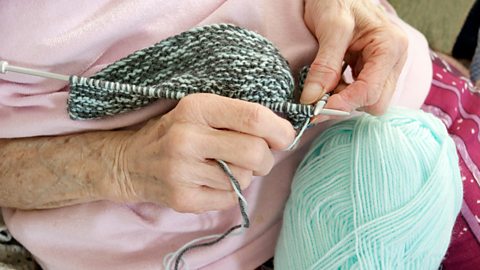
Both Sorting Through and For my Grandmother Knitting see the poet looking back at the lives of relatives:
- In Sorting Through it is the clothes and other belongings that bring to mind the mother's life and youth.
- In For my Grandmother Knitting, the woman's old but busy hands that suggest her past life and the activity her hands were involved in.
Revise Sorting Through by Liz Lochhead
Revise Sorting Through and other poems by Liz Lochhead with interactive quizzes for Higher English.
More on Liz Lochhead
Find out more by working through a topic
- count3 of 3
- count1 of 3