Overview of For My Grandmother Knitting by Liz Lochhead
In For My Grandmother Knitting, Lochhead asks us to consider the way the elderly are treated in our society and how the process of aging changes our perceptions of individuals.
The poet uses the symbol of her grandmother’s hands to emphasise her changing roles over the course of her life, from young fisher girl to the aged and infirm old lady that she has become.
You can read For My Grandmother Knitting on the Scottish Poetry Library website.
Form and structure
The poem is divided into five stanzas of unequal length but with a fairly straightforward, chronological order.
With the exception of the final stanza, every verse is constructed in one, long sentence. A poetic device where a sentence continues beyond the end of the line or verse. is used to draw our attention to certain words and phrases.
The first and second stanzas have a parallel structure. The first half of each verse focuses on the grandmother as she is now, while in the latter half she is depicted in her youth, gutting fish in her first job.
In the third stanza she is depicted as a young wife and mother. The fourth stanza recapitulates the first, showing the grandmother with her family in the present.
In the final stanza she is alone, waving goodbye to her children and grandchildren from her window. Here Lochhead deviates from the pattern of the first four stanzas, using a series of one word sentences to change the rhythm and meter and prepare us for the conclusion of the poem.
She uses the Repeating a word or phrase in a sentence can emphasise a point, or help to make sure it is fully understood. of certain phrases and words throughout the poem to invite the reader to consider the way we view our elderly loved ones.
Although the poem is written in the second person, it is done so from her grandmother’s point of view. This allows the reader to share her experiences much more fully and empathise with the situation she now finds herself in.
The most important A symbol is an object, person, image or event used to represent something bigger. For example, doves are often used as a symbol of peace. in the poem is that of her grandmother’s hands. Despite the ever changing roles of her life, they seem to have remained in almost constant and perpetual motion.
Stanza one
This verse opens with the phrase that is repeated throughout the poem:
There is no need they say
This refrain appears in almost every stanza. It reinforces a key theme of the poem - that of the grandmother's increasing sense of uselessness.
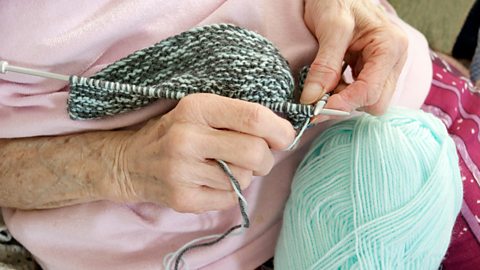 Image source, Alamy Images
The deliberate use of the word "they" also seems to create a sense of separation and distance between the grandmother and her children, who are united in their belief that her drive to knit is unnecessary.
The effect of the Repeating a word or phrase in a sentence can emphasise a point, or help to make sure it is fully understood. of these words invites the reader to doubt this assertion. It implies that perhaps the grandmother is right to cling on to her beliefs and traditions - they still have relevance today even if others don’t seem to recognise this.
There is almost something defiant in the following lines as the central image used throughout the poem of the grandmother’s hands is introduced.
but the needles still move / their rhythms in the working of your hands
The needles are Personification is when a writer gives human characteristics to something that isn’t human. , as though they have a life of their own and that the hands move instinctively, skilfully and automatically.
The word "but" is also repeated throughout the poem, appearing in every stanza. This helps to present a counter point of view to that of the grandmother’s children and their insistence that her knitting is now unnecessary.
What they fail to grasp is that her need to knit stems from her need to have purpose and feel useful. Even in old age and infirmity she still wants to contribute something tangible to the world.
Almost seamlessly, aided perhaps by the continuation of one long sentence, these same hands are transported back to her past. We see them "sure and skilful" when she was a "young fisher girl".
This jump between the present and the past too is a repeated feature of the poem. It helps to show the direct relationship between the elderly, infirm grandmother of today and the young, robust girl of her youth. Again, it is the hands that act as the central linking image between the two.
Image source, Alamy ImagesStanza two
This stanza opens with the direct assertion that the grandmother "is old now" and that her "grasp of things is not so good".
The word choice of "grasp" has a dual meaning. It implies literally that her hands are less able while figuratively suggesting that her mind too is less alert and the she is becoming increasingly forgetful.
Again though, Lochhead immediately contrasts this image of her elderly grandmother with the girl of her youth, again gutting fish, "deft and swift".
The effect of the contrast again reinforces the link between the movements of the old lady and that of the young girl. It forces the reader to see her in a variety of contexts, not just as the aged and now infirm lady of the present.
The The repetition of vowel sounds in a series of two or more words. and The repetition of the same sounds or consonants in two more words nearby each other. of the following line helps to emphasise the dexterity of her grandmother’s hands when she was young.
you slit the still-ticking quick silver fish
The short 'i' vowel increases the pace of the words. This reinforces how quickly and efficiently she was able to process the fish. The almost tongue-twisting To place two or more ideas/images close together to create further meaning for an audience. of the words reminds us that while she makes it look effortless, this was a complex, highly skilled task.
The final lines of this stanza encourage us to consider the growing sense of uselessness and irrelevance the writer’s grandmother must now feel.
Hard work it was too / of necessity
In her youth, her hands were her livelihood - they allowed her to support and provide for herself and her family. Now though, she knits not out of necessity but in order to feel useful and to contribute.
In rejecting her knitting then, her family are by extension also rejecting her and reinforcing her sense of uselessness.
Stanza three
This idea of necessity is emphasised in the opening of stanza three. It alludes back to the first line of the poem -
But now they say there is no need
Again, this shows the growing sense of distance between the writer’s grandmother and her children.
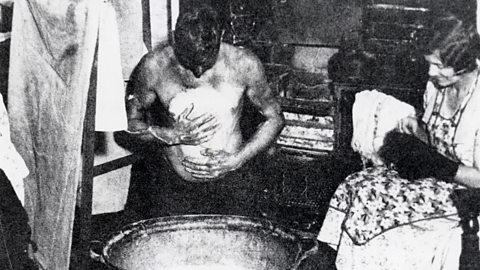
The poem then leads back to her youth, this time as a young bride with a "hand span waist" and as a mother of six. Despite her tiny frame, she is strong and robust, scrubbing her husband’s back in a
tin bath by the coal fire
Sibilance is used to describe how she "scraped and slaved slapped sometimes" to really emphasise the day to day hardships endured by ordinary, working class folk.
In doing so Lochhead invites a comparison between the past and the present - between toil and austerity and the relative comfort and quality of life that we now take for granted.
Stanza four
This stanza is given over entirely to the point of view of the grandmother’s own children.
Their continued refrain that she need not knit for them anymore only highlights how little they understand her.
Their protestation that there is "no necessity" makes us reconsider our understanding of what is necessary. For her children, the idea of need is solely attached to their needs, not their mother’s.
They fail to see that she knits not just for them but so that she feels she can still contribute - that her skills are not obsolete and that she is still relevant.
Stanza five
As the poem nears its conclusions, the poet’s grandmother is depicted waving goodbye to her children at the window after their Sunday visit.
While attentive and dutiful, it is clear that they don’t really understand their mother.
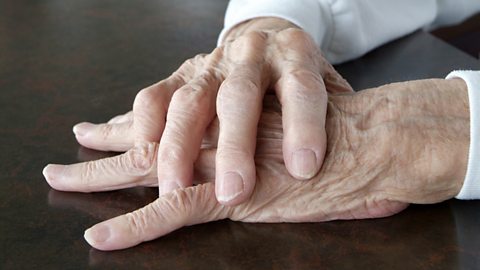
To them, she belongs to a past, bygone era that is out of step with the modern world. The meter of the poem changes here from the long sentences of the previous stanzas. Again the poet focuses on her grandmother’s hands:
Swollen – jointed. Red. Athritic. Old.
These single adjective sentences really force the reader to confront the cruelty of the aging process. They invite a contrast with the sure and skilful hands of the fisher girl and the young wife and mother of the previous stanzas.
These adjectives could be used to describe not just her hands but the way she is viewed by society and even by her own children.
This pessimistic note is relieved in some way by the final lines of the poem beginning with the line
But the needles still move / their rhythms in the working of your hands / easily
The word 'but' is almost deliberately defiant. The A poetic device where a sentence continues beyond the end of the line or verse. isolating the word 'easily' on a line of its own emphasises that, despite her physical limitations, the skills she learned over a lifetime have not yet abandoned her.
In the final lines, Lochhead alludes to the sense of comfort and solace that these patterns and rhythms have provided to her grandmother over the years. They offer the certainty of something constant in a world of flux and perpetual change.
Themes
This poem deals with:
- the cruelty and reductiveness of the aging process
- the relationships and conflict between the past and the present
To her own children, the poet’s grandmother is increasingly irrelevant to the world in which they live. For them, knitting is a skill from a past era that they no longer appreciate. This contrasts with the world in which their mother grew up, where knitting was a necessity, not a hobby.
By rejecting the scarves and cardigans which she produces, they unwittingly make her feel increasingly useless and without purpose.
Through the image of skilful hands that knit, that once provided her livelihood, that scrubbed her husband’s back and raised six children, the poet presents a different and much fuller depiction of her grandmother.
More on Liz Lochhead
Find out more by working through a topic
- count2 of 3
- count3 of 3