Overview of The Spaces Between by Liz Lochhead
- The Spaces Between is an observational poem written by Liz Lochhead in 2020, when much of the world was in lockdown due to the coronavirus pandemic.
- In this poem, the speaker witnesses the seemingly everyday activity of a young boy’s birthday being celebrated in a garden with his family. It is revealed their grandmother is observing them from behind a glass window.
- The poem moves on to consider the ancient art of pigment blowing around hands to create stencilled cave paintings.
- Finally, the poem returns to the enforced separation of a grandmother from her family, and highlights the human innate need for connection.
The poem contains themes of:
- human connection
- time and memory
You can read The Spaces Between by Liz Lochhead on the Scottish Poetry Library website.
Context
The Spaces Between was written by Lochhead in April 2020, during the first coronavirus lockdown.
What is coronavirus?
Coronavirus (COVID-19 virus) is an infectious disease, which began spreading in December 2019. It originated in China before spreading around the globe.
The main symptoms of the virus are a dry cough, fever, and shortness of breath. For the majority, these symptoms are mild; while some people will experience more severe, flu-like symptoms. An extremely small number of people become critically ill or die from the disease. The impact of coronavirus is affected by age or underlying health conditions.
What happened during this time?
In March 2020, the number of worldwide deaths from the virus passed 10,000. The UK went into a nationwide lockdown from 23 March 2020 following the outbreak. This meant people from different households were not allowed to meet up with each other. People were only permitted to leave home for one of following reasons:
- shopping for basic necessities, such as food and medicine
- one form of exercise a day, such as a run, walk, or cycle. This was only to be done alone or with people you lived with
- any medical need, to provide care, or to help a vulnerable person
- travelling to and from work, but only where this was seen as absolutely necessary and could not be done from home
Schools were closed to all pupils, except vulnerable children and children of key workers. Some young people returned to school in June 2020, but most did not return until September. Young people were learning from home, and parents and teachers were taking on additional responsibilities above and beyond their usual role. Libraries, non-essential shops, playgrounds, gyms, and places of worship were also ordered to close.
The coronavirus pandemic was an extremely challenging time for many people. Families were separated for some time and many important life events such as birthdays, weddings, and funerals were missed.
A series of national and regional lockdowns followed throughout 2020 and into 2021 in an attempt to control the spread of the virus.
Sources and further reading
Form and structure of The Spaces Between
Lochhead's poem The Spaces Between is 33 lines long with no rhyme scheme. It is divided into four stanzas of irregular length.
The focus moves through:
- domestic ordinariness
- prehistory
- an A reference that is intended to make you think of a well-known thing or person. to a global event
- a broader reflection on human expression, emotion and memory
This shift between the personal and the universal highlights the poem’s key ideas: that despite being separated by physical barriers, by generations or eras, the desire for connection and to leave a lasting mark are primal needs for humankind.
The To place two or more ideas/images close together to create further meaning for an audience. of a modern family moment with ancient cave art highlights how non-verbal actions and shared creativity are forms of expression which are universal and timeless.
Stanza one
The initial setting is the grandmother’s garden, where the family are celebrating the boy’s tenth birthday by lighting candles on a birthday cake. The tone of this apparently ordinary scene shifts when it becomes clear that the grandmother is not physically part of the celebration but can only watch from her living room window. The reason for the grandmother's separation is not yet revealed.
Stanza two
The setting changes both in place and time, to an early historical era. The speaker describes the efforts of ancient people to leave their mark by creating handprints on the walls of caves. The speaker acknowledges the difficulties they must have faced in doing this and their compulsion to ensure they did.
Stanza three
The focus of the poem switches back to the present day and the birthday party taking place on the lawn. We are now given the context of the party which sets it in a very specific time - lockdown during the Covid-19 pandemic. The joy of the celebrations is tinged with sadness as the grandmother tries to shield her grandchildren from her heartache by exaggerating her actions. These everyday family images again emphasise the importance of human connection.
Stanza four
The short final stanza uses Where a word, phrase or idea is repeated for emphasis. and a A question asked in order to create a dramatic effect or to make a point, rather than to get an answer. to emphasise the central message, that love and relationships are the enduring factors in the existence of the human race. The ending conveys a sense of hope and gratitude that, despite the circumstances, the family were able to maintain their traditions and bonds, albeit in a different way.
Stanza one
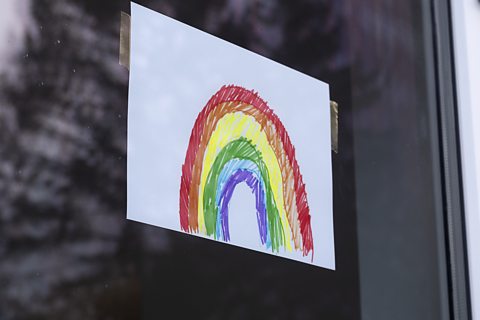 Image source, Getty images
The poem opens with a domestic scene of a family celebrating their son’s birthday in a garden. They hold up a homemade banner:
unfurl a rainbow crayoned big and bright/on a roll of old wallpaper.
The rainbow became a A literary device where an object, person, place, or event represents something beyond its literal meaning. representation of hope and resilience during the pandemic, and this is echoed in the family’s attempt to create a celebratory mood. The use of the word "crayoned" links forward to the idea of colour and pigment in stanza two.
There is a vivid description of the boy's father:
big-eyed, mock-solemn, pantomimes ceremony
This expressive and unusual word choice of "pantomimes" as a verb shows how exaggerated the man's gestures are and how it is all part of the fun.
However, the reader is then made aware that the boy’s grandmother is watching the celebration from “Inside her living-room”, as she is isolated from her family, a common occurrence during the periods of lockdown when people were not allowed to mix with those from other households.
The tender image of the grandmother and grandson copying each other’s gesture through a windowpane (“mirrors her, stretching fingers/ and they smile and smile…”) highlights human optimism in the face of adversity and suggests that love can overcome these hurdles even when people are physically separated.
The stanza ends with a contrast that adds another layer to the description:
…as if they touched/warm flesh not cold glass.
The image of the grandmother and grandson, palms 'touching', separated by the "cold glass" is poignant and designed to stay with the reader, while the poem appears to take a different direction in the second stanza.
Image source, Getty imagesStanza two
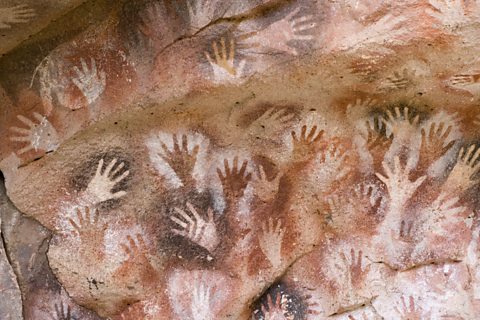 Image source, Getty images
The focus of the poem switches suddenly to the ancient past ("More than forty thousand years ago"). The image of the hands on the window pane is immediately referenced in the description:
men or women splayed their fingers thus/and put their hands to bare rock
Again, the reader imagines the texture of the hands touching the "bare rock", in contrast to the "cold glass" and even the "warm flesh" of the previous stanza. The description of ancient people’s determination to leave a physical reminder of their existence shows their resolve and strength of spirit. The speaker describes how they made pigments ("chewed ochre, red-ochre, gritted charcoal"), which links back to the use of "crayoned" first stanza, then:
blew,/blew with projectile effort that really took it out of them
The The use of run on sentences with no punctuation at the end of lines or across stanzas. and Where a word, phrase or idea is repeated for emphasis. highlighting the word "blew" adds to this feeling of exertion, that the people are blowing with all their might. This highlights the importance of this act of leaving their mark.
The act of blowing also draws attention to their breath, their life force, which is highlighted with the phrase: "their living breath". This is the first of several references to "living"; reminding us that it is the breath that shows they are alive and that makes their art possible. The mentions of breath and exertion also links to Covid, as one of the main symptoms is shortness of breath.
There are many examples of hard-hitting, evocative word choices in this stanza, for example: “bare", "gritted", "raw”, "cold" to convey the reality and harshness of their situation, yet still they persevered and more than that, "made their mark." This links to the difficult times people faced during the pandemic, and offers the idea of something that endures beyond hard times.
spattered the living stencil/that was each’s own living hand
The "living stencil" makes these ancient people feel like tools for their art. The Where a word, phrase or idea is repeated for emphasis. of “living” emphasises the intention behind the ancient art, that there was an inner drive within each generation to ensure they left a trace of themselves, whilst they were alive, for those who came after them. The images made are also one of absence. The pigment creates an outline of where the hands once were. There is an empty unmarked space that shows where a living person once was. The To place two or more contrasting ideas, images or words close together to highlight their differences. of absence and presence reinforces the idea of bridging the “spaces between” people and eras. There's a gap in understanding which the speaker explicitly acknowledges:
We do not know why they did it/and maybe they did not either
The use of “We” and "they" immediately draws the reader in, as we are sharing this experience from the perspective of the speaker, not the ancient people. However, the speaker reinforces the suggestion that we can understand the innate urge to leave some form of indication of existence:
they knew they must.
Just as in the first stanza, the bonds and shared traditions passed down between elders and the younger generation feel important, and across these two stanzas the underlying similarities between ancient times and the present day have also been set up.
Image source, Getty imagesStanza three
The poem now returns to the present day scene from the opening stanza in another time leap, as the grandchildren show their new skills to their grandmother:
The birthday boy is juggling.
The pandemic is explicitly referenced here in the word choice "lockdown", placing the events of this birthday scene very specifically in that time.
The pretence of normality and family life is presented in a poignant way, as the grandmother also ‘performs’ for her grandchildren just as they do for her. She “dumb-shows most extravagant applause” and “toasts them all in tea” as she tries to shield them from her sadness through exaggerating her actions. This also mimics the actions of the father as he "pantomimes ceremony" from stanza one - everyone here is acting or putting on some kind of show to keep the birthday celebrations feeling normal and happy.
The impact of the grandmother’s disconnect from her family is emphasised through the repetition of “miming":
miming hunger, miming prayer/for her hunger to be sated.
They cannot hear her, and so she uses these non-verbal gestures to convince her family that she is fine, and feels part of the festivities. The "hunger" that she is praying will be 'sated' is metaphorical, it is a hint that she is craving human contact. However, at the end of the stanza the phrase “blinking tears” explicitly conveys her inner distress and highlights the poet’s key message about humankind’s ultimate need for true connection and companionship.
Once again, the stanza ends with the image of hands pressing at the window, symbolising touch and identity:
Another matched high-five at her window.
It represents the children's attempts to reach, and to physically touch their grandmother, and connects this to the ancient artists’ desire to be remembered after they are gone.
Stanza four
The final short stanza sums up the main ideas of the poem and pulls the key images together.
Neither the blown candles or the blown kisses
The Where a word, phrase or idea is repeated for emphasis. of “blown” reinforces the idea of living and breathing. The frequent mention of breath, alongside the context of the pandemic, reminds us that life is precious and we should not take our breath, and our lives, for granted.
This line is also a link between the present and past. In stanza two, the ancient people "blew" the pigment around their hands, but in the first and last stanza, it is candles and kisses being "blown".
The speaker states that the simple gestures of blowing "candles" and "kisses" will not “leave any permanent mark”. However, the A question asked in order to create a dramatic effect or to make a point, rather than to get an answer. ("unless love does?") suggests that love, and the fleeting preciousness of these moments, will endure. In the final lines, the emphasis is on the main message about humankind’s innate need for connection, which goes beyond any one generation or civilisation:
on this the only afternoon/ they will be all alive together on just this day the boy is ten.
This final stanza evokes mixed emotions. It is the only day where they will all be alive celebrating this boy's tenth birthday, even though it is in lockdown. Their determination to celebrate this, and to make a happy memory whatever the circumstances has reminded the poet of the determination of the ancient people to leave their marks behind. However, it is also a sad reminder that our existence is finite and the passing of time is linked to death. It is memory and human connection that endure beyond death.
What are the themes in The Spaces Between?
Human connection
The enduring human impulse to connect with others and to seek companionship is at the heart of this poem.
It is explored through the To place two or more contrasting ideas, images or words close together to highlight their differences. of the experiences of an extended family during lockdown, and the art of cave painting undertaken by ancient communities. Both are group activities and both are also designed to leave an impression of one kind or another on the next generation, whether that's a "permanent mark" or not.
The palms pressed against window panes and cave walls are a simple and effective symbol of humans attempting to connect with each other through touch, through these activities and passing on traditions. The speaker in the poem reflects on the cave paintings, that:
We do not know why they did it
In thousands of years from now, perhaps people will not know why people painted rainbows, or even blew out candles on cakes. It is left to the reader to consider that the cave painting was a similar shared moment thousands of years ago that has left a lasting impression.
Video: What is symbolism?
The pressed palms are a symbol in The Spaces Between of human touch and connection. Learn more about symbolism with this short video.
What is symbolism? How and why would you use it?
Symbolism
The use of symbols to represent deeper meanings or themes.
Symbols are usually objects which are easy to understand.
What they represent is more complex.
We use symbols every day. Some are universal.
We all know that a red rose symbolises love or romance.
A clock is a symbol of time.
Diamonds can represent wealth or value.
A white flag symbolises surrender or a truce.
Symbolism helps writers illustrate and develop the themes of their story.
If you wanted to explore the theme of death, you might use symbols like:
The colour black
Angel’s wings
or even a skull
These symbols provoke emotions in the reader linked to death, adding depth beyond action or conversation.
In her poem 'Revelation', Liz Lochhead uses symbolism to explore the idea of evil through a young girl’s experience on a farm.
“I remember once being shown the black bull… In the yard outside, oblivious hens picked their way about…”
The black bull, half seen in the darkness, symbolises evil. This evil is a danger to order and calm, which is symbolised by eggs as well as innocent female hens.
“I had always half-known he existed – this antidote and Anti-Christ, his anarchy threatening the eggs”
Once these are established as the symbols of the poem, Lochhead uses them to guide us through the heavy concept of evil versus good.
The next time you explore difficult themes in your writing, why not give symbolism a go?
You might just crack it!
Time and memory
The creation of memory is important in this poem. The birthday party scene contains a lot of acting and keeping up the pretence of normality, so that the child has a happy birthday to remember - when in reality the situation is far from normal, and the family are struggling to maintain this effort. The exertion of the ancient artists to leave their mark, which have left something for future generations to remember them by, similarly highlights their strength and resilience.
The poem jumps from a very specific day in April 2020 (we are told this in the note of the poem "Glasgow, Scotland. April 2020.") back forty thousand years or more, and then forward to 2020 again. This emphasis on time underpins that feeling that life is fleeting, but memories and impressions can endure.
The passing of time is also crucial - birthdays mark the passing of time, and we see three generations represented in that family scene, showing the bonds that we make with different generations. The comparison of this with the cave painters, from thousands of years earlier, emphasises that really, despite all the 'spaces between', human beings are simple creatures who want to make connections, love each other and leave some kind of memory behind them.
Comparing The Spaces Between and other poems by Liz Lochhead
In the poem Sorting Through, Lochhead presents a speaker who is clearing out her mother’s possessions after her death. This poem links to The Spaces Between through the theme of memory, as each item the speaker comes to brings up distinct memories of her mother throughout her life and conveys different aspects of her identity.
Likewise, in Box Room, the speaker's lover's childhood is preserved in his old room. The idea of memories and mementos is linked to a rivalry and a mother's attempt to cling to a boy version of her son, rather than allow him to be a man and choose a life with another woman.
In considering the theme of human connection, For my Grandmother Knitting and Last Supper can also be compared to this poem. In For my Grandmother Knitting there is a depiction of a grandmother who, in a different way, is also isolated from her family. In this poem, her skills are deemed by her grandchildren to no longer be useful. This causes her to feel a lack of connection to her family as they do not appreciate her need to still have a purpose in life, despite her age.
In Last Supper, a negative aspect of human connection is presented when the dangers of toxic friendships are explored through the group of women sitting around the dinner table wishing harm on their friend’s partner.
Ritual is also an important aspect of this poem, explored through the celebration of the boy's birthday. The idea of a celebration or ceremony can also be seen in:
- Last Supper - the speaker imagines herself and her friends gorging themselves on the lies and infidelity of her ex-lover
- My Rival's House - the speaker shares tea with her lover's mothing, in what seems like a rite of passage or a passive aggressive ritual
Revise The Spaces Between by Liz Lochhead
Revise The Spaces Between and other poems by Liz Lochhead with interactive quizzes for Higher English.
More on Liz Lochhead
Find out more by working through a topic
- count1 of 3
- count2 of 3