How were men asked to join the army?
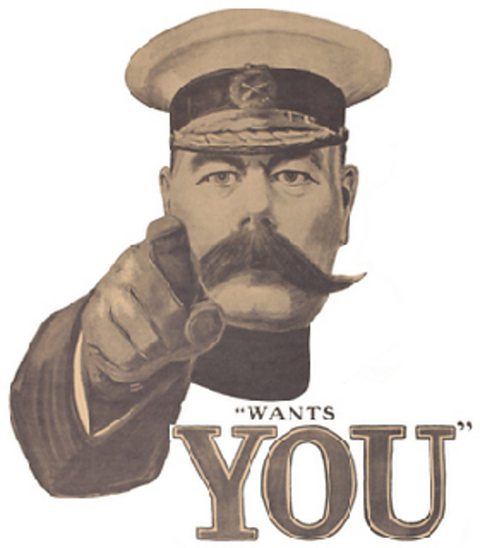
In August 1914, Lord Kitchener, the Secretary of State for War, realised Britain needed more soldiers.
Posters showed him pointing his finger at anyone passing by.
Men felt proud to fight for their country.
- 54 million posters were put up.
- 8 million letters were sent.
- 12,000 meetings were held.
- 20,000 speeches were given by military spokesmen.
In the first weekend of the war, 100 men an hour (3,000 a day) signed up to join the armed forces.
By the end of 1914 1,186,337 men had joined.
Who joined the army?
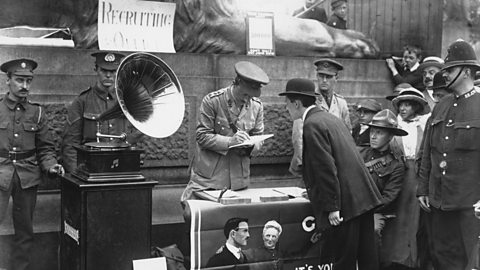
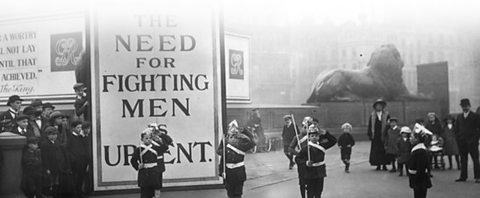
Image caption, Recruitment drives were held in places like Trafalgar Square
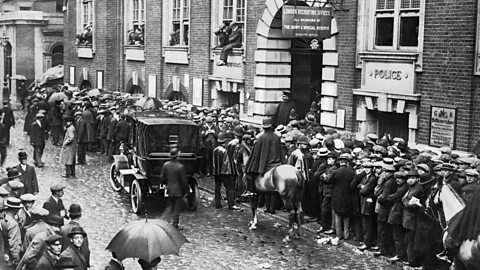
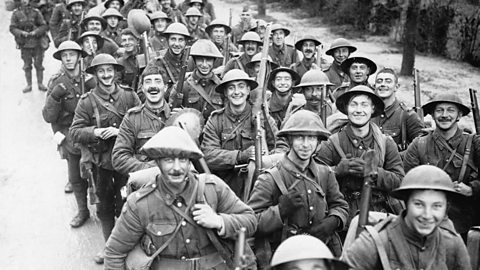
Only men aged between 18 and 41 could become soldiers. (The age limit was increased to 51 in April 1918.)
1 of 3
What were Pals Battalions?
Watch our video to find out more about men from workplaces, churches and villages who joined the army together.
[SNARE DRUMS]
CHILD: When World War One started the British Army needed lots more men.
So people like my great-great-grandfather Peter chose to become soldiers.
SOLDIER: That’s right. My friends and I all knew this was an emergency.
We wanted to help.
We all lived in Edinburgh and we were big football fans.
Our team, Heart of Midlothian or Hearts, were at the top of the league in 1914.
But the war was more important.
So some of our players and over 600 fans all joined the army.
We all wanted to make our teams and our cities proud.
The same thing was happening all over Britain.
Friends who worked together or came from the same place decided to join the army as a group.
These groups, called battalions, were full of friends, or pals, so people called them Pals Battalions.
Soon there were Pals Battalions all over the country and in four months a million new men joined the army.
I thought that was fantastic.
All the new soldiers like me had to be trained in Britain.
But soon it was time for me to go with my pals to the Western Front and the war.
I was very sad to say goodbye to my family. I was only nineteen.
I’d never left my city before and I was scared.
But it was an adventure too.
At first we marched through beautiful countryside. But that soon changed.
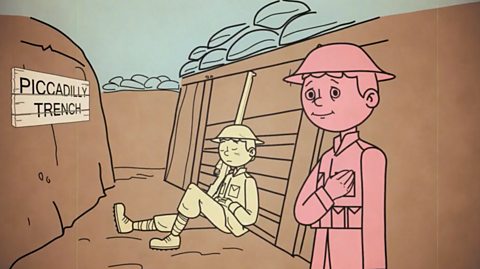
Life in the trenches was very hard.
It was good to have my pals around when I felt lonely and a long way from home.
But lots of them died in the fighting.
Hundreds of pals from the same village, town or city, were all killed together in battle.
Sometimes in one single day.
It was very hard for everyone left behind at home to hear this terrible news.
I was lucky because I survived. But lots of football fans who joined up with me were killed.
Seven of the Hearts football players died too.
Once the fighting had stopped, beautiful red poppies began to grow on the battlefields.
Some people began to wear a poppy to remind them all of the brave soldiers who had died.
War memorials were built all over Britain so in every town and village we could remember all of our friends who had died.
CHILD: And today we should still remember them too.
You could visit the war memorial where you live and learn about stories of the people in your area who fought bravely for our country in World War One.
Did some people refuse to fight?
- Some men refused to fight for moral or religious reasons.
- They were called conscientious objectors.
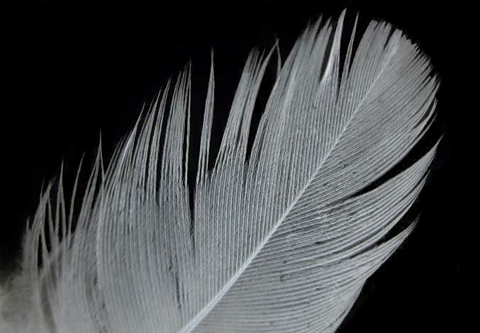
- A white feather was given to men in the street or on the bus if they weren't wearing uniform. The idea was to shame the man and make him join the army. This was unfair. There were many good reasons why a man might not be in uniform.
- Some conscientious objectors were allowed to do other jobs like farming in Britain, or carrying stretchers on the battlefield.
- Others were sent to prison.
What happened to all the soldiers?
Millions of British men were injured or died in the war. The government needed to replace them so recruitment became a part of everyday life.
By the end of the war almost one quarter of all the men in Britain had been in the armed forces.
Activities
Activity 1: Quiz – Soldier Recruitment
Activity 2: History Explorer game
Play this game to test your knowledge and learn even more facts about World War One.
History Explorer: Secrets through time
History Explorer: Secrets through time: KS2 History
Bitesize Primary games. game
Play fun and educational primary games in science, maths, English, history, geography, art, computing and modern languages.
More on World War One
Find out more by working through a topic
- count25 of 43
- count26 of 43
- count27 of 43
- count28 of 43