Overview of the characters in Duck Feet (Part Wan, First Year)
- Ely Percy’s novel focuses on a protagonist, Kirsty Campbell, and her relationships with a group of recurring secondary characters.
- Percy uses these characters to drive the central plot and to illustrate key themes in Duck Feet.
- A host of minor characters also appear throughout the story. These characters are of less importance to the overarching plot of the novel. Nevertheless, they are often used as comic or light relief and enrich the story.
The final Scottish Set Text exam paper at National 5 focuses only on section one ('Part Wan') of the novel Duck Feet, covering Kirsty's first year at school.
Looking for some quick revision? Try an interactive quiz for National 5 English.
Secondary characters
| Character | Role |
|---|---|
| Charlene | Best friend |
| Harpreet | Best friend |
| Chris Rice | Best friend |
| Wully McCoy | Potential love interest |
| Da | Kirsty's father |
| Ma | Kirsty's mother |
Minor characters
This list is not exhaustive, but shows the range of characters included in this text.
| Character | Role |
|---|---|
| Karen | Kirsty's younger sister |
| Kelly Marie | Pupil, bully, bad influence on Charlene |
| Yvonne | Pupil, replacement for Harpreet |
| Bunsen | Pupil in Kirsty's registration class |
| Tommy Campbell | Pupil, Kirsty's partner in Home Economics |
| Chris Ross | Pupil in Kirsty's registration class |
| Chris Russell | Pupil in Kirsty's registration class |
| Laura Kyle | Pupil, Kirsty tries out for the Under Fourteen's football team with her |
| Nicola Buchanan | Pupil, uses wheelchair to support a disability |
| Frieda | New pupil, claims to be pagan white witch |
| Madame Bonnet | French Teacher that Kirsty hates |
| Mister Anderson | PE Teacher that Kirsty finds attractive |
| Missus Auldhill | School cleaner |
What is Kirsty's family like?
Kirsty’s family offers a strong and loving ballast to her chaotic and turbulent school life, even if she finds little sister Karen an annoyance.
As adults, Ma and Da are particularly stuck in their ways and show little by way of character development throughout the story. However, they play two crucial roles:
- Firstly, Kirsty uses them as sounding boards in the early chapters. She values their opinions, wants to hear what they have to say, and adopts some of their attitudes.
- Secondly, as her friends’ opinions grow in importance, Kirsty starts to question and criticise Ma and Da’s opinions. She finds herself disagreeing with their stances more frequently.
Kirsty's Da
Da appears on a handful of occasions during Part Wan and is one of the novel’s many complex characters. He possesses both redeeming and off-putting personality traits.
He clearly adores his children, a love that is reciprocal as Kirsty clearly feels very protective and loving towards him. In Chapter One Kirsty is aware of how self-conscious Da is about his feet, and concentrates on finding a solution so they can go to swimming together. When Charlene mocks her dad's job in Chapter Eighteen, Kirsty uses aggressive threats to intimidate Charlene into stopping.
Don’t you EVER say anythin aboot any member ae ma family again, ah tolt her
Da has pride in Kirsty and is supportive of her. Father and daughter enjoy a shared love of football and sense of humour. Indeed, much of the dialogue between the pair is humorous in tone. Da serves as a good role model for the way that he continuously seeks work and puts his own pride to one side to undertake low-paying work to contribute financially.
Nevertheless, he does have problematic qualities, including prejudicial beliefs, ignorance, stubbornness, social awkwardness, and Belonging to a religious or political group and being intolerant of those with different opinions. If you're a religious sectarian, you are loyal to a particular religious sect or group.. Kirsty infers Da’s prejudicial beliefs. It is clear to her that Da would find it embarrassing as a white man to work for a successful Pakistani man (Iqbal).
but when it came right doon tae it wis embarrassin fur ma da tae have tae rely on sumdy lik Iqbal tae pay his wages, far mair embarrassin than shovelin shite fur a livin
Chapter Twenty Three ('Space')
Throughout the course of First Year, Kirsty grows critical of some of her father’s viewpoints. While Da’s mindset seems fixed, Kirsty displays more flexible attitudes to socio-political issues. Following a drug-related death, they have the following exchange:
Aye ah know, said ma da, Fifteen-yir-auld an she’s a junkie. She’s no a junkie, ah said.
Da’s use of a derogatory term makes Kirsty angry. Da does not know anything of the girl’s circumstances and has made an ill-informed judgement. This feels unjust to Kirsty. The character of Da is used as a way of exploring the importance of familial relationships as well as generational differences.
Classmates
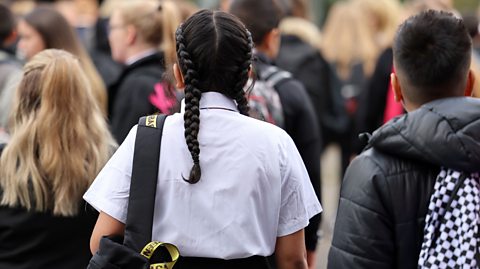 Image source, Getty Images
Whether she likes them or not, Kirsty is stuck with almost all of her classmates during her time at Renfrew Grammar. This means that characters like Charlene, Chris Rice, and Harpreet recur from chapter to chapter for the entirety of Part Wan.
Just like in a sit-com or weekly drama, recurring characters grow as familiar to us as main characters. Therefore, we not only witness Kirsty’s development but their journeys too.
Image source, Getty ImagesCharlene
Charlene, introduced as Kirsty’s ‘best pal’, is the obvious A character who creates conflict with the main character. of Part Wan. The girls have many differences that set them apart. For example, Charlene is:
- a great swimmer, and Kirsty is not
- from a single-parent family, and Kirsty lives with both parents
They grow steadily distant as Charlene bids for social dominance of "Renfra" Grammar’s S1 cohort.
When Charlene befriends A Scots word for someone who is cheeky and confident. Kelly Marie, her devil-may-care attitude develops. She is openly defiant and insolent towards teachers.
Chapter Two ('Mumbo Jumbo)
When Kirsty gets a punishment exercise in French, she compares her own punishment exercise record to Charlene’s substantial one, implying a worsening of Charlene’s behaviours:
she’s had loads a punnies since we startet high school an she forges her ma’s signature aw the time.
Charlene is stinging and cold-hearted to almost everyone in her orbit (even the boys she fancies). Her callousness is most obvious in interactions with Kirsty and Harpreet. She uses and emotionally manipulates Kirsty, demeaning her appearance. She mocks Kirsty’s dad’s jobs, makes plans with Kirsty then abandons them, and expects Kirsty to cover for her. Charlene views friendships as one-sided (she takes and gives nothing back).
Chapter Three ('Social Dancin')
Charlene’s attitude towards Harpreet is incredibly Discriminates against individuals or groups, often based on characteristics like race, ethnicity, gender, religion, or sexual orientation. She refuses to acknowledge Harpreet’s faith (Sikhs are followers of the religion Sikhism. Sikhs believe in one God who guides and protects them. They believe everyone is equal before God. Sikhs believe that your actions are important and you should lead a good life. ) and wilfully misrepresents its traditions by ignorantly describing what she believes to be aspects of the faith.
Kirsty is "gobsmacked" by Charlene’s ignorance and intolerance: such cruelty forces Kirsty to recognise the kindness in Harpreet.
Ah wis proper gobsmacked by that. So wis Harpreet ah think. […] she’s been a much better pal tae me than Charlene has lately.
Though Kirsty recognises the injustice of Charlene’s treatment of others, she doesn't hold her to account for fear of being excluded by the group. As a result, Kirsty tends to take the brunt of Charlene’s sarcastic and bitter comments.
Chapter Twelve ('V.L.')
Charlene’s mockery of Kirsty is ceaseless, calling her a "V-L-V-L-Veeee-" (which stands for ‘virgin lips’ and suggests that Kirsty has never kissed anyone). Kirsty is angry that she has spread these rumours:
Gaunnae shut up, ah said tae Charlene. She’d been sayin it aw day an ah wantet tae slap her. She said it tae aw the boys in oor class an nearly aw ae them laughed apart fae Bunsen because he cannae staun Charlene […].’
Charlene treats Kirsty as a joke so that she can interact with boys. This suggests continued breakdown in relationship but despite this, Kirsty rarely judges Charlene without trying to justify where her behaviours come from.
Chapter Twenty-Seven ('Sick')
Charlene’s insecurities surface when pupils notice her disordered eating habits and insensitively comment on it. While some see her weight loss as further “attention-seeking”, Kirsty can see illness.
Having seen a description of an eating disorder in a magazine, Kirsty instantly recognises Charlene’s plight and is aware that this is serious. She desperately wants to help her but does not know the right way to do so:
Aw ah could think aboot wis Charlene. At the bottom ae the page thir wis a number fur the eatin disorders helpline; ah wis gaunnae phone it up but then ah couldnae think whit tae say. In the end ah bottled oot cause ah wis scared in case […] ma ma thought it wis me that wis anorexic.
Chapter Twenty-Eight ('The Mad Hoose')
The severity of the situation increases when Charlene is hospitalised. Because she is impressionable and easily led, Charlene finds hospital rules to bend, becomes paranoid about medical scrutiny, and finds reintegration to home life difficult. Moreover, the need to “fit in” to the ward sees Charlene engage in yet more damaging behaviours (self-harm and recreational drug use). Despite receiving help for her diagnosed condition, Charlene’s mental health deteriorates in the Adolescent Psychiatry Unit.
Charlene is used to explore:
- the self-destructive behaviours of some young people
- the very real factors (such as neglect, family dynamics, environment) that lead to poor or even dangerous decision-making.
Kirsty and Charlene are therefore A character whose traits contrast with another character's. This is often done to highlight specific qualities of the other character. for each other: where Kirsty has a stable home life that gives her the space to grow and think critically before acting, Charlene does not.
Adversity experienced in early childhood is difficult to overcome and can lead to distrusting or toxic relationships, as well as a lack of self-care, in teenage years. This plays out through Charlene’s character. Despite starting the novel as the most obviously antagonistic character, Charlene ends Part Wan as a character for whom we have a good degree of sympathy.
Chris Rice
Chapter Three ('Social Dancin')
Chris is introduced. He is in Kirsty’s registration class and Kelly Marie thinks he is "pure sexy". When Chris ignores Kelly Marie’s advances and asks Kirsty to dance during PE social dance lessons, Kirsty is stunned.
Chris’ actions here are more about taking a stand against those he sees as cruel, idiotic, or unfair, than they are about any (potentially romantic) interest in Kirsty. This character trait develops throughout, and he frequently calls others to account when they say something he disagrees with.
Chris is often used as Kirsty’s social compass. He is presented as sensible, managing his epilepsy responsibly and performing well at school. Kirsty and Chris are both shown to be different from their classmates (but similar to each other) because of their choices.
Chapter Ten ('The Real McCoys')
Chris and Kirsty go to a house party:
Me an Chris Rice are the only wans at the party that urnae drinkin an that’s cause he’s an epileptic. He did his English talk on it the other week and got an A plus fur it […]
We see the severity of his condition when he has an epileptic seizure at the party and Kirsty and Wully McCoy come to his rescue. A lasting and trusting relationship is established between the narrator and her classmate here.
Chapter Twelve ('V.L.')
Chris is not entirely immune to peer pressure and ignorance. He is also not without his own struggles to overcome. When Chris tries to defend Kirsty from Charlene’s cruel taunts, he worries that his defence might open himself up to mockery:
If Kirsty’s a V.L. [virgin lips] then ah’m a big gay. […] He turnt roon an whispert […] Yir no are ye?
Repeated references are made by pupils to Chris’ sexuality. Chris feels compelled to “prove” his heterosexuality by kissing Kirsty – an action that seems to also remove social stigma from Kirsty. Despite heightened peer pressure, Kirsty and Chris remain just good friends. Chris’ sexuality is once again scrutinised when the lead singer of the pupils’ favourite band is “outed” as gay by a national newspaper, prompting another pupil to insult Chris with homophobic language. The slurs ignite something in Chris, who responds with aggressively homophobic outbursts and a display of hyper-masculine behaviours.
Chapter Twenty-Nine
Kirsty senses a stark change in his behaviour towards the end of Part Wan. She knows that something is not right but does not broach it with him:
Ah don’t know whit’s gaun on wi Chris Rice. He still comes up tae ma hoose after school, an me an him an Laura still aw go tae the swimmin baths thegether […] but see when wur actually in school, he hings aboot wi aw the nut jobs noo an he jist totally dingies us.
The following reveal contains a spoiler reference to events that happen later in the novel, and are therefore out of scope for the exam.
It is not until much later in the novel (Chapter Fifty-Four, Part Three – a section not covered by the SQA exam) that we learn Chris is gay. It might be argued that his behaviours earlier in the novel have been his own attempt to divert attention. Part Wan, however, shows the difficulty pupils can face in coming to terms with and growing comfortable within, their sexuality. In the mid-2000s, gay pupils were still stigmatised and bullied for their sexuality. Chris Rice’s masking is typical of the setting.
Harpreet
Harpreet is introduced at the beginning of the novel; she is in Kirsty’s beginners’ group at swimming.
Harpreet is characterised throughout Part Wan as possessing a kindness and compassion that many of the other pupils in the novel do not deserve.
Chapter Five ('Aw Grown Up')
Tensions grow in Kirsty’s friendship with Harpreet when Kirsty fails to defend Harpreet from Charlene’s cruel taunts about her outfit for the school disco and the insinuation that she doesn’t belong there. Charlene shows her disgust that Harpreet has come to the disco, mis-naming her on purpose:
Whit did ye bring […] Harpreach fur. She said it lookin back ower at the gate makin it really obvious who we wur talkin aboot. Her name’s Harpreet, ah said, An she wantet tae come.
Harpreet runs away from the dance and Kirsty shows a thoughtless and hurtful side to her personality.
Ah wis tryin tae convince [Harpreet] tae come back up tae the school but really ah couldnae care less if she wantet tae jump aff the Erskine Bridge
Even though Harpreet is disappointed by her friend’s failure to act, she nevertheless demonstrates her thoughtfulness by buying Kirsty a gift of swimming flippers for Christmas.
Chapter Seven ('A Bad Influence')
In Chapter Seven, Kirsty ditches the Lauras at lunchtime to go to the shop with Charlene: "the Lauras had asked me if ah wantet tae go wi them but ah said naw".
Kirsty gets a taste of her own medicine when Charlene ditches her at lunch. Harpreet takes pity on Kirsty and waits for her so she is not alone:
Harpreet wis staunin ootside the class waitin on me […] you can still come tae packed lunches wi me if yi want cause Charlene sais tae tell yi she couldn’t wait so she’s away wi Laura McNish.
Within her cohort, Harpreet refuses to be swayed by fads, fashions or bullies. She is unique, interesting, and knows her own mind. Harpreet’s selflessness contrasts with Charlene’s selfishness.
Chapter Three ('Social Dancin')
Faced with Charlene’s ignorance about her faith in, Harpreet responds graciously and with understanding.
Harpreet giggult. Ah’m not a Muslim, she said, But it’s OK ah’m not offended – lotsa folk get us muddled up.
Harpreet helps Kirsty better appreciate what a good friendship looks like.
Chapter Twenty-Two ('Left')
Harpreet leaves Renfrew Grammar, but the girls continue to communicate. Even though she is not physically present, Kirsty retains the lessons of kindness in companionship taught to her by Harpreet.
Kirsty feels the loss of Harpreet deeply but tries to make new friends to fill the gap. Even though she’s gone for good, Kirsty does not want to exclude Harpreet:
Ah didnae tell her aboot me bein partners wi Yvonne in English though […] Ah don’t know why ah didnae tell her cause it wisnae really a big deal. Ah spose it had somethin tae dae wi that last letter she sent me, an how when ah reread it fur the second time ah realized she hadnae mentioned makin any new pals. Ah jist didnae want Harpreet tae feel left oot.
Wully McCoy
Wully is introduced as an Stock types of character that often appear in fiction, such as heroes, villains, outlaws or jokers. bad boy hailing from a troublesome family. Charlene is clearly drawn towards him for this reason.
However, as the novel continues, we see Wully emerge as a sensitive and smart boy, with his own aspirations to achieve. More impactful for the plot, however, is Wully’s emerging romantic interest in Kirsty (a plot point that is not fully developed until Part Three of the novel, which is out of scope for the purposes of the exam).
At Renfrew Grammar, Wully’s reputation precedes him and much of the action surrounding Wully McCoy focuses on what pupils think they know about him (for example, his family life). When Wully’s cousin’s girlfriend dies and Wully is absent from school, rumours abound that he has run away from home, entered witness protection to save him from harm, or died. In reality, Wully has fallen victim to chicken pox and been lying low with the infection. Whatever his reality, the thought of Wully McCoy excites the other pupils’ imaginations.
In actuality, Wully’s character is defined by practicality. For example, when Chris has an epileptic seizure, it is Wully who has the knowledge, skills and level-headedness to guide Kirsty through supporting him. Moreover, Wully has a keen sense of Justice in terms of the distribution of wealth, opportunities, and privileges within a society.. He takes the formal rap at school for other pupils’ misdemeanours while enacting his own form of street justice (beating them up as punishment).
Despite rumours about his hardened family, there is a surprising sweetness and romance to Wully. It's evident when he sends Kirsty a bunch of red roses and card for Valentines’ Day before asking her out on a date. Wully is the first boy to show a genuine interest in Kirsty.
The character of Wully is used to explore relationships in the novel, as well as the wider teenage experience.
Learn more about archetypes here:Characters as archetypes
Revise the secondary characters in Duck Feet
Revise the characters in Duck Feet by Ely Percy with interactive quizzes for National 5 English.
Information and support
If you, or someone you know, have been affected by issues for young people, the following page contains a list of organisations and information that may be able to help: Information and Support: Bitesize
More on Duck Feet (Part Wan)
Find out more by working through a topic
- count4 of 7
- count5 of 7

- count6 of 7
- count7 of 7