Overview of style, language and technique in Duck Feet
- The novel is told in A first person narrative is when the story is told from the point of view of one person using the pronoun ‘I’.. Kirsty is the novel’s The chief character in a novel, film or play. and narrator, we hear her reflections and thoughts.
- Kirsty speaks and thinks entirely in a regional variety of Scots.
- Ely Percy attempts to reflect a range of authentic voices in Duck Feet. They reflect how people from Renfrewshire in the early 2000s spoke, specifically teenagers and working class characters.
- Each chapter is set up in a similar way. There is an opening (that establishes the situation), a middle section (where the sub-plot is introduced) and an ending (that resolves or fixes the situation).
- There are lots of examples throughout the novel where the author achieves A plea or argument designed to evoke an emotional response. and When a text moves from describing a lofty or important topic directly into a humorous description or episode..
The final Scottish Set Text exam paper at National 5 focuses only on section one ('Part Wan') of the novel Duck Feet, covering Kirsty's First Year at school.
Looking for some quick revision? Try an interactive quiz for National 5 English.
Narration
The novel is told in A first person narrative is when the story is told from the point of view of one person using the pronoun ‘I’..
Kirsty is the novel’s The chief character in a novel, film or play. and narrator. We hear Kirsty’s voice as she talks with friends and family, but we also hear her reflections on the thoughts of others. Like any teenager trying to navigate the increasingly adult world they find themselves in, Kirsty does not always know what to think or how to behave.
Moreover, there are times when what she thinks or says might not be considered acceptable, particularly to a reader approaching the story almost twenty years after the novel is set. Kirsty is, therefore, a flawed character. Nevertheless, as we see things from her perspective, our sympathy remains with her throughout.
Kirsty’s voice is very distinctive: from the start of the novel she is funny, warm, critical, quizzical, matter-of-fact, thoughtful, perplexed, and naïve. As Part Wan unfolds, we hear Kirsty’s voice become angrier or more frustrated in tone.
Many Scottish people can Switching between two or more languages, dialects, or language varieties in a single conversation or situation.. This means they can switch between:
- speaking a variety of Scots - often in less formal settings, ie. at home, with family/friends
- speaking Scottish Standard English - often in more formal settings, ie. at school/in the workplace
Importantly, Ely Percy creates a narrator who speaks and thinks entirely in a regional variety of Scots. When we hear the reported speech of others (like teachers), it is also delivered in Kirsty’s Renfrewshire Scots.
The author has chosen not to use speech marks to indicate Speech that is spoken. : this might feel strange to begin with. However, as we get used to the speaking voice, we appreciate that this decision brings immediacy and realism to the storytelling. It is chatty and makes the reader feel as though we are part of Kirsty’s gossipy conversations.
It allows us to see and experience the whole technicoloured world of Renfrew Grammar through a young person’s eyes.
Language
To create characters that are authentic to the time and place of the novel, the author uses a variety of language features and devices.
Duck Feet is written in a variety of Scots language found in west central Scotland. The story takes place in Renfrew. Simultaneously, the author attempts to represent:
- Renfrewshire voices
- teenagers
- working class characters
- characters from the early 2000s
Renfrewshire dialect
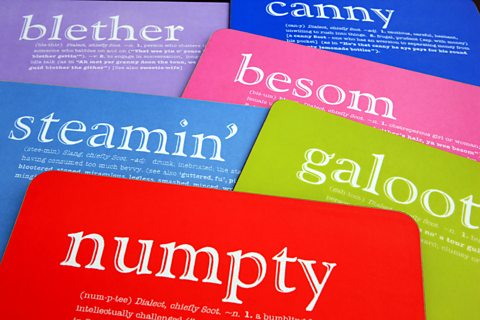 Image source, Lynne Sutherland
There is no standard way to write in Scots – there are no set grammatical rules for writing it down. In Duck Feet, you may notice the following patterns adopted consistently by the author to create a believable Renfrewshire dialect:
- pronouns (ie. "Ah" for I; "yi" for you; "ma" for my etc.)
- contractions (ie. "gaunnae" for going to; "didnae" for did not etc.)
- vowel changes (ie. "bliddy" for bloody; "wis" for was; "intae" for into etc.)
- glottal stops (ie. "Somethin", "draggin", "bumpin" etc.)
- dentalisation (ie. "Kiddit on" for kidded on; "decidet" for decided; "stupit" for stupid; "wantet" for wanted; "startet" for started etc.)
- verb-tense disagreement (ie. "Ah wise bangin on the door fur aboot five minutes but naebudy wid open it"; "as if he’d jist grew horns")
- Scots vocabulary (ie. "Wee" for little; "stramash" for uproar/row; "stooshie" for commotion; "pure" for very; "lavvies" for toilet; "mingin" for disgusting etc.)
Image source, Lynne SutherlandActivity: Identify features that create a believeable Renfrewshire dialect
Look at the opening paragraphs of the novel. You should be able to identify most of the features listed above:
Ma da’s got bad feet. He says it’s cause when he wis wee his mother made him wear shoes that didnae fit him. She made him squash his feet intae shoes that used tae be his brother’s cause she couldnae afford tae buy new wans fur the baith ae them. He’s got curly toes noo because ae it: thir aw twistet aroon on top ae each other lik the plaits ma ma pits in ma hair. Yi can see aw the big blue veins in his feet lik sumdy’s drew them on wi a felt tip pen. He cannae bend his toes right an he has tae wear steel toe caps tae work, in case anywan stauns on them.
Here are some of the examples from this extract:
- pronouns eg "ma" for me in "Ma da's got bad feet."
- contractions"cannae" for cannot in "He cannae bend his toes" and "sumdy" for somebody in "lik sumdy’s drew them on"
- vowel changes - "wis" for was in "when he wis wee"
- dentalisation"twistet" for twisted in "thir aw twistet aroon on top ae each other"
- verb-tense disagreement"Yi can see aw the big blue veins in his feet lik sumdy’s drew them on wi a felt tip pen." This is because "can see" is the present tense and "sumdy’s drew" is a contraction of "somebody has drew" but "has drew" uses a different verb-tense.
- Scots vocabulary"wee" for little
Teenage voice
To capture the essence of a teenage voice (its energy, youthfulness, ignorance, and playfulness), and to root the story in the 2000s, the author includes:
- Scottish/local/teenage idioms (ie. phrases or saying particular to place)
- cultural references (ie. references to fashion, technology, teams, music, film, styles etc.)
- expletives (ie. swear words)
- humour (ie. puns, jokes, mimicry)
Look at this example from the novel and try to identify some of the language features listed above:
Chris Rice jist tolt me that Iqbal’s looking fir sumdy tae dae the free papers. Ah quite fancy masel as a paper lassie cause it’s good exercise an it’s no exactly rocket science. When ah asked ma da aboot it he said, Aye that will be shinin.
Offensive language
It is important to remember the mid-2000s setting of this novel. The way characters refer to race, sexuality, disability and mental health reflects attitudes of the time, but also the age and immaturity of many of the characters.
Many jokes, puns and phrases used by the pupils in their dialogue would not be considered politically correct or socially acceptable now. Some of the language also gives us more information about the characters; who they are, their opinions and their backgrounds.
The author typically contextualises these moments to reflect a modern audience, examining the impact on people involved in a way that the characters themselves don't consider.
Chapter Eleven, ('Support')
For example, in this chapter Kirsty repeats a sectarian phrase she has heard her father use, in a football context, without fully realising it is an offensive phrase to Catholics.
She pure went aff her nut at me earlier on cause ah went an said somethin aboot the Pope; it wis ma da that said it first anaw
From this, it is revealed that Kirsty's Ma is Catholic and her Da is not. The writer allows the characters to discuss the consequences of this kind of language and the difficulties her parents have had as a result of sectarian opinion at the time. This in turn allows readers today to better understand how things were at the time of the book, specifically in working class West of Scotland communities.
Chapter Twenty-Nine ('Pure Gay')
In this chapter, Kirsty and her classmates discuss their views on homosexuality when they learn that a member of the band Stramash is gay. Kirsty and her friends use slurs and derogatory language, which tells us a lot about the attitudes towards LGBTQ+ people at the time. However, the author also invites the reader to reflect on their behaviour by including the repercussions of bullying someone for their sexuality.
Apparently this boy, Dylan, wis getting bullied at school fur [being gay] an he tried tae kill himself an that's why he's in the hospital.
The reader learns that a young boy has attempted suicide after being bullied for being gay. While the teenagers do not seem to learn from this moment, it is a stark reminder to the reader of the awful, real-world consequences of prejudice and hateful behaviour.
Structure
The whole novel covers six years in time and is split into three sections:
- Part Wan – First Year, containing chapters 1-30. This is the only part that will be covered in the exam.
- Part Two – Fourth Year, containing chapters 31-53
- Part Three – Sixth Year, containing chapters 54-70.
Each chapter exists as a self-contained episode in the life of Kirsty. When stitched together, the episodes and vignettes create a rich tapestry effect – we see the whole picture of Kirsty’s experiences.
Most chapters within Part Wan contain:
- a main plot - a storyline that involved Kirsty directly
- a sub-plot - a less important anecdote/example involving others that nevertheless contributes to wider lesson learnt by Kirsty in that chapter
Each chapter is set up in a similar way to a sit-com episode. There is an opening that establishes the situation. Then comes a middle section, where the sub-plot is introduced and events in the story seem to be going in a strange direction. Finally, there is an ending that resolves, fixes, concludes or answers the situation.
This structure gives the sense that Kirsty is fully in control of the stories she tells us – whatever madness or sadness she describes in the chapter, there will be some form of conclusion by the chapter’s end.
Pathos
Pathos is an attempt by a writer to evoke the sympathy or compassion for a character in a particular moment or situation.
There are lots of examples throughout the novel where the author achieves this effect. A good example can be found in the extract below, taken from Chapter Twenty-Eight, ‘The Mad Hoose’:
It wis Charlene’s review the day. Her ma wis up talkin tae the doctor aboot whether or no she wis tae get discharged. She isnae. She’s gettin kept in fur another four weeks. […] She says she isnae that bothert aboot gaun home though, cause her ma’s boyfriend’s movin in permanently.
The reader gets the impression that Charlene desperately needs her mum's support. Sadly, she would rather stay in a hospital ward because of her negative home situation.
Bathos
Bathos in literature is when a text moves from describing a lofty or important topic directly into a humorous description or episode.
A good example of bathos can be found in Chapter Twenty-Three, 'Space'. At the end of this emotionally heavy chapter in which Kirsty dissects the drug-related death of a Fourth Year pupil and its aftermath, Kirsty describes one last episode involving another pupil, Tommy. Despite the school’s bid to educate against recreational drug taking:
Tommy went an bought a bag ae speed aff this guy in fourth year the day an he wis sittin in French actin pure hyper lik he’d jist come aff another planet. Turnt oot though that it wis a total wind up an the guy had gied him a bag ae sugar that’d been knocked oota Home Ec.
In this example, Kirsty has a very light-hearted tone and uses a humorous simile to describe Tommy as "pure hyper lik he’d jist come aff another planet" and in the end, the drugs were actually only a "bag ae sugar". This is bathos because we transition from describing a serious drug-related death straight into a silly situation.
Each chapter includes both pathos and bathos: this allows the author to build our sympathy for this band of flawed characters while also ensuring that the heaviness of life does not weigh too heavily on the young characters. School can be, after all, ridiculous.
Video - What is tone?
In this example, the author creates a humorous The overall mood or 'feel' of the text or part of the text; this can be created by the writer or speaker's choice of words, pace, rhythm or imagery., which contrasts the serious drug-related incident we have just learned about.
Learn more about tone and how writers create it with this short National 5 English revision video.
What is tone? How is it created?
The attitude that a writer expresses towards a subject.
Tone always sends a message!
“What are you doing?”
A simple question, right? Adding a few extra words to this sentence can completely change the tone.
“What the hell do you think you’re doing?”
Whoever sent this message is not happy, and their tone gets this message across.
Everything we say or write has a tone. It’s shown in lots of different ways through word choice, imagery, sentence structure and even punctuation.
Tones can be driven by emotion. What we say and how we say it can change depending on whether we’re worried, excited, upset or affectionate.
But tone isn’t just about emotions. The situation is important too.
This can affect whether you choose a formal or informal tone.
“Dear student, It is with great pleasure that we offer you a place on your chosen university course…”
Though this is a very exciting letter to receive, it’s still written with a formal tone. The message you send your friend right after it might be a tad more informal, though:
“OMGGG!! I GOT INTO UNI! ”
Tone can say a lot in poetry.
In Liz Lochhead’s poem, My Rival’s House, she describes a simple scene of visiting her lover’s mother for tea.
“my rival thinks she means me well. But what squirms beneath her surface I can tell.”
Lochhead’s tone here is hostile and critical, as she feels her partner’s mother is trying to undermine her. The word “squirm” suggests discomfort.
“Deferential, daughterly, I sip and thank her nicely for each bitter cup.”
On the face of it, “deferential, daughterly” and “thank her nicely” all sound pleasant enough, but the word choice and imagery of "bitter cup” brings this surface tone into question.
It shows there is a poisonous attitude between the two women, as the speaker feels she is being forced to be submissive in the older woman’s presence.
Lochhead’s attitude is expressed clearly here through lots of different techniques!
The next time you’re at someone’s for tea, watch your tone!
Or you’ll no get yer puddin’!
Revise style, language and technique in Duck Feet
Test your knowledge of the style, language and techniques used in Duck Feet by Ely Percy with interactive quizzes for National 5 English.
Information and support
If you, or someone you know, have been affected by issues for young people, the following page contains a list of organisations and information that may be able to help: Information and Support: Bitesize
More on Duck Feet (Part Wan)
Find out more by working through a topic
- count7 of 7
- count1 of 7
- count2 of 7

- count3 of 7