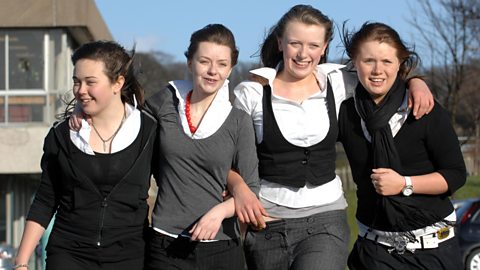
Overview of the setting in Duck Feet
- Duck Feet by Ely Percy is set in Renfrew, a Social class is a measure of a person’s status or position within society. Social class usually takes account of an individual’s income, wealth, occupation, education, etc, although different classifications use different criteria. town six miles west of Glasgow.
- It is set during the 2000s. The novel begins in Autumn 2001 and ends in Summer 2007. Part Wan, the section studied in the National 5 exam, ends in Summer 2002. It captures cultural elements of this time period.
- The central setting of the novel is a fictional school, Renfrew ("Renfra") Grammar.
- The setting creates a backdrop to explore socio-political issues, such as unemployment and Belonging to a religious or political group and being intolerant of those with different opinions. If you're a religious sectarian, you are loyal to a particular religious sect or group..
The final Scottish Set Text exam paper at National 5 focuses only on section one ('Part Wan') of the novel Duck Feet, covering Kirsty's First Year at school.
Looking for some quick revision? Try an interactive quiz for National 5 English.
Renfrew in the mid-2000s
Unemployment
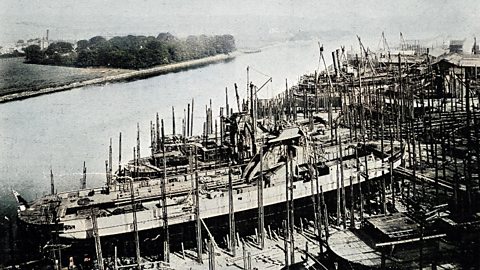 Image source, Chronicle
Renfrew in the mid-2000s could be described as a A post-industrial economy is when manufacturing is replaced by service industries. town.
Sitting on the south bank of the Clyde, the town was part of the wider Clydeside industrial area, home to shipyards, an engineering factory, harbour and other industries during the 19th and early 20th Century.
In the latter half of the 20th Century, there was a decline of traditional industries in Scotland, such as shipbuilding on the Clyde.
Renfrew's shipyards closed in the 1960s, the engineering works in the 1980s. The overall employment in British shipyards fell drastically by the 2000s and this had significant negative social impacts on formerly shipbuilding-dependent communities, like Renfrew.
In Duck Feet, we can see the impact of unemployment in Da’s attempts to secure work for himself.
Chapter Eighteen ('Shite')
Kirsty's father has done the same job since he left school, and when he is left without employment, he struggles to find another job.
Ma da worked at the Parks Department since he left school at sixteen. Sixteen years an he's never had another job.
There are very few employment options for him. In the end, her father takes a job cleaning toilets, much to Kirsty's embarrassment:
Ah don't know why ma da had tae take a job as a toilet cleaner. How could he no've been a road sweeper or a windae washer, or how could he no've jist took the job wi Iqbal
Learn more abouteconomic change in the UK and the post-industrial era.
Image source, ChronicleRivalries
Family feuds, turf battles, and intense rivalries are also characteristic features of setting in the novel.
Chapter Eleven (‘Support’)
Kirsty Campbell is a Rangers supporter. In this chapter, Kirsty reflects on the intense footballing rivalry that continues to characterise this part of west central Scotland, a rivalry that sits on deep-rooted Belonging to a religious or political group and being intolerant of those with different opinions. If you're a religious sectarian, you are loyal to a particular religious sect or group..
We learn more of the wider socio-political impact of sectarianism in Renfrew when Kirsty references the cancellation of her team’s first football match (against the Catholic school, Saint Brendan’s) owing to organised Orange Walk. We also learn that Ma and Da have married across the sectarian divide. This is the main theme of this chapter.
Ma da made a big sighin noise an then he said, Cause every wan ae them’s right orange an ah don’t agree wi some ae things they come away wi […] Aye, but ah don’t know whit yi mean thir right orange. They hate Catholics, said ma ma. Aw, ah said. Pure conversation stopper.
Learn more aboutthe history of sectarianism in Scotland.
Renfrew Grammar
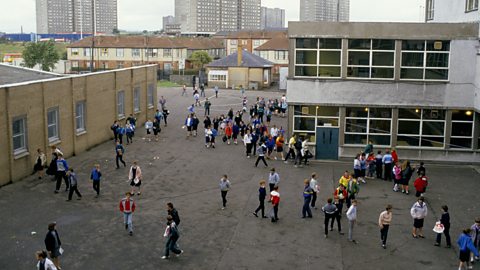 Image source, Mike Goldwater
The fictional Renfrew Grammar is a typical Not specifically tied to any branch of Christianity. Scottish secondary school.
In Part Wan - First Year, Kirsty describes attending a range of subjects (such as Office and Information Studies, French, and Craft and Design).
Kirsty follows the 5-14 A collection of subjects that make up the course of study at a school or college.. This was the system before Curriculum for Excellence’s Broad General Education, so some of the subjects taught in school now have different names.
Image source, Mike GoldwaterDiversity in schools during the 2000s
Non-denominational schools in Scotland during the 2000s were not typically When something is varied and contains lots of different types of people or things. in their make-up. This means that points of difference could feel exaggerated and also tense.
Class
Many of the recurring characters that Kirsty engages with in the story appear to be from Social class is a measure of a person’s status or position within society. Social class usually takes account of an individual’s income, wealth, occupation, education, etc, although different classifications use different criteria. families. There is little mention of middle class pupils at the school, and when this is touched upon, it is a point of tension.
Chapter Thirteen ('Privileged')
For example, when fellow student, Nicola, appears to have more money and social connections than her classmates, Kirsty appears resentful and jealous. She calls Nicola "dead snobby" and complains that Charlene and Nicola are:
gaun roon bumpin thir gums tae evrubdy in school that they've got front row seats [to the Stramash concert]
Nicola explains that she got the tickets because she is in a wheelchair, but Kirsty states that "Nicola's ma's got pals in high places" and Kirsty's Ma says:
the two ae them'll come doon tae Earth wi a bang wan ae these days
The metaphor of "coming doon tae Earth" implies Nicola and her mother are not rooted in the same reality as everyone else in the town and they need to be more grounded.
This idea is reinforced later in Part Wan when Kirsty worries about being branded a "snob" for "wantin ma da tae be somethin better than a toilet cleaner." This fear of appearing to be middle-class, or above one's station, reflects the working class character of the school and the wider community.
Religion and culture
Harpreet’s difference (as a practising Sikhs are followers of the religion Sikhism. Sikhs believe in one God who guides and protects them. They believe everyone is equal before God. Sikhs believe that your actions are important and you should lead a good life. ) is magnified. Sometimes this is done in subtle, and seemingly harmless, ways. Kirsty is open minded and curious about her friend's background but the reader is still made very aware that Harpreet is different from the other school pupils. For example, when Kirsty is having lunch with Harpreet, the difference between the foods they eat is highlighted.
Ah'd a roll an cheese wi tomata, an Harpreet an Navdeep had these triangle pastry things. Whit's that yiv got, ah said.
However, Harpreet's religious beliefs are often belittled and the object of ridicule at school. Charlene refuses to acknowledge Harpreet’s faith, purposefully misrepresents its traditions, and ignorantly describing what she believes to be aspects of the faith.
Charlene's prejudice is indicative of wider prejudices at the time the book is set. Religious prejudice was significantly heightened by events like the 11 September 2001 terror attacks, leading to increased Islamophobia and discrimination against anyone perceived as Muslim. This often extended to anyone considered to be of Middle Eastern or South Asian heritage.
Learn more about the events of 11 September 2001 and their aftermath here:BBC Teach: Remembering 9/11
Disability
During the 2000s, improvements were made towards rights and inclusion for people with disabilities. However, disabled people were (and still are) navigating major barriers to social inclusion in schools and wider society. We see this exclusion and inequality in Duck Feet as Nicola Buchanan is marginalised because she uses a wheelchair.
Chapter Thirteen ('Privileged')
The first line of this chapter immediately magnifies Nicola's difference:
Charlene's startet pallin aboot wi this lassie in oor class that's in a wheelchair.
Before the reader even knows Nicola's name, we know that she is a wheelchair user. This is a dehumanising way to speak about someone. Kirsty is also unkind and jealous of Nicola. She says "Naebdy in oor class really likes her" and that "they aw try an be nice tae her" because of her disability.
Kirsty uses highly offensive language to describe Nicola and shows no empathy or respect for her. She insinuates that her peers are only nice to her because of her disability, and that they don't treat her as an equal. Likewise, in this chapter, Charlene also uses an extremely offensive and disablist word to insult Kirsty. The attitudes of the school students towards Nicola are indicative of wider issues in society.
Sexuality
During this time period, LGBTQ+ pupils would typically feel pressure to mask or conform for fear of bullying or being excluded.
Chapter Twenty-Nine
In this chapter, we learn that a member of the band Stramash is gay and the reaction of Kirsty and her friends tells us a lot about the attitudes towards LGBTQ+ people at the time.
In this chapter, and throughout Part Wan, being gay is used as the basis of slurs by many characters. For example, Chris calls Nicola a lesbian, treating the word as an insult; Tommy Campbell uses offensive language to refer to the band members. This was unfortunately common in schools at the time the book is set.
However, the reader is still encouraged to scrutinise their behaviour, as we learn about its repercussions.
Thir's a rumour gaun roon oor school that Colin Kellerman's gay […] Apparently this boy, Dylan, wis getting bullied at school fur it an he tried tae kill himself an that's why he's in the hospital.
The word choice "rumour" tells us that people's sexuality was viewed as gossip and scandal. The word "bullied" and the mention of attempted suicide also highlight the consequences of homophobia. While many of the characters in Duck Feet use prejudicial and derogatory language, it is clear that Ely Percy does not agree with this, as they always remind the reader of this by showing the consequences of these words.
Mental health
Mental health issues were often not adequately understood or supported during the 2000s. We see this most clearly with the treatment of Charlene's mental health issues and eating disorder.
Chapter Twenty-Eight ('The Mad Hoose')
The title of this chapter highlights the societal perspective of mental illness at the time. A "mad hoose" is an informal and offensive term for a psychiatric hospital. It implies people with mental health issues are behaving in a chaotic or out-of-control manner.
The school pupils treat Charlene's stay in the psychiatric hospital like it is gossip for them to be entertained by:
nosey folk lik Laura McNish an Nicola Buchanan come right up an startet tae question us: wis it dead scary, wis Charlene aw doped up, did they huv her in a straight jacket.
The questions Laura and Nicola ask tell us how people viewed mental illness at this time. It was seen as something to be afraid of ("dead scary"). There is also a negative, unfair stereotype of people dealing with mental health issues being overly medicated ("doped up") and having to be restrained ("straight jacket").
Tabloid newspapers and magazines in the 1990s and 2000s fostered a national culture of gossip and scandal. We see this culture in One small version of a larger world, eg a school could be described as a microcosm of society. in the world of Renfrew Grammar, such as the rumours about Colin Kellerman's sexuality or how Charlene's mental health is treated as entertaining gossip by her school friends.
Video - What is word choice?
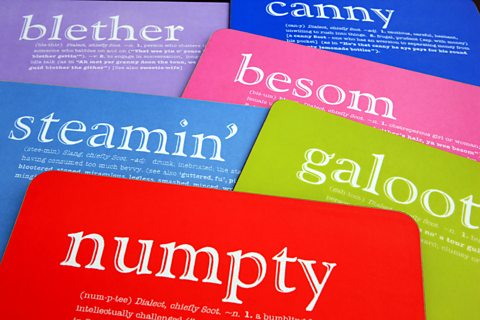
The words Ely Percy uses in Duck Feet build a picture of Renfrew Grammar and what life was like for teenagers in the 2000s. Many of the characters use offensive language that would not be used today but that tell us more about viewpoints at the time.
Brush up on your understanding of word choice as a technique with this short National 5 English video.
What is word choice? Why is it important?
Word choice can have a massive impact on your writing.
Words are like ingredients: even a small change in the recipe can affect the finished dish.
"They had a warm laugh"
But what if "they had a hearty laugh"?
Even though these sentences pretty much tell us the same thing, the words have different effects.
‘Warm’ suggests the laugh is friendly.
‘Hearty’ suggests it is wholesome, passionate and sincere.
When you choose a word you need to think about its denotation.
That's what it literally means.
But you should also think about its connotations - ideas or feelings that the word might suggest or hint at.
"Feeling dizzy, she slid her hand along her head"
This just tells us what happened. But what if:
"Feeling dizzy, she slid her hand along her skull”
The skull is the bone structure in your head. This is the denotation - what it definitely is.
But the connotations of skull are fear, mortality and even death.
These connotations suggest that the dizziness she is experiencing is serious.
In the poem 'The Circle’, Don Patterson watches his son painting the planets in the solar system.
“He draws around his upturned cup, his hand shakes, and he screws it up.”
Patterson could have easily written “he messes it up” but “screws it up” is a far more interesting choice.
These words are really informal compared to his word choice in the rest of the poem.
This helps him capture the reality and rawness of a young boy’s frustration.
At the same time, “screw” suggests a circular motion, another reference to circular shapes within the poem.
It also suggests scrunching up paper and throwing it away.
Word choice is a really important part of writing.
It’s an invaluable part of writing.
It’s crucial!
Revise setting in Duck Feet
Revise the plot and setting in Duck Feet by Ely Percy with an interactive quiz for National 5 English.
Information and support
If you, or someone you know, have been affected by issues for young people, the following page contains a list of organisations and information that may be able to help: Information and Support: Bitesize
More on Duck Feet (Part Wan)
Find out more by working through a topic
- count5 of 7

- count6 of 7
- count7 of 7
- count1 of 7