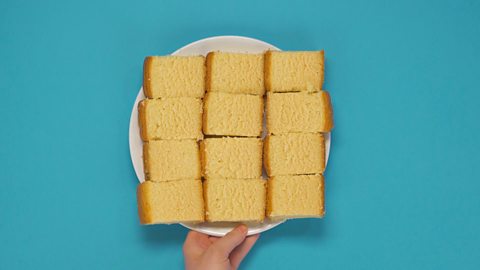
In fractions, the denominator is the bottom number and the numerator is the top number.
When multiplying two fractions together, we are left with a fraction of a fraction.
It can be useful to visualise maths problems.
Have a go
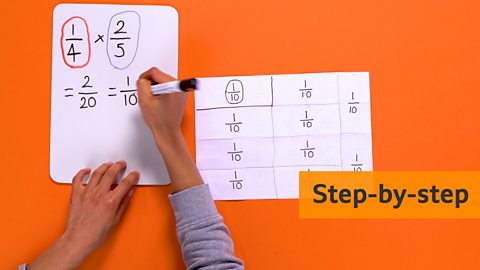
Image caption, Click to see a step-by-step slideshow.



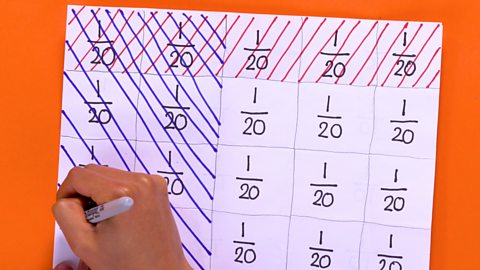
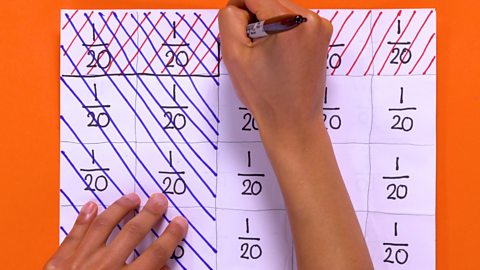
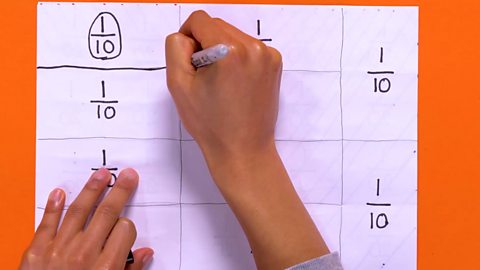
1 of 9
How does it work?
Using this method is a good way to visualise the multiplication of fractions.
The denominator of the first fraction tells us how many rows we need to make by folding our paper. The denominator of the second fraction tells us how many columns we need to fold.
The numerator of the first fraction tells us how many rows we should shade. The numerator of the second tells us how many columns we should shade.
Colour each section in with different colours, for each numerator.
We then need to identify the sections which have both been shaded in, and overlap. Count how many of these there are out of the total number of sections.
Example
¼ × ⅖
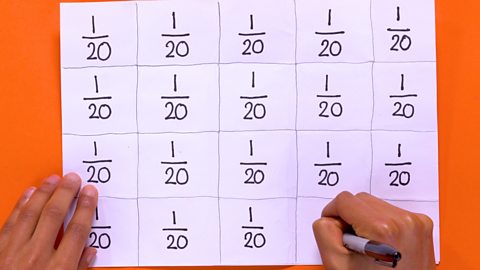
Fold the piece of paper into 4 rows (because the denominator of the first fraction is 4). Now fold the paper into 5 columns (because the denominator of the second fraction is 5).
Identify how many pieces you have divided the piece of paper into. Here there are 20 sections, so each section represents ¹/₂₀
Label each of the sections with ¹/₂₀
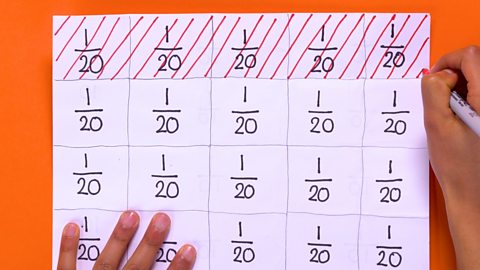
Shade in 1 of the rows (because the numerator of the first fraction is 1). Then shade in 2 of the columns (because the numeratorof the second fraction is 2).
Finally count the overlapping sections. In this example 2 sections overlap out of the 20 parts in total. This means the answer is ²/₂₀
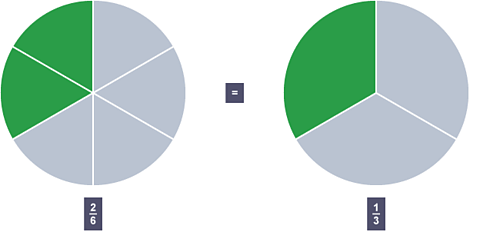
The answer can be simplified as a fraction as ¹/₁₀
More on Fractions
Find out more by working through a topic
- count1 of 8
- count2 of 8
- count3 of 8