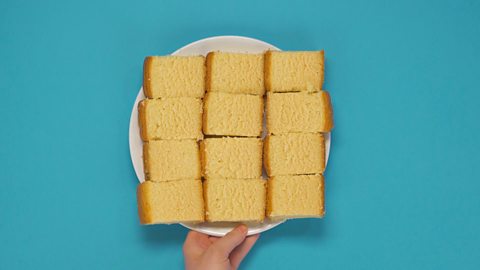
Dividing by a fraction tells us how many smaller parts make up a whole number or another fraction.
Bar models can help visualise the process of dividing by a fraction.
We can also use the 'invert and multiply' method to find the solution.
Find out how to divide fractions using a bar model
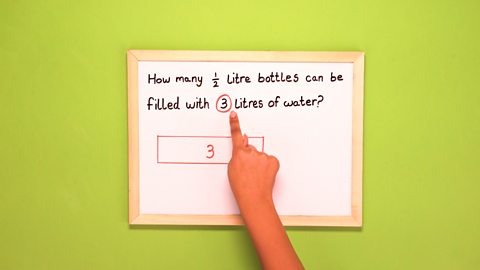
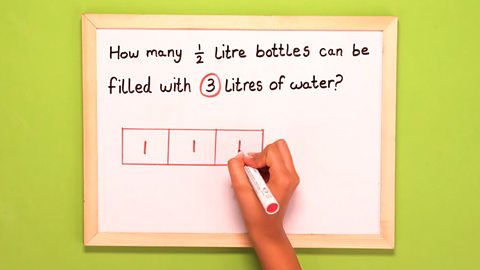
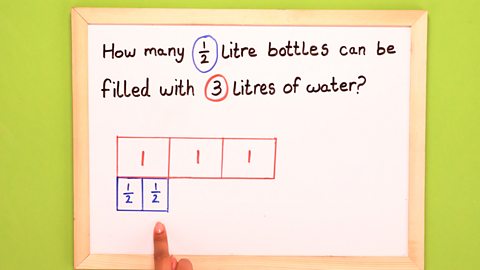
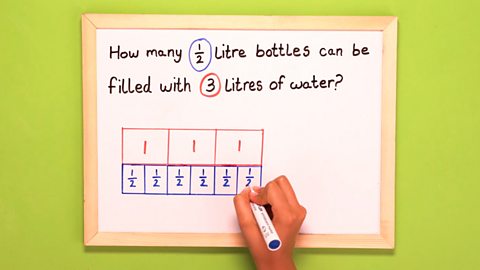
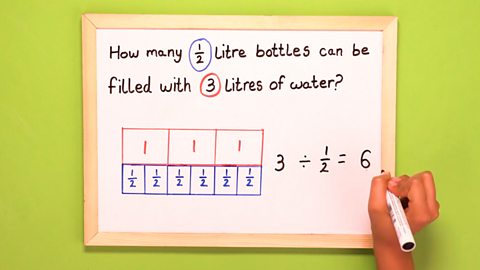
How to divide by a fraction using bar modelsHow many half litre bottles can be filled with three litres of water?Draw a bar and add the number three to represent three litres of water.Divide the bar into three sectionsand add a one to each – one times three is three.You want to know about half-litre bottles, though,so draw a bar underneath one of the sections,divide it into two and write half in each block.Do the same under the remaining sections.Add together the sections in the top bar – that’s three!Divide by half.And the answer is … six!
Have a go
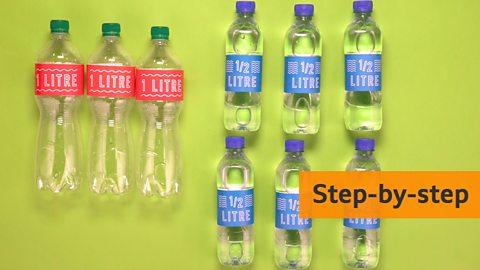
Image caption, Click to see a step-by-step slideshow.

1 of 7
How to divide by a fraction using a bar model
Bar models can help visualise the process when you divide. To do this, you need to know your original amount, in this example it is 3, and the amount you are dividing into, in this case it's ½. A bar is then drawn to represent this amount.
The whole bar is split into single units (bars of one).
You then split each single unit into two halves.
To complete the calculation, count the total number of smaller pieces you needed for the whole bar.
Dividing by a fraction using the 'invert and multiply' method
When dividing by a fraction, we can calculate the answer using the invert and multiply method.
- If the number you are dividing into is already a fraction, leave it alone. If this number is a whole number, convert it into a fraction by making the whole number the numerator (top number), and making the denominator (bottom number) '1'.
- Change the division sign into a multiplication sign.
- Invert the second fraction (find its reciprocal).
- Multiply the numerators of the two fractions together.
- Multiply the denominators of the two fractions together.
- Simplify, if necessary.
Example 1
3 ÷ ¹/₂ = ?
[Convert '3' into a fraction. Change '÷' to 'x'. Invert the second fraction.]
³/₁ x ²/₁ = ⁶/₁ = 6
Example 2
5 ÷ ¹/₃ = ?
[Convert '5' into a fraction. Change '÷' to 'x'. Invert the second fraction.]
⁵/₁ x ³/₁ = ¹⁵/₁ = 15
More on Fractions
Find out more by working through a topic
- count1 of 8
- count2 of 8
- count3 of 8